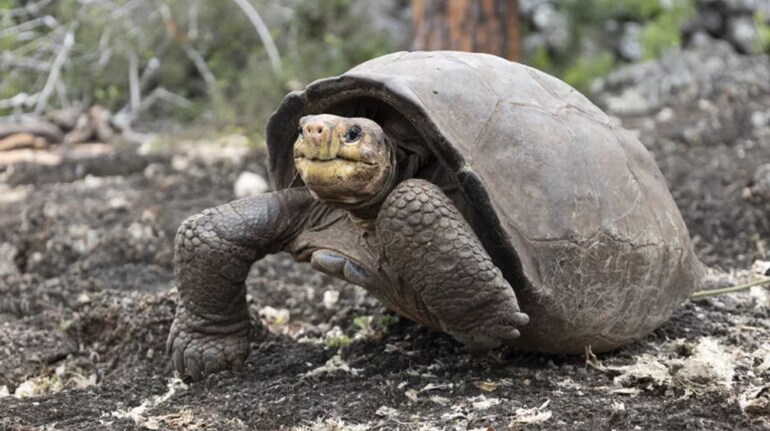

On a remote volcanic island in the Galápagos, a tortoise once declared extinct has quietly rewritten its own story. Scientists have confirmed that a lone female found in 2019 belongs to a lineage missing for more than 100 years. The finding, published in Communications Biology, reveals that the Fernandina Island giant tortoise, Chelonoidis phantasticus, still survives against the odds.
Fernandina Giant Tortoise Rediscovered
The tortoise, named Fernanda, was located on Fernandina Island, one of the youngest and harshest islands in Ecuador’s Galápagos chain. The island is covered largely in black lava flows and sparse vegetation. For decades, the species was known only from a single male collected in 1906 and preserved at the California Academy of Sciences.
To confirm her identity, researchers sequenced Fernanda’s full genome. They compared it with DNA from the museum specimen and from all other living Galápagos tortoise species. The analysis showed that Fernanda and the 1906 male form a distinct genetic branch, separate from other island tortoises. Scientists from Newcastle University, Princeton University and Yale University led the research.
Fernanda was found in a small patch of scrub isolated by old lava. Her shell shape appears different from the preserved male, possibly due to stunted growth. Genetic testing proved essential, showing that appearance alone can mislead when few animals remain.
What Survival Means for Conservation
The rediscovery raises wider questions about hidden survivors in remote habitats. Field teams have reported tracks and droppings suggesting at least two or three more tortoises may exist. These signs are not confirmed proof, yet they justify further searches across the island’s dangerous terrain.
Dr Evelyn Jensen, one of the lead authors, said it is truly exciting that the species is not extinct but lives on. Fernanda now lives at the Galápagos National Park’s Giant Tortoise Breeding Center on Santa Cruz Island. A Princeton summary notes she receives constant monitoring and veterinary care there.
Giant tortoises once numbered about 250000 across the archipelago. Today roughly 15000 survive in the wild. Genome data from Fernanda and the museum male provide a baseline for future breeding plans, should more individuals be found.
Hope and Fragile Futures
Conservationists know survival can hang by a thread. Lonesome George, the last Pinta Island tortoise, died without offspring. Fernandina’s tortoise could face the same fate if no mate appears.
Fernanda’s existence offers hope, yet also a warning. A species may endure unseen for decades. One storm, disease outbreak or fire could still erase it. Her story reminds scientists and policymakers alike that extinction declarations carry weight. Protecting habitat early may decide whether rare lineages fade quietly or recover once more.
Discover the latest Business News, Sensex, and Nifty updates. Obtain Personal Finance insights, tax queries, and expert opinions on Moneycontrol or download the Moneycontrol App to stay updated!
Find the best of Al News in one place, specially curated for you every weekend.
Stay on top of the latest tech trends and biggest startup news.