






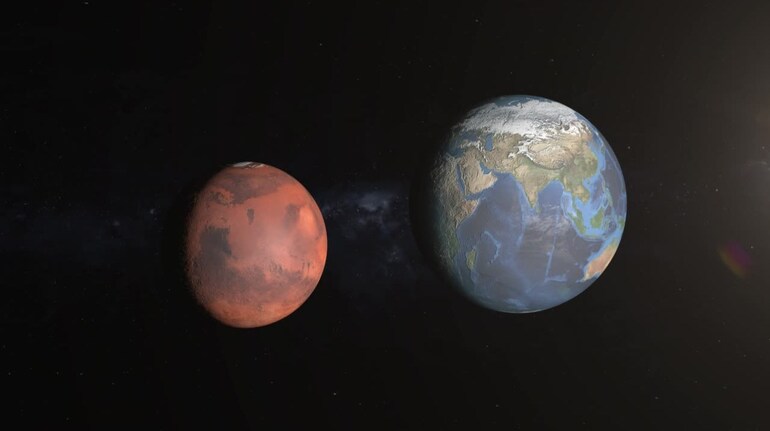
Imagine a world where life survives not on the surface but deep beneath the ground. As scientists delve into Mars’ mysteries, they’re using Earth’s most ancient life forms as a guide to uncover potential Martian secrets.
Mars: A Hidden Water WorldRecent findings from NASA’s Mars Insight Lander have unveiled that Mars is more than just a dry, red expanse. On 12 August, researchers discovered a vast reservoir of liquid water trapped within the Martian crust. This revelation comes from analysing over 1,300 Marsquakes recorded over four years. According to Vashan Wright from the University of California San Diego’s Scripps Institution of Oceanography, seismic waves detected by the lander passed through layers of wet rock, suggesting that significant volumes of water lie between 11.5 and 20km (7.1-12.4 miles) below the surface.
The Potential for Subterranean Life“If this data is accurate, then it could be a game-changer,” notes Karen Lloyd, a microbiologist at the University of Southern California. The presence of water underground opens up the possibility that life on Mars might be hidden beneath the surface. Much like Earth’s deep biosphere, which teems with life despite extreme conditions, Mars might harbour similar subterranean ecosystems.
 Mars has surface remnants of ancient lake beds, but any remaining water is now located deep underground (Image: NASA)Life in the Deep: Earth’s Microbial Analogues
For over three decades, biologists have found that life thrives deep underground on Earth. From the ocean floor to deep continental rocks, single-celled organisms like bacteria and archaea dominate these hidden realms. These microbes survive in total darkness and extreme conditions by relying on chemosynthesis—using chemical reactions with rocks and water for energy rather than sunlight.
 Potential mud volcanoes have been observed on the surface of Mars. (Image: Nasa/JPL-Caltech/University of Arizona)
“The deep biosphere is incredibly diverse,” says Cara Magnabosco from ETH Zurich. Researchers have identified numerous bacterial phyla thriving underground, with some of these phyla being previously unknown. These microorganisms adapt to life without sunlight, feeding on chemical compounds like methane or hydrogen sulphide.
A Glimpse into Mars’ Potential EcosystemsThe parallels between Earth’s deep life forms and potential Martian life are striking. If Mars has similar subsurface environments, it could host microbial life that relies on chemosynthesis, just like Earth’s deepest organisms. While no direct evidence of Martian life has been found yet, features like ancient canyons suggest that Mars once had surface water, and much of it might still be present underground.
Methane plumes observed on Mars add to the intrigue. On Earth, methane is often a byproduct of microbial activity. If these plumes are linked to subsurface water, it could hint at microbial life beneath the Martian surface.
The Challenges of Martian ExplorationFinding life on Mars is no small feat. Drilling 10km (6.2 miles) into the Martian crust poses significant challenges. NASA’s upcoming Mars Sample Return mission might provide crucial insights by bringing Martian rocks back to Earth, potentially revealing traces of life.
“There are places on Mars where subsurface samples have been brought to the surface,” Lloyd suggests. These mud volcanoes might offer a glimpse into the Martian subsurface. While the search for life could take decades and might only yield fossil evidence, the quest itself is fascinating. “Whether we find current life or evidence of past life, discovering life on Mars would be a monumental achievement,” Lloyd adds.
In the end, whether life exists beneath Mars’ surface or not, these discoveries bring us closer to understanding the Red Planet’s hidden depths and the possibilities for life beyond Earth.
Discover the latest Business News, Sensex, and Nifty updates. Obtain Personal Finance insights, tax queries, and expert opinions on Moneycontrol or download the Moneycontrol App to stay updated!
Find the best of Al News in one place, specially curated for you every weekend.
Stay on top of the latest tech trends and biggest startup news.




