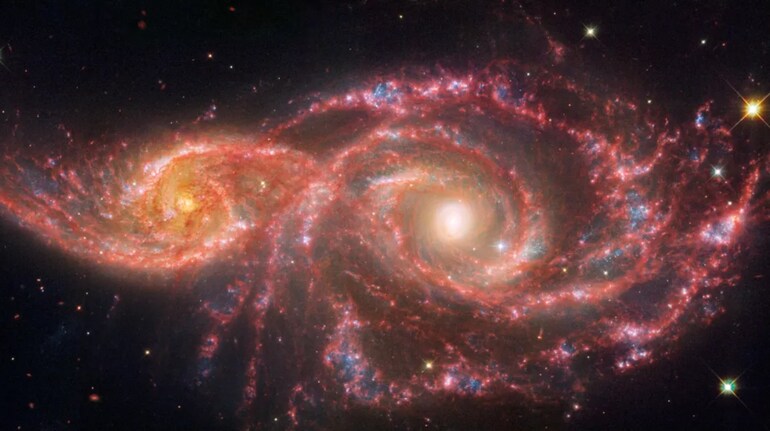
NASA has unveiled striking new images of a galaxy pair, IC 2163 and NGC 2207, captured through the lenses of the James Webb Space Telescope and Hubble Space Telescope. The images reveal what looks like a pair of “blood-soaked” eyes staring into the cosmos, giving the galaxies an eerie, otherworldly appearance. Despite their menacing look, these galaxies are simply passing neighbors in space, engaged in a slow-motion dance that began millions of years ago.
The smaller spiral galaxy, IC 2163, appears to “creep” behind the larger spiral, NGC 2207, in what NASA describes as a “light scrape.” This grazing encounter created shock fronts where the galaxies’ materials collided, forming vibrant, vein-like structures across their arms. Webb and Hubble's combination of mid-infrared, visible, and ultraviolet light reveals these bright red lines, resembling eyelids, which accentuate the pair’s surreal, eye-like appearance.
Astronomers note that the gravitational tug between the galaxies has stretched and distorted their spiral arms, creating tendrils of stars and dust that drape between them. This first encounter pulled out fine tidal extensions in their structures, with IC 2163’s delicate spiral arms stretched out, and wispy, semi-transparent arms of NGC 2207 appearing to drift off-screen, giving the galaxies an ethereal quality.
A unique characteristic of these galaxies is their high star formation rate. Together, they create an estimated two dozen new Sun-sized stars each year, far surpassing our Milky Way, which forms only two to three Sun-sized stars annually. This intense star formation is visible in the bright blue regions captured by Hubble’s ultraviolet imaging and the vibrant pink and white regions in Webb’s mid-infrared light, marking areas known as “super star clusters.” These regions, particularly noticeable in the top spiral arm of NGC 2207, sparkle with youthful, energetic stars.
What lies ahead for IC 2163 and NGC 2207 Over millions of years, these galaxies may continue to pull closer, possibly merging into one unified structure with a single, cyclops-like core. This merger would reshape their features, and, as they use up their gas and dust supplies, their prolific star formation will eventually quiet, leaving behind a cosmic calm after a turbulent celestial union.
Discover the latest Business News, Sensex, and Nifty updates. Obtain Personal Finance insights, tax queries, and expert opinions on Moneycontrol or download the Moneycontrol App to stay updated!
Find the best of Al News in one place, specially curated for you every weekend.
Stay on top of the latest tech trends and biggest startup news.