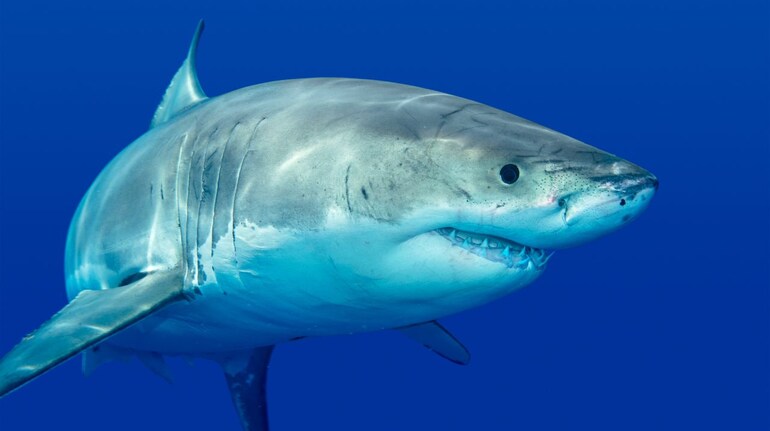

A giant great white shark named Deep Blue continues reshaping scientific understanding of shark size, behaviour, and survival, as researchers confirm she remains the largest reliably recorded individual of her species.
Deep Blue and the limits of great white size
For centuries, sailors told stories of enormous sharks roaming oceans worldwide. Some accounts proved exaggerated, yet modern tracking has confirmed one truly exceptional animal. Deep Blue, a female great white shark, was first documented in 2013 near Mexico’s Guadalupe Island. Researchers measured her length at about 20 feet during observations. Her estimated weight reached nearly 5,500 pounds, based on girth.
Typical adult great white sharks usually measure between 11 and 16 feet. This clear difference placed Deep Blue beyond previously verified records. Scientists also noted her unusually wide body profile during early encounters. That feature suggested possible pregnancy, though births were never observed. The confirmation relied on direct visual measurements and photographic scaling techniques.
Behaviour, movement, and survival beyond expectations
Despite her intimidating size, Deep Blue displayed calm, inquisitive behaviour around humans. Researchers reported cage contact but no direct aggression towards divers. Some swimmers even entered waters alongside her without incident. Experts caution against such encounters, stressing safety risks remain serious. Still, these observations challenged popular assumptions about constant shark hostility. Deep Blue carries a satellite tracking device fitted by scientists. This tag has transmitted location data for more than ten years.
Records show she migrates extensively across the Pacific Ocean. Her movements often span California, Baja California, Cabo San Lucas, and Ensenada. On rare occasions, signals suggested journeys near Florida waters. By 2024, tracking data confirmed Deep Blue remained alive. This was notable, given great white sharks average roughly 30 years. Researchers estimate Deep Blue’s age exceeds 50 years. No confirmed sightings occurred during 2025, worrying some observers. Scientists say changing ocean temperatures and prey shifts may explain absences.
Conservation meaning and disputed giants of history
Deep Blue has become an unlikely ambassador for shark conservation worldwide. Her tracking data helped scientists design improved protection strategies. Platforms like OCEARCH Shark Tracker allow public engagement with real-time movements. These tools replaced unreliable historical size claims from earlier centuries. In the 1870s, Australian fishermen reported a supposed 36-foot great white. Later jaw analysis showed the animal measured closer to 16 feet. A similar claim in 1930s Canada proved mistaken identity.
That shark was actually a basking shark species. As such, Deep Blue remains the largest confirmed great white recorded. Her story also highlights broader population decline concerns. Scientists estimate only about 3,500 great white sharks remain globally. The International Union for Conservation of Nature lists them as vulnerable. Studies show a 30 to 49% decline across generations.
Threats include overfishing, bycatch, orca predation, and ecosystem disruption. Genetic research reveals three distinct great white populations worldwide. Loss of any group would mean permanent extinction for that lineage. Conservationists warn urgent action remains necessary. Without intervention, oceans could lose a vital apex predator.
Discover the latest Business News, Sensex, and Nifty updates. Obtain Personal Finance insights, tax queries, and expert opinions on Moneycontrol or download the Moneycontrol App to stay updated!
Find the best of Al News in one place, specially curated for you every weekend.
Stay on top of the latest tech trends and biggest startup news.