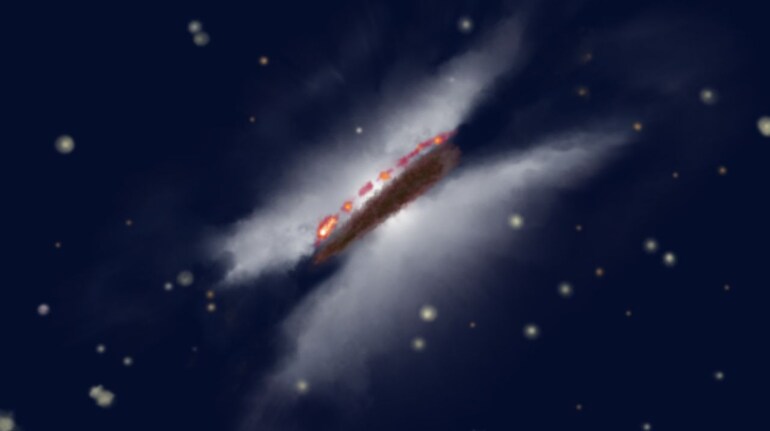

Astronomers have discovered a massive protoplanetary disk nicknamed Gomez’s Hamburger. It is a huge swirling disk of gas and dust in space. The system was observed edge-on, revealing layers resembling a giant bun. This unique alignment allows scientists to study planet formation processes clearly.
Observations were conducted using the Atacama Large Millimeter/submillimeter Array (ALMA) in Chile. Researchers believe the disk has enormous potential to form giant planets.
How Was This Discovery Made?
The discovery was made using the ALMA telescope in Chile. ALMA observes millimetre-wavelength light, revealing gas and dust structures clearly. Astronomers analysed the disk in multiple molecular emissions, including sulfur monoxide. High-resolution imaging allowed them to map the disk’s layers accurately.
Observations show asymmetries and clumps indicating dynamic activity within the disk. This edge-on view provides an unprecedented glimpse of early planetary processes.
What Makes Gomez’s Hamburger Unique?
The disk contains light gases floating above the central dust layer. Heavier molecules and millimetre-sized dust settle into a thin midplane. These layers resemble the top and bottom buns of a hamburger.
The disk extends hundreds of times beyond Earth’s distance from Sun. Its large size and dust richness make it ideal for planet formation. Asymmetries and clumps suggest vortices where solid material could accumulate quickly.
🍔A "Cosmic Hamburger" Offers New Clues to Giant Planet Formation. 🪐 New observations with ALMA have provided astronomers with an unprecedented view into the structure of a massive protoplanetary disk, nicknamed Gomez's Hamburger ("GoHam") https://t.co/ClWtIUrk3i#AAS247pic.twitter.com/NnAqnPCk7l— ALMA Observatory📡 (@almaobs) January 7, 2026
Could This “Cosmic Hamburger” Grow Giant Planets?
Signs of early planet formation are visible in the disk already. One clump, called GoHam b, appears to be collapsing under gravity. Such collapsing regions may form massive planets far from the central star.
Dust traps and vortices encourage solid materials to clump and grow. The disk’s size allows potential formation of multiple giant planets simultaneously. Scientists believe this system could resemble early stages of a new solar system.
Why Study on This Hamburger Matters?
Studying Gomez’s Hamburger gives rare insight into wide-orbit planet formation. Most protoplanetary disks studied are smaller and less active than this. It helps astronomers test theories about how giant planets form quickly. This research bridges gaps between theory and actual planet-building processes.
How Science Sees Future Research?
Astronomers plan continued ALMA observations to track the disk over time. They hope to monitor GoHam b and other clumps forming into planets. Further studies may reveal chemical processes occurring in dust and gas. Future research may uncover multiple planets forming simultaneously in the outer disk. Gomez’s Hamburger is now a key target for understanding cosmic evolution.
Discover the latest Business News, Sensex, and Nifty updates. Obtain Personal Finance insights, tax queries, and expert opinions on Moneycontrol or download the Moneycontrol App to stay updated!
Find the best of Al News in one place, specially curated for you every weekend.
Stay on top of the latest tech trends and biggest startup news.