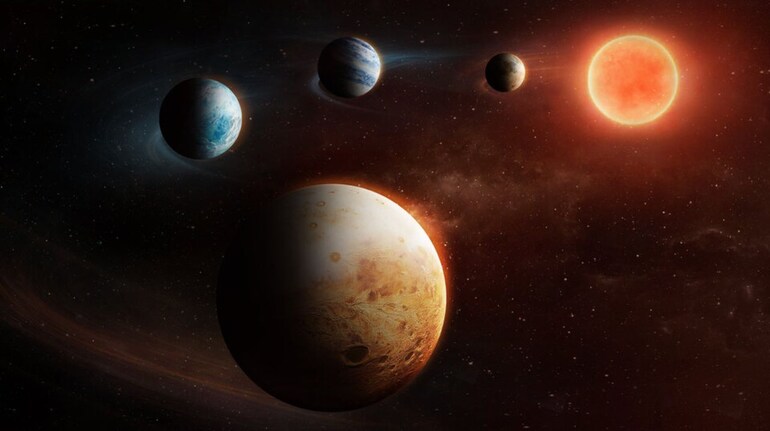

Astronomers have identified a distant planetary system that challenges long held ideas about how worlds form, after spotting an unusual rocky planet orbiting far from its small red star LHS 1903, findings announced on 13 February 2026. The discovery could reshape current planet formation models.
Cheops mission spots unusual LHS 1903 system
The star at centre is LHS 1903. It is a cool red M dwarf. It shines less brightly than our Sun. The system was studied using CHEOPS. The mission belongs to the European Space Agency.
Thomas Wilson from the University of Warwick led the research team. Scientists combined space and ground telescopes. They identified three planets first. The innermost world appeared rocky. Two outer neighbours seemed gaseous.
Later analysis revealed a fourth planet. It orbits furthest from LHS 1903. Surprisingly, this outer planet appears rocky. That arrangement defies common expectations.
Inside out planet formation theory questioned
Current theories predict rocky inner planets. Gas giants usually form further outward. Close stellar radiation strips atmospheric gases. Cooler outer regions allow thick atmospheres.
This system shows rocky, gaseous, gaseous, rocky. Researchers describe it as inside out. Rocky planets rarely form so distant. Simulations tested possible past collisions. They also examined orbital swapping scenarios. Those explanations were ruled out carefully.
Instead, scientists propose sequential planet formation. Planets may have formed one by one. Traditional models suggest simultaneous planetary embryos. These grow within protoplanetary gas discs.
In this case gas may have faded. The outer rocky world formed later. It likely emerged in depleted conditions. Researchers call it a late bloomer.
What it means for Solar System theories
Project scientist Maximilian Günther welcomed the findings. He said mysteries still surround planet evolution. Isabel Rebollido of ESA offered perspective. She noted theories reflect Solar System bias.
As more exoplanets are discovered, revisions follow. Instruments now reveal stranger planetary arrangements. Each system broadens scientific understanding.
The discovery raises larger questions. Is our Solar System typical or rare. The familiar order taught to children may mislead. This distant system hints at diversity. Astronomers now seek further similar examples.
Discover the latest Business News, Sensex, and Nifty updates. Obtain Personal Finance insights, tax queries, and expert opinions on Moneycontrol or download the Moneycontrol App to stay updated!
Find the best of Al News in one place, specially curated for you every weekend.
Stay on top of the latest tech trends and biggest startup news.