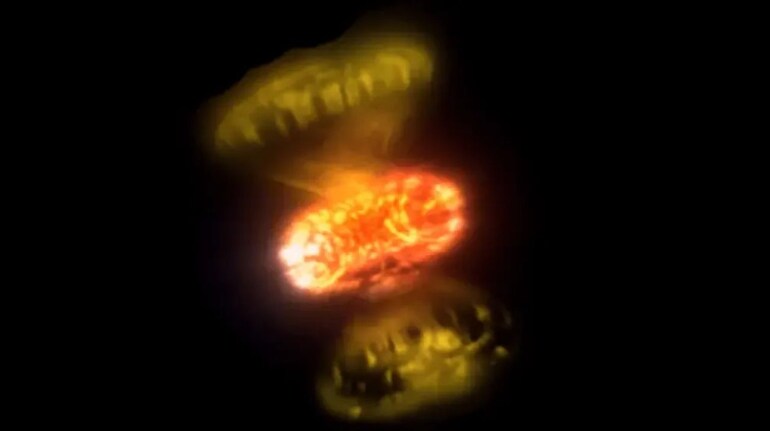
A pair of stellar eruptions recently caught my attention. Their bright outbursts showed activity usually hidden from distant eyes. Each eruption revealed complex motions shaping dying stars. These fresh observations help scientists study fading stellar lives.
How were these stellar eruptions first observed?
Astronomers imaged two novae only days after eruption. They used the CHARA Array in California for clarity. The system captured expanding material around each erupting star. The images exposed delayed ejections and several separate outflows. These findings appear in Monthly Notices of the Royal Astronomical Society. The detailed views show post-eruption behaviour far more intricate. The data now adds evidence for evolving galaxies.
What role do cosmic filaments play here?
Cosmic filaments act like channels feeding young galaxies. These structures move matter and momentum across great distances. The studied filament shows notably aligned galactic rotation. Several galaxies share one coordinated spinning direction. The entire filament appears to rotate collectively too. This pattern challenges views of random galactic alignment. The structure influences galaxy rotation on massive scales.
Dr Lyla Jung explained the unusual motion seen. She compared galaxies to spinning teacups on platforms. Each galaxy rotates while the whole filament turns. This dual motion reveals how galaxies gain momentum. The system shows traits of youth and calm behaviour. Gas-rich galaxies cluster tightly within the filament. Their gentle motion suggests a dynamically cold phase. Hydrogen within these galaxies signals active star formation. Such gas highlights how material enters forming galaxies.
Why do these observations matter for galaxy growth?
Hydrogen traces movement across the cosmic structure. It marks where gas streams into young galaxies. This movement helps define galactic shape and spin. Dr Madalina Tudorache called the filament a fossil record. It preserves history of cosmic flow and rotation. She said it clarifies how galaxies gather fuel. Professor Matt Jarvis noted the collaborative effort behind it. He stressed how combined datasets deepen scientific insight. The work used MeerKAT radio data and optical surveys. DESI and SDSS added crucial supporting information. Teams from the UK and South Africa contributed heavily.
Discover the latest Business News, Sensex, and Nifty updates. Obtain Personal Finance insights, tax queries, and expert opinions on Moneycontrol or download the Moneycontrol App to stay updated!
Find the best of Al News in one place, specially curated for you every weekend.
Stay on top of the latest tech trends and biggest startup news.