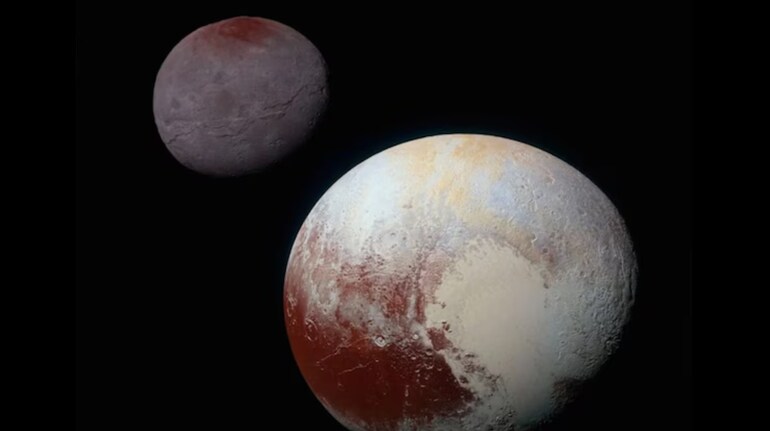
Astronomers have long been puzzled about Charon's origins. Now, a new theory may provide an answer. A paper published in Nature Geoscience on Monday explores how Pluto's largest moon, Charon, might have come to orbit the dwarf planet.
Collision and "Kiss and Capture" Theory
According to the new research, Charon's formation could be linked to a collision. Around 4.5 billion years ago, Pluto may have been struck by another body. This collision could have resulted in Pluto and Charon briefly merging before separating. The researchers call this a "kiss and capture" scenario.
Adeene Denton, the study's lead author and planetary scientist at the University of Arizona, explained the significance of the event. "Charon is half the size of Pluto," she said. "The only comparable system is Earth and its moon."
The Role of Angular Momentum and Resurfacing Pluto
The research suggests that Pluto's fast rotation played a key role. As Pluto spun rapidly, it swung Charon around three times before the two separated. The impact may have caused Pluto's surface to resurface entirely, while Charon lost much of its ice.
Additionally, the collision could have led to the creation of Pluto's smaller moons: Nix, Styx, Kerberos, and Hydra. These moons, observed by NASA's New Horizons spacecraft in 2015, are much smaller than Charon.
Next Steps and Future Research
The scientists propose that further study of Pluto may confirm this theory. However, Denton noted that it could be years before another spacecraft visits the dwarf planet. "If Charon deposited rock into Pluto, we would see that in gravity data," she said.
For now, the collision theory provides a new perspective on how moons may form. The results may also challenge long-held ideas about collision dynamics in space.
Discover the latest Business News, Sensex, and Nifty updates. Obtain Personal Finance insights, tax queries, and expert opinions on Moneycontrol or download the Moneycontrol App to stay updated!
Find the best of Al News in one place, specially curated for you every weekend.
Stay on top of the latest tech trends and biggest startup news.