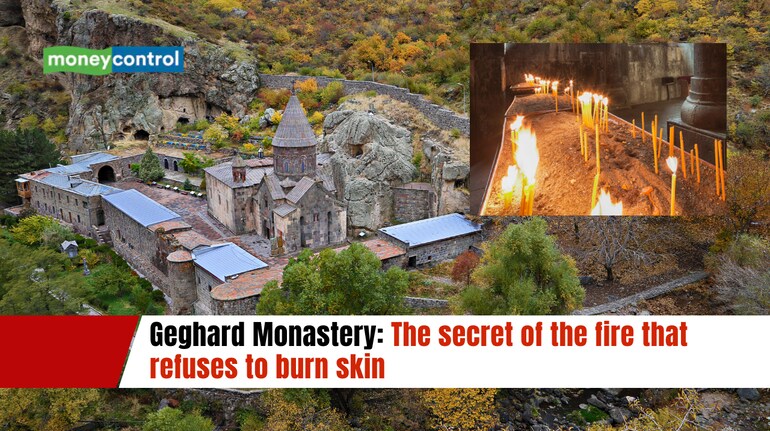

Armenia: In the cool shadows of the Geghard Monastery there exists a phenomenon that challenges the survival instincts of every visitor who enters its ancient halls. Deep within the rock-cut chambers of this UNESCO World Heritage Site burns a natural eternal flame that defies the laws of physics known to the outside world. It is a fire that offers light without scorching heat and pilgrims from across the globe travel here to witness it.
A miracle within the rock
They stand in line with bated breath waiting for their turn to approach the altar. One by one they reach out and pass their hands directly through the dancing yellow tongues of fire. Instead of searing pain or injury they report a gentle warmth or even a sensation of coolness. To the faithful this is not merely a geological curiosity but a divine embrace known as the "Fire That Heals."
The allure of this miracle draws thousands of believers to the cliffs of the Azat River gorge every year. The monastery itself is a marvel of medieval architecture that was partially carved out of the adjacent mountain. It was founded in the fourth century by Saint Gregory the Illuminator at the site of a sacred spring inside a cave. While the architecture is breathtaking it is the spiritual mystery of the flame that captures the imagination of the public.
Kelimutu in Indonesia: How did the colour-changing lakes become linked to life after death?
The legacy of the holy spear
Local tradition holds that the fire is a manifestation of the Holy Spirit. It is said to possess a holy quality that purifies rather than consumes. Visitors often arrive seeking relief from physical ailments or spiritual burdens. They believe that touching the flame imparts a blessing that can mend the body and soothe the soul. The stone walls around the altar are often illuminated by the soft glow of the fire and the candles lit by hopeful travelers.
The history of the site adds weight to these claims of the miraculous. The complex was originally called Ayrivank or the Monastery of the Cave but was later renamed Geghard which means spear. This name honors the legendary lance that pierced the side of Jesus during the Crucifixion. Legend states that the Apostle Thaddeus brought this relic to Armenia and stored it amongst these very cliffs. For centuries the monks have guarded this holy ground and many believe the residue of such power allows miracles like the non-burning fire to exist.
Where faith meets the unexplained
The experience of visiting the altar is immersive. The acoustic properties of the cavernous halls are exceptional. The sound of ancient Armenian chants or sharakan resonates clearly against the hollowed cliffs and creates an atmosphere of otherworldly peace. The air is heavy with the scent of beeswax and frankincense which adds to the sensory journey.
Scientists might attribute the flame to natural gas vents seeping through the porous rock but for the pilgrims standing before the altar the explanation is irrelevant. They do not come for a lesson in geology. They come to connect with a history that spans millennia and to touch a mystery that refuses to hurt them.
For those who make the journey the fire serves as a profound symbol of faith. It represents a light that endures through darkness and a power that protects rather than destroys. As visitors exit the dimly lit sanctuary and step back into the sunlight of the Kotayk Province they leave with more than just a story. They carry the memory of a fire that warmed their spirit without burning their skin.
ALSO READ | This Japanese grand shrine is rebuilt every 20 years in exactly the same way, but why?

Discover the latest Business News, Sensex, and Nifty updates. Obtain Personal Finance insights, tax queries, and expert opinions on Moneycontrol or download the Moneycontrol App to stay updated!
Find the best of Al News in one place, specially curated for you every weekend.
Stay on top of the latest tech trends and biggest startup news.