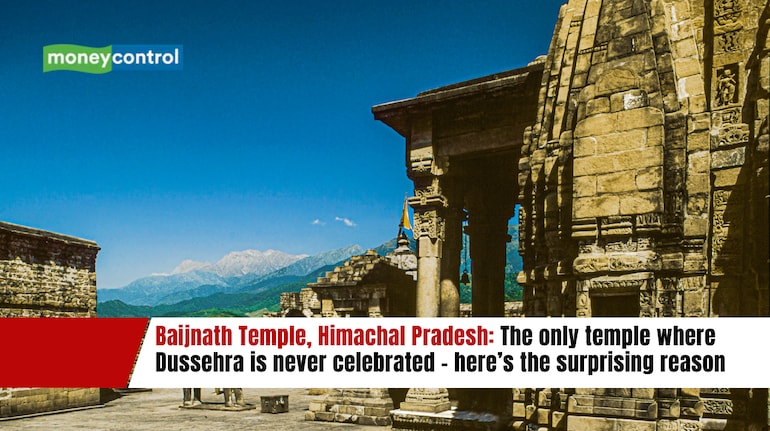
Baijnath Temple, Himachal Pradesh: Baijnath Temple in Himachal Pradesh is one of the most revered Shiva temples in North India, known for its ancient Nagara-style architecture, spiritual significance and a unique tradition that sets it apart. Located in the peaceful town of Baijnath in Kangra district, this temple draws pilgrims from across the country. But what truly captures attention is a tradition followed here for centuries: Dussehra is never celebrated at Baijnath Temple. This rare custom, rooted in a powerful legend, makes the shrine a subject of curiosity for devotees and travellers alike.
Built in 1204 AD by two local merchants, Ahuka and Manyuka, Baijnath Temple is dedicated to Lord Shiva as Vaidyanath (the divine healer). The temple is protected by the Archaeological Survey of India and stands as a remarkable example of Nagara-style stone architecture. The sanctum houses a sacred Shivalinga, surrounded by intricate carvings of Hindu deities on the outer walls.
Historical inscriptions inside the temple reveal that an older Shiva shrine existed here long before the current structure. Over the centuries, the temple has survived natural calamities and political shifts, including the devastating Kangra earthquake of 1905, sustaining only minor damage.
Renovation Under Raja Sansar Chand
In the late 18th century, the temple underwent major restoration under Raja Sansar Chand, the ruler of Kangra. His family priest, Ganga Ram, supervised the repair work, which included rebuilding the spire and strengthening the roof. These efforts helped preserve the temple’s spiritual and architectural heritage.
Why Dussehra is never celebrated here?
The most intriguing part of Baijnath Temple’s identity lies in a centuries-old belief from the Puranas. According to the legend, Ravana, the king of Lanka, performed intense worship of Lord Shiva on Mount Kailash. To please Shiva, he even sacrificed his ten heads, earning the deity’s blessings.
Pleased with his devotion, Shiva granted Ravana a boon and agreed to accompany him to Lanka in the form of a Shivalinga, placing one condition — Ravana must not set it down until he reached home.
During his journey, Ravana stopped at Baijnath, then known as Kiragrama, to drink water. He briefly set the Shivalinga on the ground, and in that moment, it permanently rooted itself in the earth as Ardhanarishwara.
Since Ravana is regarded as a great devotee of Shiva, the people of Baijnath decided never to burn Ravana’s effigy. As a mark of respect to his devotion, Dussehra has never been celebrated here, making Baijnath the only temple in India to follow this tradition.
Architectural Beauty and Sacred Sculptures
The temple’s stone walls feature rich carvings of deities, many older than the temple itself. Idols of Ganesha, Harihara, Kalyanasundara, and scenes of Shiva defeating the demon Andhaka can be seen on the exterior. Inside, two major inscriptions in Sharada and Takri script offer valuable historical details - from the names of the creators to references of the ancient district name, Nagarakot.
How to reach Baijnath temple?
The temple is well connected by road, rail, and air. It lies along the Pathankot–Manali National Highway 154, making it easily accessible from Dharamshala, Palampur, Bir, and Pathankot.
Baijnath Temple is more than just an ancient Shiva shrine. It's rare tradition of not celebrating Dussehra, combined with its architectural beauty and spiritual depth, makes it a fascinating destination for devotees and history lovers. The temple stands as a symbol of devotion, heritage, and timeless faith - inviting every visitor to explore its sacred story.

Discover the latest Business News, Sensex, and Nifty updates. Obtain Personal Finance insights, tax queries, and expert opinions on Moneycontrol or download the Moneycontrol App to stay updated!
Find the best of Al News in one place, specially curated for you every weekend.
Stay on top of the latest tech trends and biggest startup news.