For time-pressed delivery drivers in Bengaluru, replenishing the batteries of the electric auto rickshaws increasingly being used to ferry everything from people to groceries around India’s teeming tech hub can now take just a matter of minutes.
Sagyarani, a 38-year-old e-shuttle driver for MetroRide, pulls up to one of startup Sun Mobility’s 14 automated orange-and-black booths, taps her authentication key to open a vacant compartment, inserts a drained battery and pulls out a fully powered pack. That means more hours on the road transporting commuters to metro stations, MetroRide’s main business. Another bonus: it costs just 50 rupees (67 cents) to swap out a single fully discharged battery, which is about half the price of 1 liter (¼ gallon) of gasoline.
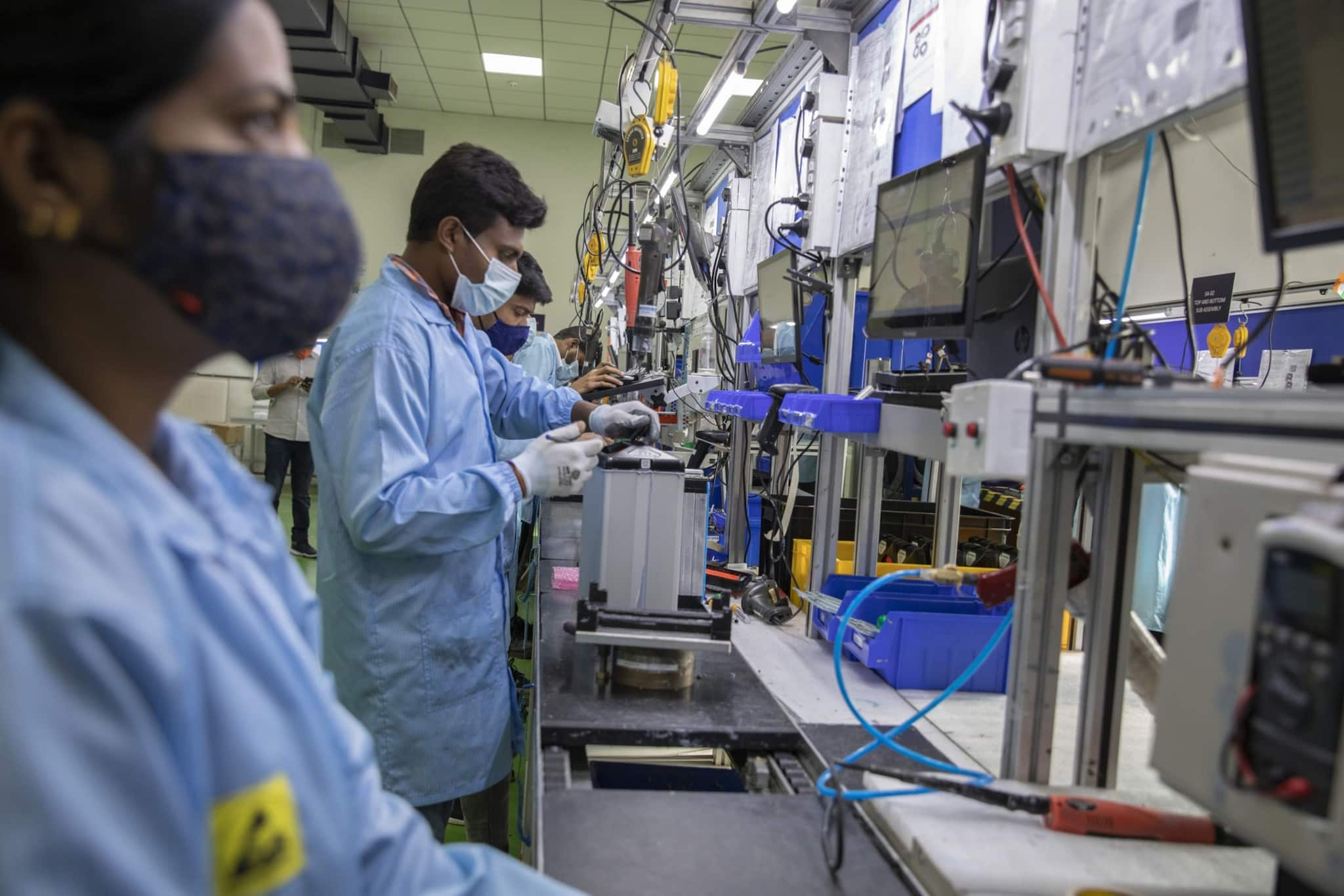 The Sun Mobility battery plant in Bengaluru. Photographer: Samyukta Lakshmi/Bloomberg
Battery swapping, a relatively new technology pioneered in China, has been transformative for Sagyarani, who goes by only one name. She has to recharge three lithium-ion batteries -- which give a combined range of 80 kilometers (50 miles) -- in her auto rickshaw twice every five-hour shift.
“Swapping is best because I’m back on the road in five minutes,” said Sagyarani. “I don’t have to worry about how much charge is left,” she said, though the 13 kilogram (29 pound) batteries are heavy to lift. Recharging the rickshaw at a charging station would keep her off the road for up to three hours, or more than half her shift.
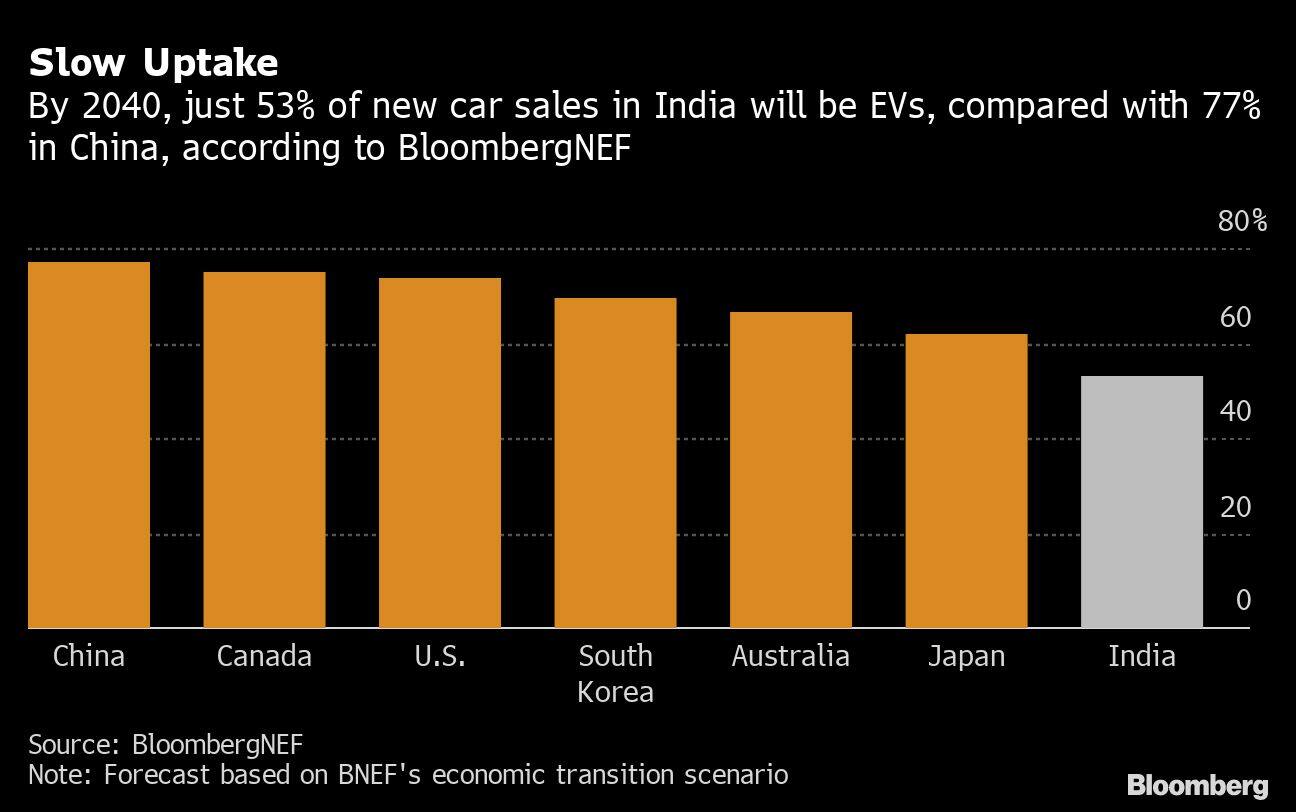
Beyond its obvious benefits for drivers like Sagyarani, battery swapping is now being seen in India as a way to help electrify what is the world’s largest fleet of two- and three-wheel vehicles, a crucial step if the country wants to reduce emissions in some of the planet’s dirtiest cities and meet its goal of becoming net carbon zero by 2070. But the pace of change in battery technology and reluctance among automakers to adopt standardized designs means it may not be a catalyst for passenger cars, with India lagging behind nations like China and U.K. in the take-up of EVs more broadly.
The pivot to battery swapping was a centerpiece of Finance Minister Nirmala Sitharaman’s budget speech last month. The government is developing policies to encourage the industry, she said, given the lack of space in India’s crowded urban areas makes it harder to rollout traditional charging infrastructure. Key to the move, the government plans to standardize battery hardware design and compel automakers to follow the new norms, said Economic Affairs Secretary Ajay Seth.
So far, battery swapping hasn’t really caught on outside of China, partly because it needs a critical mass of EV uptake to make it profitable, and partly because electric car owners in the U.S. and Europe tend to have better access to charging at home. A lot of drivers in China, the world’s biggest EV market, live in apartment blocks and so don’t necessarily have personal charging outlets. That’s seen battery swapping flourish with companies including Nio Inc. and Geely Automobile Group planning to build more than 26,000 stations by 2025, according to BloombergNEF.
The situation is similar in India, especially when it comes to the burgeoning market for electric two- and three-wheelers. The nation of about 1.3 billion people has just 1,640 operational public EV chargers, more than half of which are concentrated in nine major cities.
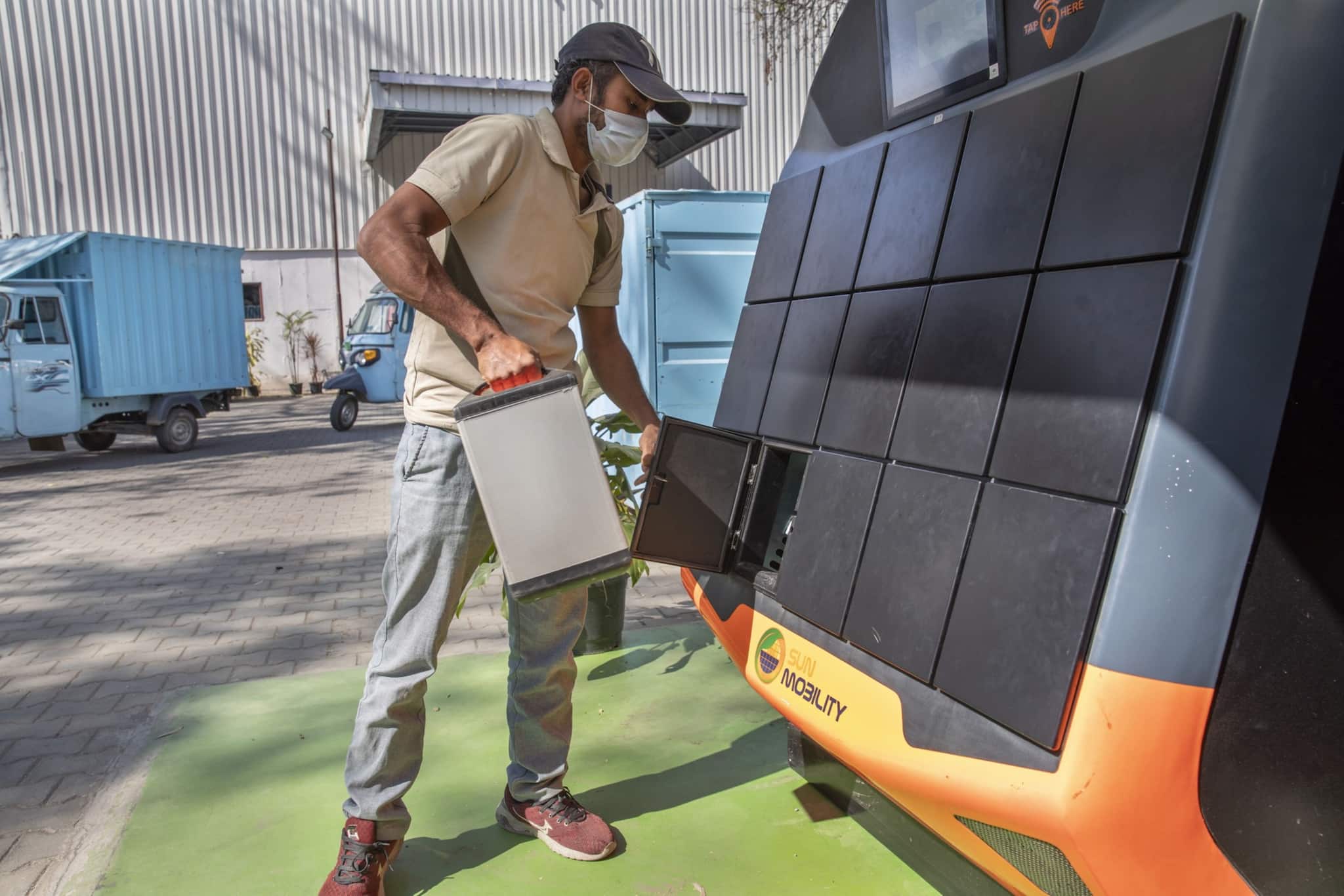 A Sun Mobility battery-swapping station in Bengaluru. Photographer: Samyukta Lakshmi/Bloomberg
In one incident that garnered national media attention, an e-bike owner in Bengaluru had to lug his scooter up to his fifth-floor apartment and power it up in his kitchen when he wasn’t allowed to install a charging point.
Swapping in India will be mainly used by the nation’s 1.5 million electric rickshaws that make up 83% of total EV sales. Because swappable batteries deliver a shorter range, they’re a better fit for the low-speed vehicles as opposed to sedans and SUVs, which need high-power batteries to deliver greater distance, said Rajeev Singh, partner and automotive lead at Deloitte India.
Automakers may also push back on adopting a standardized battery design, which accounts for a major part of the way an electric vehicle is constructed and brand differentiation, said Singh. Some battery developers are also opposed to standardizing power packs anytime soon because the technology is evolving rapidly and India could switch to the more efficient and environmentally friendly sodium-ion batteries from the lithium-ion ones favored by e-rickshaw makers.
But even before the government threw its weight behind swapping, entrepreneurs were diving in. Sun Mobility was established in 2017 by Chetan Maini, who invented India’s first electric car, the Reva, to tackle three biggest impediments to EV adoption -- high upfront costs, range anxiety, and long charging times. Sun Mobility has since attracted investments from oil trader Vitol Group and Bosch Ltd., which bought a 26% stake in the startup. It plans to expand its swap-station network to 600 from 70 in India by the end of this year.
Another startup, RACEnergy, founded in 2018, sells retrofit kits to convert gasoline rickshaws into clean vehicles with removable batteries that can be swapped at one of its six stations in two cities. While most startups are largely focused on electric three-wheelers used by fleet operators, Bounce Infinity has launched an e-scooter for personal use and is planning to invest over $100 million to expand its battery swapping network.
“Battery swapping makes immense sense for the Indian market,” said Sun Mobility’s Maini. “It’s low-hanging fruit for boosting electrification.”
Discover the latest Business News, Sensex, and Nifty updates. Obtain Personal Finance insights, tax queries, and expert opinions on Moneycontrol or download the Moneycontrol App to stay updated!
Find the best of Al News in one place, specially curated for you every weekend.
Stay on top of the latest tech trends and biggest startup news.