




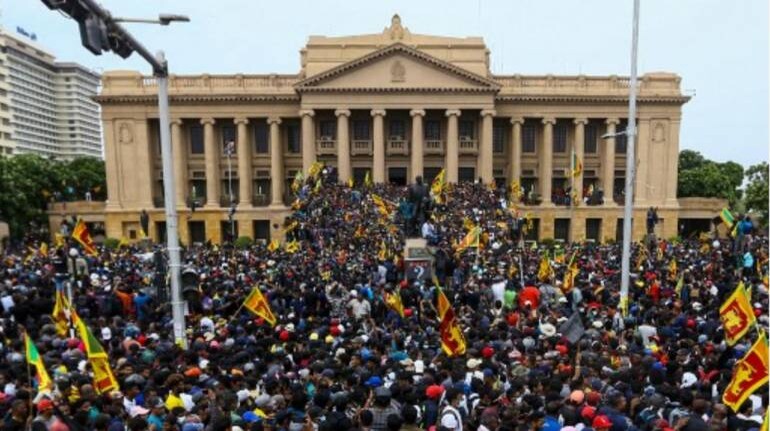
The serious political crisis in Sri Lanka has not attracted the attention of the global community and the West, which is much too caught up in the Ukrainian war, says a former Indian envoy to Sri Lanka.
“The western world is too caught up with Ukraine to devote much time and resources to Sri Lanka. Other than India, which has pledged close to $4 billion as economic assistance to Sri Lanka, western agencies like the World Bank and the IMF have done very little,” India’s ex-ambassador to Sri Lanka, Ashok Kantha, told Moneycontrol.
The Sri Lankan government needs to resume negotiations with the IMF, notwithstanding the terms that the international financial institution offers, he said. The island country steeply devalued its currency in March this year ahead of talks with the IMF for a loan programme, further aggravating its economic woes.
New Delhi’s commitment this year alone stands at around $3.8 billion, making India the biggest supporter of Sri Lanka in this hour of crisis and one reason, which has helped a bad situation from getting worse.
Also Read | Sri Lankan Crisis: Lessons for South Asia
“Sri Lanka, apart from being a close friend of India, is also this country’s strategic partner,” Kantha said.
The political disaster in Sri Lanka is the result of the country’s economic crisis caused by a series of highly questionable decisions taken by its governments in the last few years that lacked due diligence, said Kantha, who was Indian High Commissioner in Colombo between 2009 and 2013.
“An ever-surmounting debt, ad hoc decisions taken in the agriculture sector like adopting organic farming, and the severe impact of COVID-19 on tourism, have all collectively played their part,” the former Indian envoy pointed out.
Unprecedented public outrage over the government’s handling of a severe economic crisis compelled President Gotabaya Rajapaksa to flee Sri Lanka for Maldives this week. The economic slowdown has been fashioned by a drastic shortage of foreign currency to pay for essential imports, including fuel, leading to 15-hour power cuts, shortage of essential goods, and skyrocketing inflation.
How responsible was China for Sri Lanka’s debt crisis? “I would say it has contributed heavily, but it is by no means the only factor. The Rajapaksa government invested heavily into useless infrastructure, much of which was Chinese-backed. China was lending at commercial rates, which should have raised alarm bells, but they did not. The Hambantota port, built under the ownership of Sri Lanka Ports Authority (SLPA), is a classic example. It started commercial operations in 2011, when I was the high commissioner. By 2016, it had incurred losses of about SLR 46.7 billion,” said Kantha.
Sri Lanka had to repay nearly $1.7 billion to China as principal and interest for the loan it had taken to build this port, till about 2036. The debt repayment for this loan at that time was close to about $100 million annually.
“In addition, China has been less than keen to pull Sri Lanka out of this economic crisis,” says Kantha.
Also Read | India may provide emergency food aid to Sri Lanka as situation worsens
With Sri Lanka’s lucrative tourism industry and foreign workers’ remittances sapped by the coronavirus, credit rating agencies moved to downgrade the country, locking it out of international capital markets, derailing its debt management programme.
According to the former Indian envoy, Sri Lanka continued to justify its huge losses and offered tax holidays, all of which ended up contributing to its debt trap.
In the diplomat’s estimation, the economic crisis has one positive: the two major ethnic groups in the 22-million-strong country, Sinhalese and Tamils, have come together in the face of this economic and political calamity. “This is the right time for greater devolution of powers in that country,” Kanth noted.
For a better part of the last six decades or so, the political leadership of the majority Sinhalese and minority Ceylon Tamils, have been unable to work out an appropriate model for sharing political power, leading to a brutal civil war between 1983 to 2009. It ended with the killing of Liberation Tigers of Tamil Eelam’s (LTTE) feared underground leader, Velupillai Prabhakaran. Experts believe that the issue is still not settled, despite decades of fratricidal violence.
Kantha is hopeful that a new Sri Lankan President, scheduled to be elected on July 20, will pave the way for greater stability, and a more viable political consensus in the island nation. “A stable Sri Lanka suits Indian interests,” he said.
Discover the latest Business News, Sensex, and Nifty updates. Obtain Personal Finance insights, tax queries, and expert opinions on Moneycontrol or download the Moneycontrol App to stay updated!

Find the best of Al News in one place, specially curated for you every weekend.
Stay on top of the latest tech trends and biggest startup news.




