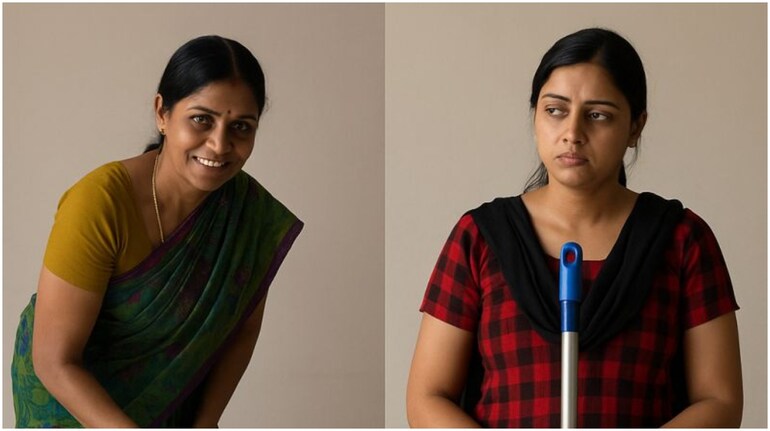
A woman recently took to LinkedIn to share a deeply personal reflection shaped by her experiences living in two distinct urban environments—Chennai in the south and Delhi in the north. Drawing on nearly five years of firsthand observation, she explored how geography could influence values, behaviours, and workplace culture, particularly in the context of domestic workers. What began as a comparison of work ethic soon developed into a broader commentary on dignity, accountability, and the social frameworks underpinning labour expectations.
Dedication and discipline in the South
Having spent close to four years in Chennai, the woman observed a striking consistency in both professional and domestic work environments. Among household staff, she noted a distinct sense of organisation and commitment. One domestic worker employed in her home followed a tightly structured routine—beginning early in the morning, working across multiple households during the day, and concluding with duties in a corporate office in the evening. Even weekends were occupied with tailoring assignments or the crafting of flower garlands, all in an effort to increase household income for her children’s future.
What left the strongest impression, she said, was not merely the work ethic, but “a quiet sense of integrity and personal responsibility.” Expectations were clearly communicated, and boundaries were mutually respected. Discussions around issues such as time off, wages, or even leftover food were handled with “maturity and transparency”. She credited this professional clarity and mutual respect to the cultural ethos of the region.
A shift in experience after moving to Delhi
However, after relocating to Delhi, she encountered a stark contrast. Within a year, she had to replace domestic help multiple times. Although wage agreements were set, she reported inconsistencies in the actual execution of duties. Frequent unexplained absences became routine, and when questioned, she was often met with vague or evasive responses.
Her attempts to address these lapses diplomatically—including proposing adjusted pay for missed days—were met with resistance. According to her, simple discussions about accountability frequently escalated into tension, and she was made to feel like the unreasonable party for merely reiterating agreed expectations.
Another aspect that stood out was the reaction to offers of leftover food. While in Chennai such gestures were received with gratitude and regarded as respectful, in Delhi, she said the same was sometimes declined—occasionally accompanied by a tone of discomfort or perceived attitude. This behavioural shift prompted her to reflect more deeply on the psychological and social reasons behind such differences.
“Ironically, in the South, despite language barriers, communication was respectful. In the North, with no language gap, I often faced ego and resistance,” she wrote in her post.
The woman emphasised that the contrast extended beyond day-to-day conduct. It appeared, to her, to reflect broader mindsets around ambition and self-worth. In Chennai, she encountered domestic workers who, despite a lack of formal education, carried themselves with quiet confidence. Many attempted basic English, managed their schedules effectively, and displayed an evident drive to improve both their personal and economic situations.
By contrast, she suggested that in Delhi, a section of workers seemed “caught in a survival loop”—reliant on subsidised government rations but lacking long-term goals. She speculated that benefits such as low-cost rice and dal, while vital for immediate relief, might have dulled the pursuit of advancement through education or skill-building.
Despite sharing the same language in Delhi, she said communication often felt strained. In Chennai, where she did not speak the local language fluently, she recalled respectful and cooperative interactions.
She was quick to clarify that her post was not intended to “pit one region against another”, but rather to examine how systems and cultural environments influence people’s responses to work and responsibility. She raised a provocative question: could well-intentioned government aid, in some cases, unintentionally suppress motivation?
Her post concluded with a call for introspection: “Are we truly empowering people if we only enable survival, and not ambition?”
The post drew strong reactions online, with many accusing her of framing domestic workers through a lens of unconscious bias. Critics took issue with several implications: that domestic workers should unquestioningly accept leftover food; that pay cuts were a fair response to absence; and that workers who complied without challenge were inherently better.
Commenters argued that such views romanticised hardship and reinforced outdated stereotypes. “Why should anyone be expected to accept leftovers?” asked one user. Others condemned the suggestion that asserting self-respect equated to “ego”, or that questioning wage deductions reflected poor work ethic.
Several voices pointed out that domestic work is legitimate labour deserving of clear contracts, mutual respect, and appropriate compensation. They warned that reducing professionalism to mere compliance, especially through regional comparison, ignored structural inequities and historical labour dynamics.
Some went further, accusing the woman of glorifying subservience. They challenged her assertion that government aid diminishes ambition, suggesting instead that systemic exclusion from education, healthcare, and opportunities was the real inhibitor of progress.
Despite the backlash, the post sparked a wider and overdue conversation about labour, privilege, and the varying degrees of social respect granted to different forms of work. While her narrative focused on regional contrasts, it inadvertently spotlighted a much larger issue: the undervaluing of domestic labour in urban India.
In reflecting on her experiences, the woman raised essential questions—however controversial—about what constitutes professionalism, how society rewards certain behaviours, and whether ambition is equally nurtured across class lines.
Discover the latest Business News, Sensex, and Nifty updates. Obtain Personal Finance insights, tax queries, and expert opinions on Moneycontrol or download the Moneycontrol App to stay updated!
Find the best of Al News in one place, specially curated for you every weekend.
Stay on top of the latest tech trends and biggest startup news.