




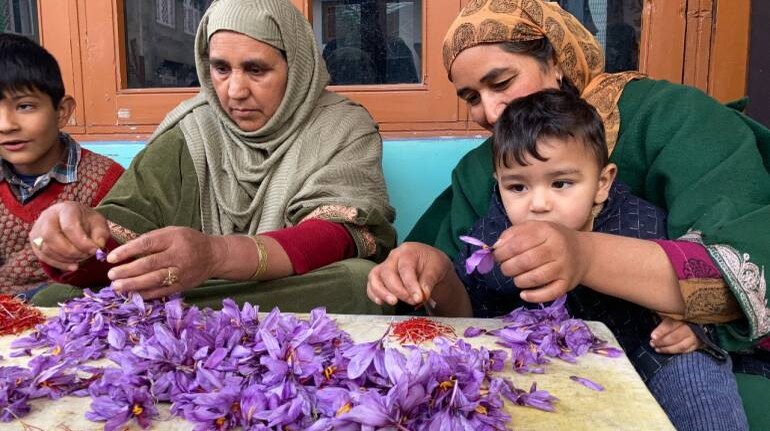
Pampore: These days, the highlands in Jammu and Kashmir’s Pampore town are adorned with vibrant purple flowers and the air is filled with the sweet aroma of saffron, the world's most expensive spice.
Harvested just once a year between October 20 and November 15, the prized Kashmiri saffron (Crocus Sativus), is considered the best in the world due to its aroma, colour and medicinal value.
Iran accounts for 88 percent of the world’s saffron production, while India is a very distant second with 7 percent. The rest comes from Spain, Greece, Italy and other countries.
Jammu and Kashmir is the largest saffron-producing region in the country.
Officials from the Department of Agriculture in Kashmir claim that the saffron produced in Kashmir is not just organic but contains a good amount of colouring strength (crocin concentration), and high aroma power (safranal). The taste of saffron determines its quality (picrocrocin).
The officials added that crocin is responsible for the distinct aroma and medicinal properties in saffron. The amount of crocin in Kashmir saffron is roughly 8.72 percent, higher than the 6.82 percent in Iranian saffron.
Muzamil Salmani, who heads the e-auction centre at the India International Kashmir Saffron Trade Centre (IIKSTC), told Moneycontrol that saffron grown in Kashmir is prized for a number of reasons, mainly due to its quality, colouring and flavouring strength. “Unlike in Iran, the saffron produced in India is a rare commodity and anything that is rare has a good market value,” said Salmani. “Saffron is like a handicraft in Kashmir, involving painstaking manual work and intensive efforts by farmers and labourers. The growers do not use any chemicals and pesticides.”
Altaf Aijaz Andrabi, Kashmir’s former agriculture director, noted that the limited production of Kashmiri saffron has increased its demand in the market, making it costlier than its Iranian counterpart.
National Saffron Mission
Climate change and the lack of irrigation facilities between 2000 and 2010 have badly hit the Kashmir Valley’s saffron industry, forcing the central government to launch the National Saffron Mission in 2010.
According to official figures, before the mission was launched, saffron production had dwindled from 15.9796 metric tonnes (MT) in 1997 to 8.2 MT in 2009 and the land under its cultivation had also shrunk from from 5,707 hectares in 1996 to around 3,280 hectares in 2009.
Data shows that the Rs 400 crore mission helped production rise from 1.4895 MT in 2011 to 13.357575 MT in 2020 and during the same period the acreage was also expanded from 331 hectares to 2,598.75 hectares.
The spice, known locally as ‘Kong’, is produced in four districts of J&K: Pulwama, Budgam, Srinagar and Kishtwar. However, it is Pampore in Pulwama district that has earned the sobriquet ‘saffron town’ because of the quality of its saffron.
Used as a spice in various cuisines and medicinal preparations, saffron butters the bread of around 32,000 families in the Valley, including 11,000 women.
Also read: In a first, Kashmir woman food entrepreneur reaches MasterChef India top 12
Harvest time
Men, women, and children in Pherans (traditional Kashmir attire) pick the delicate flowers from the elevated tableland known as ‘Karewa’ and fill their wicker baskets
This year, however, the saffron flowers have blossomed after a 10-day delay and currently the farmers are busy harvesting the crop. Aijaz Ahmad Reshi, a seasoned farmer from Lethpora in Pampore, has completed three rounds of picking the delicate flowers so far.
“This year we have harvested the crop more than a week after the actual harvest season begins. So far, I have yielded a good crop on my 2.5 acres of saffron land compared to the past two years. The crop production seems 20 percent higher than last year,” 36-year-old Reshi told Moneycontrol.
Once the flowers are plucked from the saffron fields the families sit together after sunset and start separating the stigmas from the flower, to extract the spice. Each flower contains three stigmas: the petals, the yellow strands and the red strands. They are handpicked and dried either traditionally or technologically to make the saffron spice. Pure saffron, also referred to as ‘red gold’ is extracted from the red strands.
Compared to the saffron produced in Iran, Spain, Greece, Italy and other countries, the Himalayan saffron in Kashmir has the longest stigmas and thicker heads, with a reddish hue.
Mongra, the costliest and finest, and Lacha, the second costliest, are the two popular types of Kashmiri saffron being sold in the domestic and international markets.
According to Reshi, the average wholesale price of Kashmiri saffron is approximately Rs 1.80-2.20 lakh per kg, while Iranian saffron sells for about 1-1.3 lakh per kg.
“During the past few years the price of Kashmiri saffron has remained constant,” said Reshi, who, besides being a farmer, also sells packaged saffron at his outlet on the Srinagar-Jammu national highway.
Also read: World’s most expensive mushroom is found in Jammu & Kashmir
Technology and a GI tag to the rescue
Salmani said that IIKSTC, Kashmir’s first high-tech spice park, has helped maintain all the quality parameters of the crop by providing advanced post-harvest management facilities to farmers. He claimed that the price of saffron has increased sharply. “After 2020, when the high-tech spice park under the National Saffron Mission became operational in Kashmir, the quality of saffron was enhanced. In order to end the menace of adulteration and maintain the quality of the crop, IIKSTC started a wide range of services, including stigma separation, drying through electrical and vacuum dryers, grading, packaging, testing, e-auctioning and marketing, all under one roof,” Salmani explained.
He added that the park has obtained a Geographical Indication (GI) tag for Kashmiri saffron, which has increased the price of the crop. A GI tag is a sign used on products to indicate that they are from a specific geographical origin and possess qualities or a reputation due to that origin and are therefore authentic.
“The GI tag has doubled the income of farmers in a short span. For example, in 2019, 1 kg of saffron was sold at Rs 1 lakh but now a farmer is selling the GI tagged saffron at Rs 2 lakh per kg,” he claimed. “The rates have also increased because middlemen no longer exist in the business.”

Discover the latest Business News, Sensex, and Nifty updates. Obtain Personal Finance insights, tax queries, and expert opinions on Moneycontrol or download the Moneycontrol App to stay updated!
Find the best of Al News in one place, specially curated for you every weekend.
Stay on top of the latest tech trends and biggest startup news.




