





Sahil Naik is weighed down by an unsettling sense of history these days. The young Goan artist has inherited a site at the seafront venue of the Kochi-Muziris Biennale that has housed such legendary figures as the Japanese-American multimedia artist Yoko Ono, celebrated Chilean poet Raúl Zurita and India's own Vivan Sundaram in the art biennale's previous editions.
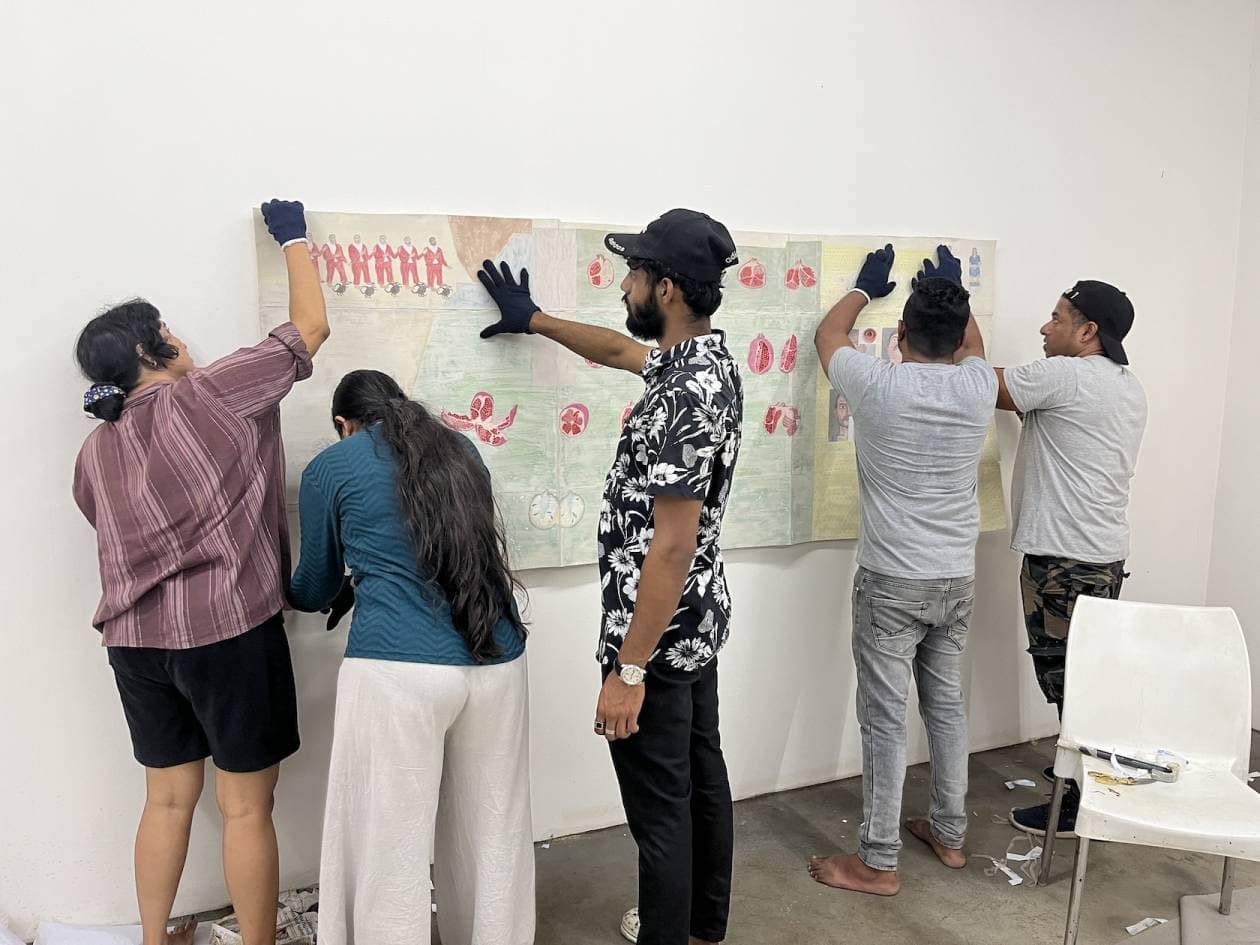 Artist Mithra Kamalam (far left) is helped by volunteers to mount her work, 'Corrective Measures', at the Pepper House venue of the fifth edition of the Kochi-Muziris Biennale beginning on December 12. (Photo: Faizal Khan)
"It is a hard act to follow," confesses Naik, who is racing against time to assemble his art installation for the December 12 opening of the fifth edition of India's first biennale. Besides their harmony with a giant hall in a 19th century spice warehouse — the main venue of the event — the striking similitude between the works of Naik and his predecessors is rather uncanny. All of them share a particular creative philosophy — submergence.
If the Delhi-based Sundaram, the nephew of Amrita Sher-Gil, used the disappearance of the ancient port of Muziris on the Arabian Sea in Kerala after a flood for his work, Black Gold, in the first edition of the biennale in 2012, and Zurita filled up ankle-deep water in the same space fronted by a poem in 2016 to reflect the suffering of refugees washed ashore from fatal boat journeys in the sea, Naik draws on the submergence of a Goan village 50 years ago to build a dam for his work.
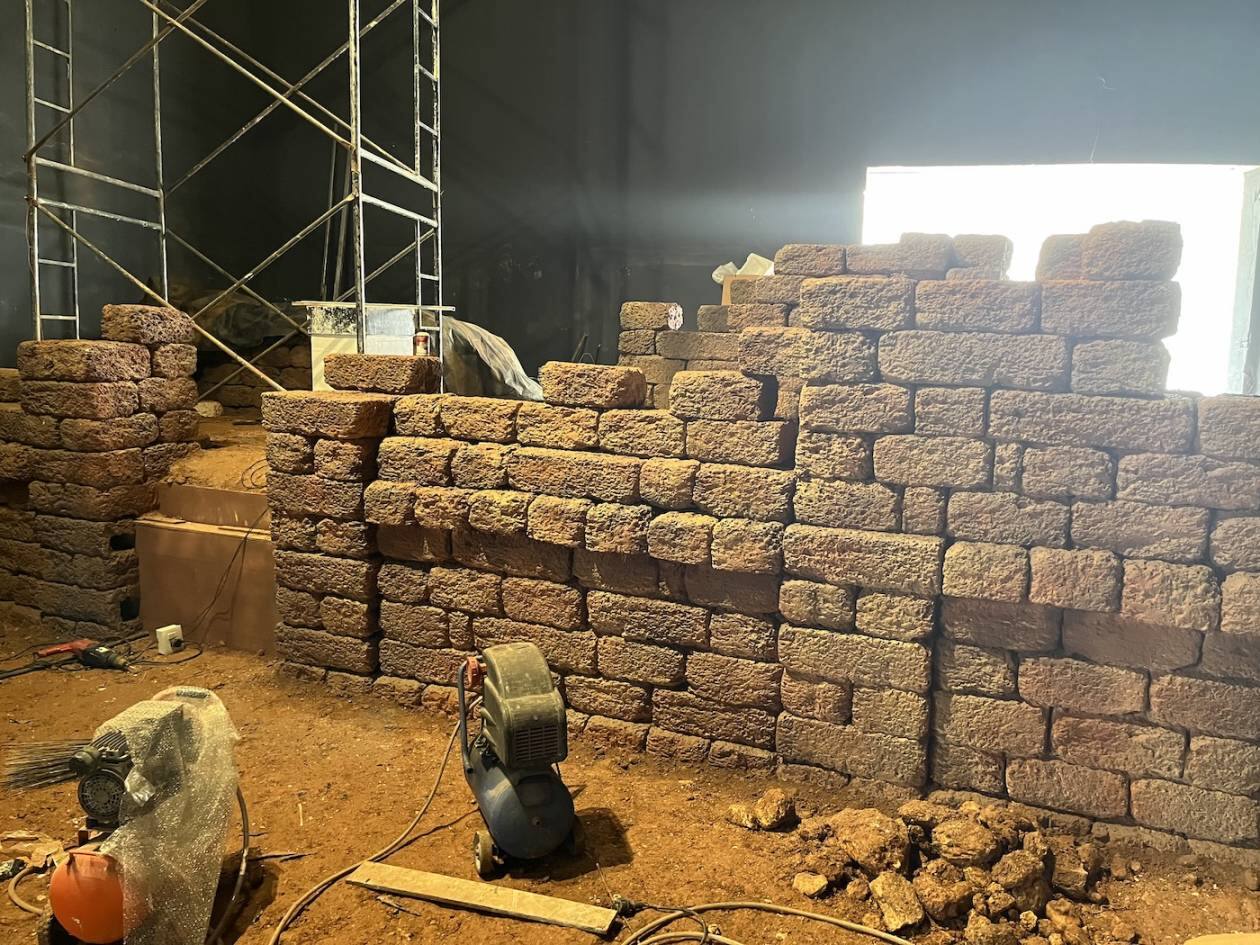 Goan artist Sahil Naik's installation, 'All is water and to water must we return', is about the perils of development. (Photo: Faizal Khan)
Titled All is water and to water must we return, Naik's installation narrates the shared history of the victims of development through live images of the ruins and sounds of folk songs. "The first chief minister of Goa, Dayanand Bandodkar, commissioned a dam to solve Goa's water crisis that resulted in the submergence of many villages," says the artist, who gathered stories and songs of the lost villages to create his art installation.
Naik focuses on the fate of one of the submerged villages, called Curdi, to recreate the ruins. The installation has a waterbody in the centre flanked by the ruins of two homes with folk songs sung by the village's residents wafting through the air. "I wanted to show how songs connect us as a carrier of memories," explains Naik, a sculptor who studied visual arts at the MS University, Baroda. "Songs are also carriers of history."
Naik is among the 90 artists from around the world who are busy mounting their works at the four venues of the biennale — Aspinwall House, Pepper House, Anand Warehouse and Cabral Yard — that will be held from December 12 to April 10 next year in Kerala's heritage towns of Fort Kochi and Mattancherry. Curated by Indian-born Singaporean artist Shubigi Rao, the theme of the Kochi-Muziris Biennale 2022 is "In Our Veins Flow Ink and Fire".
"To envision this biennale as a persistent yet unpredictable murmuration in the face of capriciousness and volatility comes from my unshakeable conviction in the power of storytelling as strategy, of the transgressive potency of ink, and transformative fire of satire and humour," says Rao, who was a participating artist at the Venice biennale this year.
While, at least, two prominent artists (Vivan Sundaram and Amar Kanwar) return to the biennale after their works in the previous editions, many young practitioners, from both India and abroad, portray the philosophy of the curator in letter and spirit. Mithra Kamalam, who studied visual arts the MS University, Baroda, fabricates an imaginary in her figurative work, Corrective Measures, a continuing project that borrows heavily from her own experiences and dotted with literary references from Malayalam writers Kamala Das and R Rajasree and fragments of former cultural practices like sati.
"Corrective Measures is a title phrase used for a series of works that I have been doing lately," says Kamalam, who was born in Kozhikode, Kerala, while mounting the work at the Pepper House venue of the exhibition. "I used it to address intimations of counter narratives in my work, and to denote the idea of healing by using the notion of repetition. Here, repetition of forms is used as a therapeutic expression and to bring emotions. Healing something which is disrepair, disordered and interrupted, it extends as historical and social over a deeply personal space. It also has connections with female psychology, body, social and gender positions," adds the artist, who is influenced by miniature art.
Archana Hande, who lives in Bengaluru, investigates the prevalence of male chauvinism in labour through her work, My Kottige, kottige a Kannada word meaning space. Hande, who moved from Mumbai to her home state a few years ago, collected objects from markets for discarded material across Karnataka to create a kaleidoscope of social imperfections at the Aspinwall House venue. In a strong statement that embodies the sanctity of space, the artist invites viewers to peep into the work from windows. "You can't enter," says Hande.
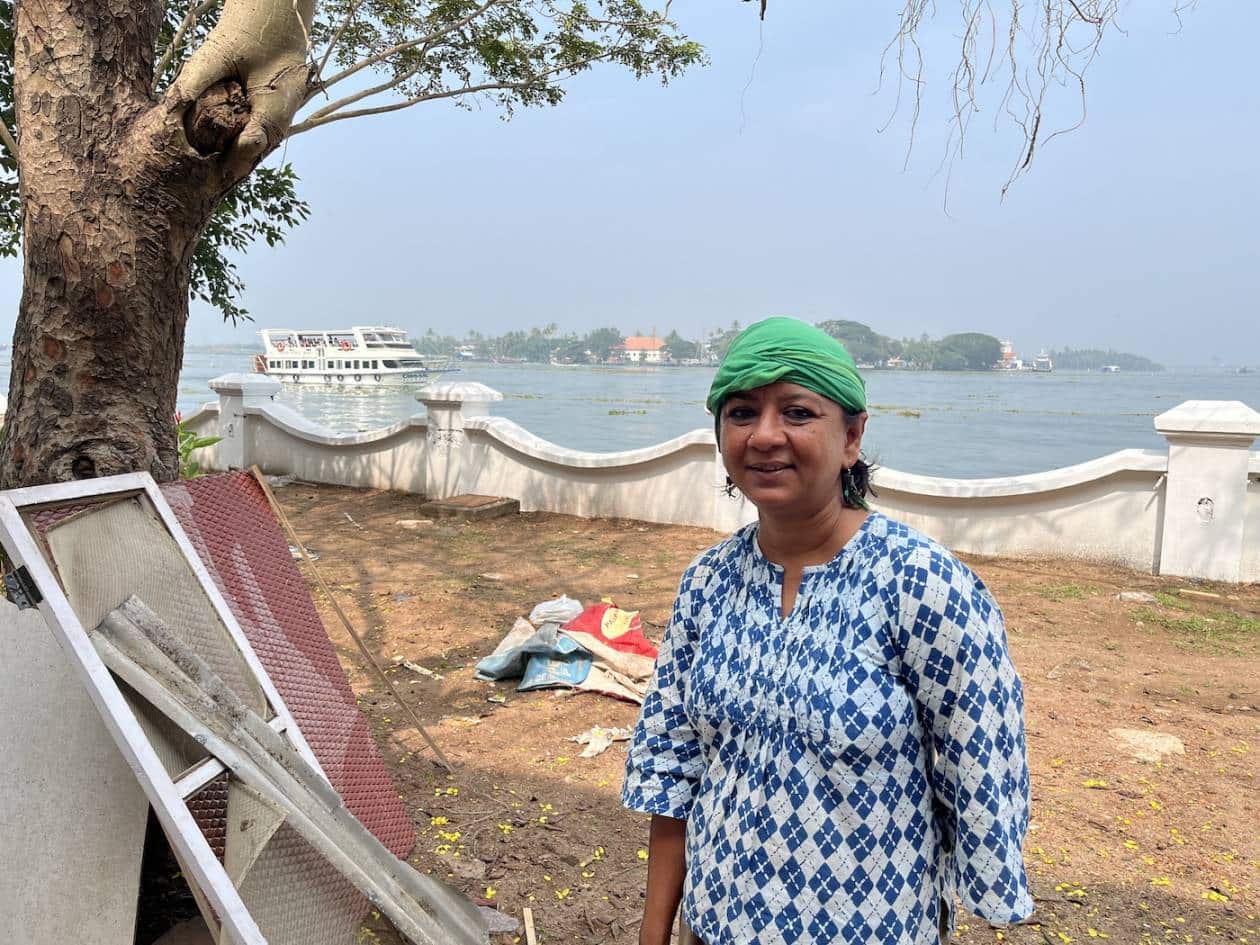 Bengaluru-based Archana Hande collected discarded material from across Karnataka for My Kottige, an installation that investigates chauvinism in the society. (Photo: Faizal Khan)
The works show discarded material like rusting scissors from garment factories resting inside a flower vase and weights from wrestlers' gyms strewn around on the floor that Hande collected over two years. In Mangaluru's old wrestling gyms, women routinely made the mud surface, but lost their jobs when these gyms were modernised. In former community kitchens across Bengaluru, women who cooked the food were made redundant when food delivery apps took over. "Everything is getting modernised, but gender inequalities remain," says Hande.
Amar Kanwar's 2017 work, Such a Morning, at the Anand Warehouse venue, combines a five-minute film and an accompanying installation containing scripts of seven letters. It tells the story of a teacher who quits his job one day and disappears. "The work is about the predicament we are in. We need to find new ways of thinking and newer responses," says Kanwar, an acclaimed filmmaker. "There are some truths you can see with your eyes open and some others only with your eyes closed," he adds. "The key question is what can you see in the heart of darkness. The teacher is all of us."
Sikkim-born Tenzing Dakpa's The Hotel is a collection of photographs, a video and a book that document his family enterprise in Gangtok. "My parents started a restaurant business in Sikkim in 1989 and since have been providing hospitality to the guest who come to the hotel," says Dakpa, who now lives in Goa. The pictures were taken by the artist during a two-month-long visit home from Providence city in the United States where he was a master's student at the Rhode Island School of Design. "The hotel I grew up in is also my home," says the artist, whose work revolves around migration, labour and diaspora experience. "The deeper I delved into the nuances, the more I felt that a stake in survival was far more immediate than analysing power structures.”
The Hotel shows Dakpa's brother dusting a mat, his father cleaning a guest room and a cat his parents had adopted moving around. "My grandparents moved from Tibet to Bhutan, my parents from Bhutan to India (Sikkim), and I moved first to Delhi and later the United States for university," says Dakpa, a second-generation Tibetan. “For me, these photographs serve as marker, because they add the complexity of a political climate that my family had to deal with, which existed outside of the frame. The deliberate decision to photograph my parents at work was to insert this idea of survival.”
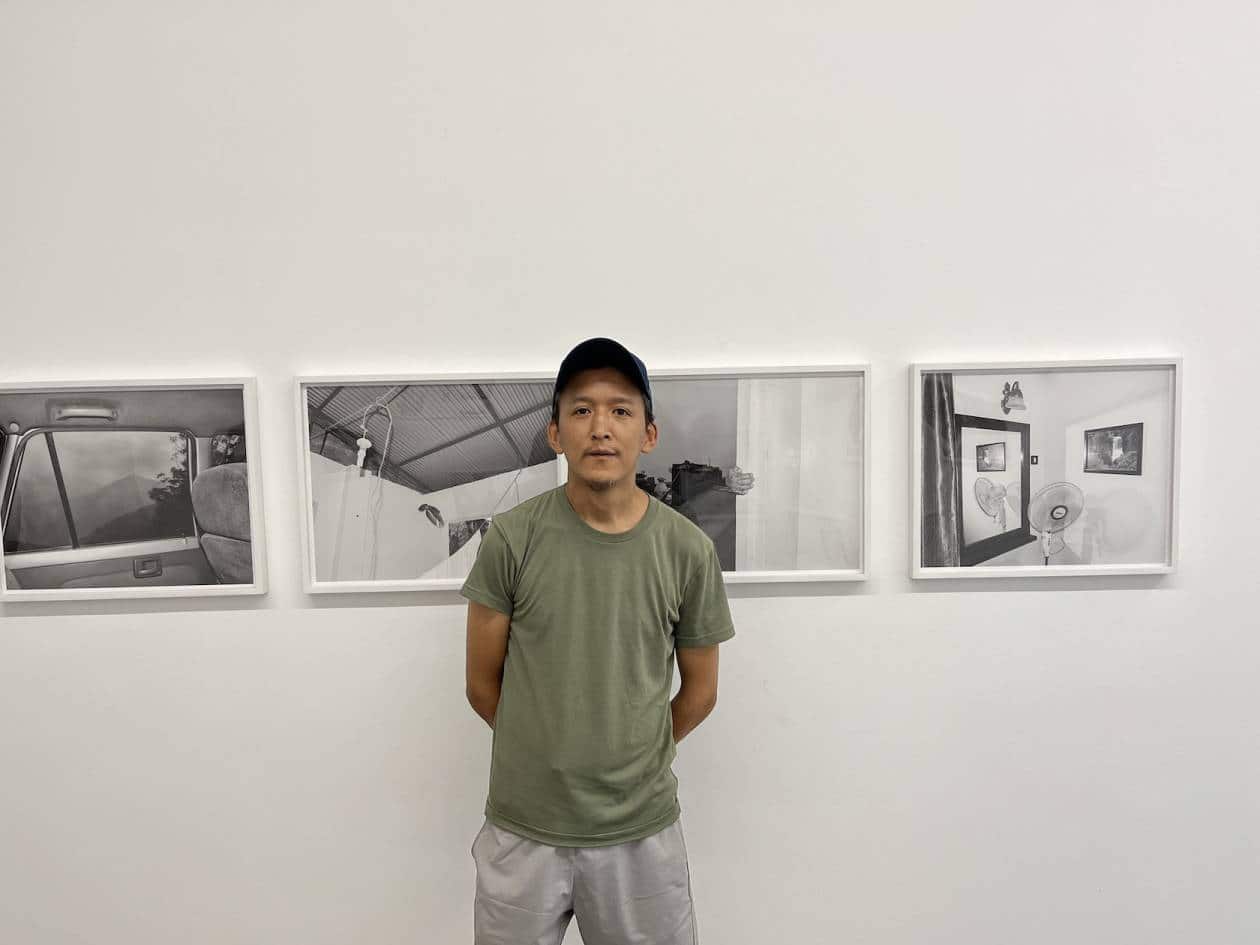 Sikkim-born Tenzing Dakpa's work, The Hotel, contains photographs, a video and a book that document the struggle and survival of Tibetans in exile around the world. (Photo: Faizal Khan)
Also among the artists are Massinissa Selmani, an Algerian-born artist now living in Tours, France, who uses images from newspapers for his drawings which imagine absurd situations that are unlikely to happen. "It is a kind of fictional testimony about situations," says Selmani, who studied computer science in Algeria and fine arts in France. One of the drawings shows a man standing near a wall holding a flag. "The wall (denoting a national border) for some people is a violent object," says the artist.
"This is the most important edition of the Kochi-Muziris Biennale," says Kochi Biennale Foundation president and artist Bose Krishnamachari. "It reflects the story of human optimism, how we can rise up like phoenix, from chaos and disasters. Art can give confidence and solace. The biennale is a place for resurrection," he adds. "It was not easy to return the biennale this time. Every step was a challenge."
There will be two changes to the duration and timing schedule of the biennale. From the earlier 108 days, the biennale now extends to 120 days and the daily schedule changes from 10 am-6 pm to 10 am to 7 pm. The Students' Biennale opens on December 13 at four venues in Mattancherry, while this year, there is an added Invitations Programme which will feature major galleries.
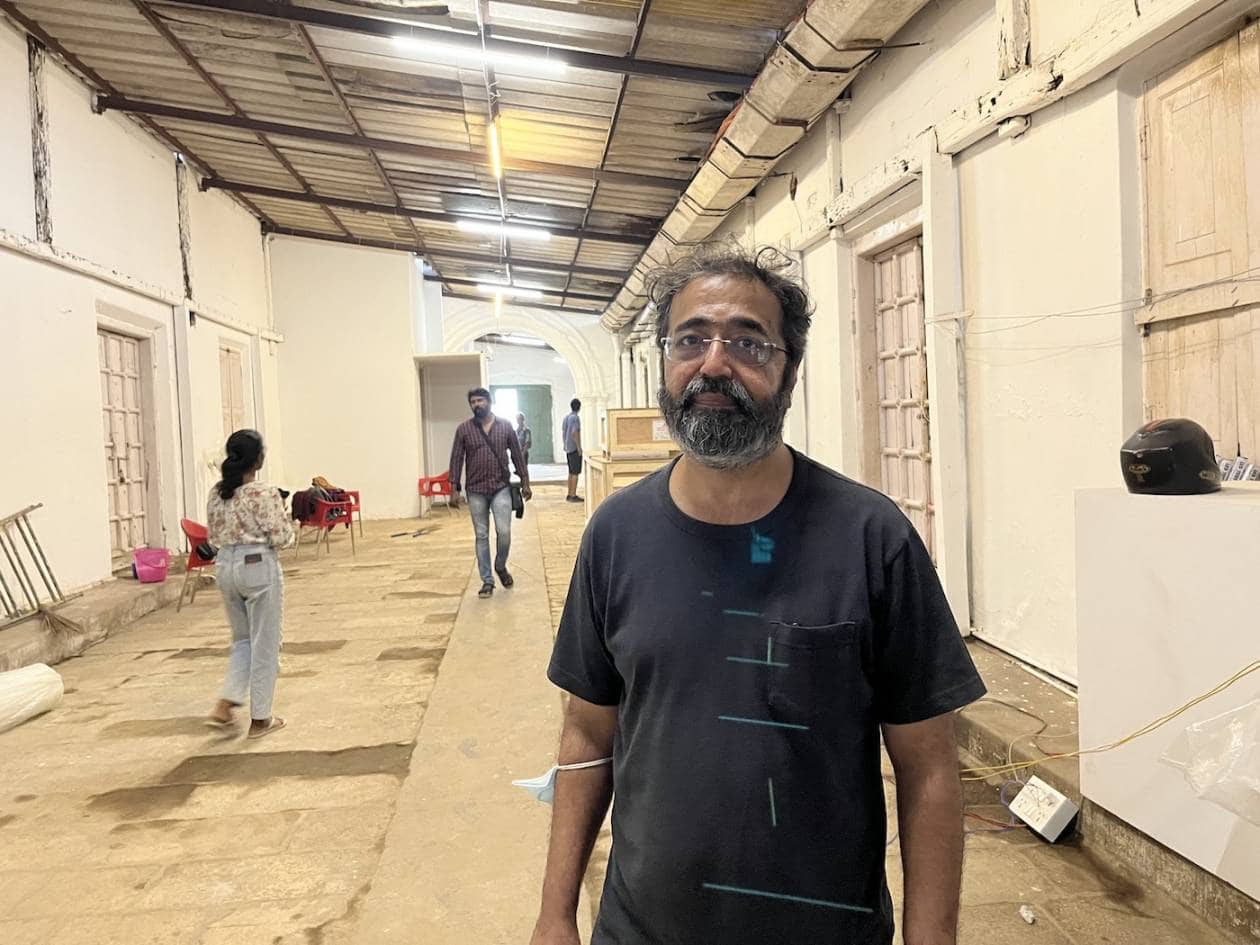 Noted filmmaker Amar Kanwar at the Anand Warehouse where his 2017 work, Such a Morning, portrays the human predicament today. (Photo: Faizal Khan)
When and Where:
December 12 to March 10, 2023.
Venues: Aspinwall House, Pepper House, Cabral Yard, Anand Warehouse.
One-day pass: Rs 150 for adults, Rs 50 for children and students
Discover the latest Business News, Sensex, and Nifty updates. Obtain Personal Finance insights, tax queries, and expert opinions on Moneycontrol or download the Moneycontrol App to stay updated!
Find the best of Al News in one place, specially curated for you every weekend.
Stay on top of the latest tech trends and biggest startup news.