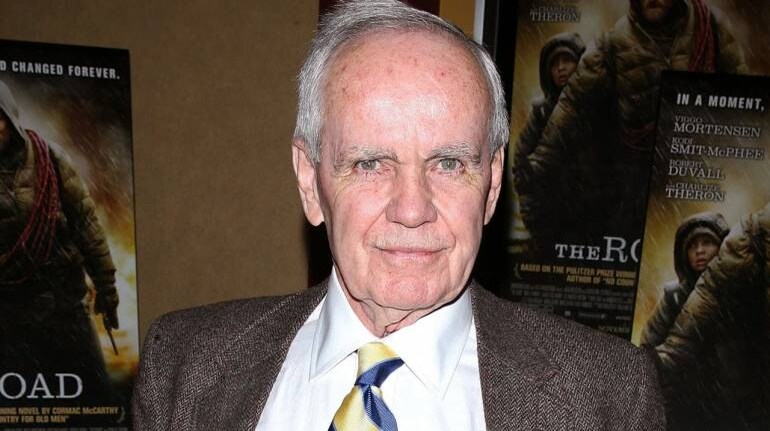
Writers are urged to go out and talk about their writing all the time. Creating a brand is all the rage, and publicity is oxygen. But fame, organic or contrived, does go against the ‘show, don’t tell’ mantra that all good writers chant. American author Cormac McCarthy, who died recently, suffered no such dilemma — he let his writing do the talking. He was never seduced by the celebrity potential of his profession.
In this day and age that seems an impossible thing — a successful career without personal tom-tomming. A genuine disinterest in the frills and frippery of fame in any field where remuneration is seen as directly proportionate to visibility has to be a genetic disorder. To play the game artists jump in with various reasonings to self, very few able to actually stay away from the merry go round.
Cormac had no agent for the longest time, and was averse to public appearances, neither dispensing profound wisdom nor issuing quotable quotes from a pulpit. He may be described as a writer’s writer, but had once confessed in an interview that writing was way, way down at the bottom of the list. His sparse use of punctuation was, perhaps, indicative of his general style, pointing to the minimalist in him.
His novel, The Road (2006), bagged the James Tait Black Memorial Prize for Fiction in 2006 and the Pulitzer Prize for Fiction in 2007 — which he did not turn up to collect in person — and was made into a film in 2009. The story of a father and son trying to survive in a world under destruction, where ‘once there were brook trout in the streams in the mountains. You could see them standing in the amber current where the white edges of their fins wimpled softly in the flow. They smelt of moss in your hand. Polished and muscular and torsional. On their backs were vermiculate patterns that were maps of the world in its becoming. Maps and mazes. Of a thing which could not be put back. Not be made right again. In the deep glens where they lived all things were older than man and they hummed of mystery’.
After The Orchard Keeper (1966), Outer Dark (1968), Child of God (1973), Suttree (1979), Blood Meridian (1985) came his All the Pretty Horses (1992), which got him the National Book Award and National Book Critics Circle Award, and then The Road. The PEN/Saul Bellow Award for lifetime achievement in American fiction followed. His No Country For Old Men (2005) was adapted into a film that went on to win an Oscar in 2008.
And, yet, it was not limelight or lucre that kept him writing book after book — just the urge to write. He even (somewhat naively) expected his first wife to support him while he wrote, cited as a reason for the collapse of that marriage. Fame, when it came, he wore like someone else’s jacket.
He left no fancy statements to be flaunted posthumously. As he said in The Road, ‘When you die it's the same as if everybody else did too.’

Discover the latest Business News, Sensex, and Nifty updates. Obtain Personal Finance insights, tax queries, and expert opinions on Moneycontrol or download the Moneycontrol App to stay updated!
Find the best of Al News in one place, specially curated for you every weekend.
Stay on top of the latest tech trends and biggest startup news.