




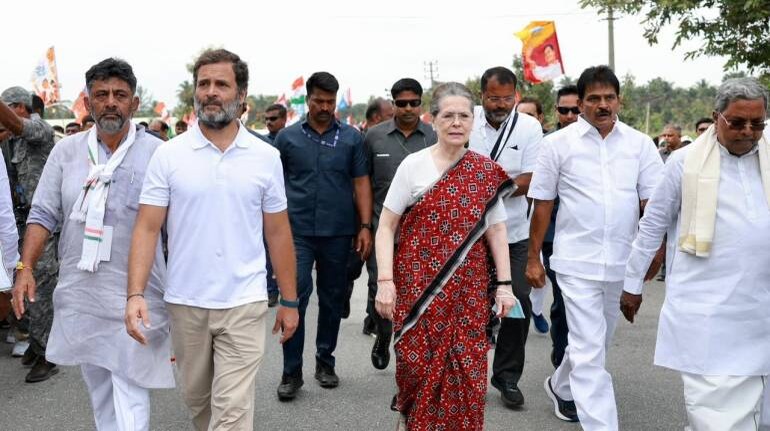
Manthan derives from the Sanskrit word Manthanam, which means to churn. In mythology, Samudra Manthan was a tug of war that revealed all banes and boons, including the elixir of eternal life, on earth. In a new book in the Rethinking India series, The Great Indian Manthan: State, Statecraft and the Republic, the contributors seem to be seeking a churning, probably a big one, to take India out of its current state. Sonia Gandhi, Margaret Alva, Hamid Ansari, Dr T.M. Thomas Isaac, Sitaram Yechury, and Mallikarjun Kharge have each contributed an essay to the book that releases on November 30, about six months ahead of the 2024 general elections.
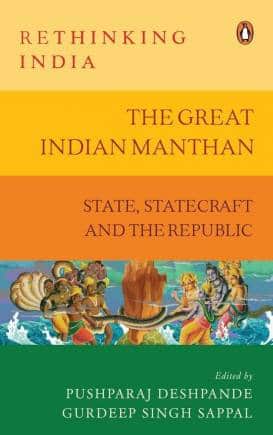 Vintage Books, 256 pages, Rs 699
The authors and publishers have said in a note circulated to the media that “India is rapidly becoming the world’s largest flailing democracy, and India’s institutional framework has been systematically undermined, from within and without.” The book, claim the publishers, is a white paper, or a visionary blueprint for India’s future.
Does India need a blueprint?
Yes, say the writers because they do not like the current state of the nation and feel they want to redress what they call structural flaws in India’s existing institutions. The authors even want to create new institutions to address fresh challenges and re-engage with all of India’s systems. The writers call themselves India’s progressive forces and want to socialise Indians to what they call missing Constitutional values.
The thoughts of the writers assume importance, ostensibly because India is headed for general elections next year. So this book may be seen as a political statement. The articles have been curated by Gurdeep Singh Sappal, a member of the Congress Working Committee. He has, for company and balance, Pushparaj Deshpande, director of the Samruddha Bharat Foundation.
So are the argumentative contibutors actually disruptors?
Not quite. In a democracy, an alternative viewpoint is necessary - desirable even. The writers seem to be trying to get to the bottom of the truth about their nation that - they feel - is not moving in the right direction. Yet the words in which the writers express themselves are very strong. Sample this: “With either actual or looming crisis in every branch of government, at every level, be it central, state or local; with nearly every institution failing; with unemployment at historically high rates; with an ecosystem ready to implode; with a healthcare system in a shambles; with an education system on the brink of collapse; with gender, caste and class inequalities unabating; with civil society increasingly characterised by exclusion, intolerance and violence; with our own minorities living in fear; our hundreds of millions of fellow citizens in penury; and with few prospects for the innumerable youth of this nation in the face of all these increasingly intractable problems, the reflection is not sightly. Our true enemies are not external to us, not Pakistani terrorists or Bangladeshi migrants, but our own selves: our own lack of imagination, communication, cooperation and dedication towards achieving the India of our destiny and dreams.”
This reviewer was keen to read what Sonia Gandhi wrote in the book. Gandhi laments what she calls the total dilution of the National Advisory Council (NAC), created by the UPA to advise the government on social development issues. “Despite the fact that the NAC was to function purely as an advisory body to the Prime Minister, it was uncharitably caricatured publicly as a separate power centre because the chairperson happened to be the president of the Indian National Congress.”
Gandhi felt that the NAC had been vilified. More importantly, there has been an excessive centralisation of power and functions in the PMO (something often heard in the corridors of powers). So what has happened as NAC got diluted? Gandhi writes many things which should have not happened have happened. For example, forest land, Adivasi land slowly getting into the hands of big corporations.
She also feels the RTI Act has been diluted, the core principles of MNREGA pushed into a supply-driven programme and a large number of Bills introduced in Parliament did not see any consultations. “This excludes citizens from the policymaking process and makes a mockery of India’s parliamentary democracy.” It would be worthwhile to mention here that the BJP, when in opposition, criticised the Congress-led UPA for similar procedural lapses and often said the power centre of the government was not in the PMO but at the home of the Gandhis.
Similar arguments are all over the tome. One from Hamid Ansari caught this reviewer's attention. The former Vice-President of India writes he was unhappy with the way Parliament was functioning, and that there has been a decline in its effectiveness as an institution of accountability and oversight. Ansari, in short, wrote the procedural devices in Parliament were not being followed and hence many (dissenting) viewpoints were not voiced in the houses. “The primary objectives of proposed correctives should be to induce Parliament to accommodate in its functioning the realities of our times, restore its primacy in the functioning of institutions of the Indian state, and convince a younger generation that it remains relevant.”
(I remember Sappal was the Officer on Special Duty for Ansari, and defended him vociferously in the needless social media dustup over Ansari not saluting the national flag during the Republic Day parade in 2015.)
It would be futile to individually analyse what each contibutor wrote in the book. Two writers impressed with their solid point of views. One was Madan Lokur who wanted total reimagining, reforming and transforming of the country’s judiciary; he expected the courts to impartially resolve disputes in accordance with the law of the land, an issue often filling the headlines and the minds of Bollywood directors. And the other was Prof. Ingrid Srinath whose viewpoint would have found an echo from every corner of India: He felt India must have a serious agenda for policy reforms for the country’s civil society, the social basis of democracy. India definitely needs participatory governance, the nation must ensure CSR does not get lost in the balance sheets of big buck companies.
It would have been good if Sappal had included right-wing voices in this book as well. After all, he is only showing the mirror, right? So why not read the minds of the incumbents as well? A solid read, actually an eye-opener (especially for those who still believe India can and will win the World Cup football).
Discover the latest Business News, Sensex, and Nifty updates. Obtain Personal Finance insights, tax queries, and expert opinions on Moneycontrol or download the Moneycontrol App to stay updated!
Find the best of Al News in one place, specially curated for you every weekend.
Stay on top of the latest tech trends and biggest startup news.