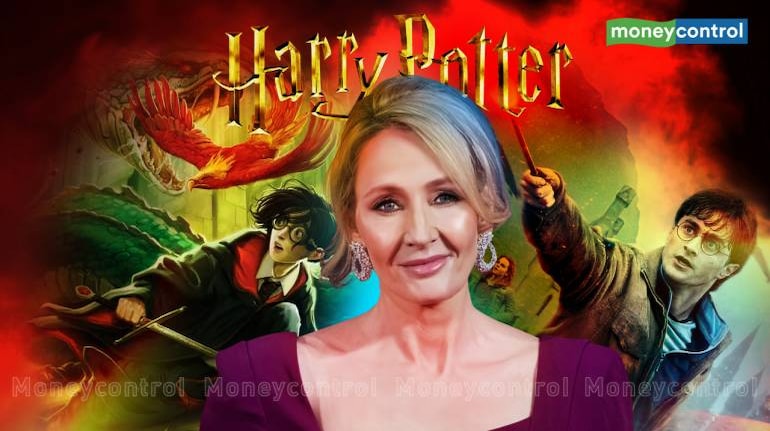
Twenty-six years ago, on June 26, 1997, a novel was published in Britain, that would transform children’s literature forever. It was written by a woman who had just got herself out of an abusive marriage and was living on government dole with her little daughter. She was working her way out of deep depression by spending whole days in coffee shops in Edinburgh, banging out a manuscript on her rickety typewriter from a stack of paper slips where she had been writing down her ideas for years. And then when the novel was done, it was rejected by a dozen leading British publishers.
Finally, when Bloomsbury agreed to take it on, she was advised that since the primary readership would most likely be adolescent boys, the book would not work with a woman as the author. So Joanne Rowling added Kathleen as her middle name, in memory of her grandmother, and became J.K. Rowling. And the Harry Potter saga began with Harry Potter and the Philosopher’s Stone—called Harry Potter and the Sorcerer’s Stone in the United States, since the American publisher was afraid young readers would be put off by the word “philosopher”.
 Harry Potter and the Philosopher’s Stone (Photo via Amazon)
The success of the seven-book Harry Potter series—and a few add-on books set in the same universe—is unmatched in the history of fiction. It has been published in almost every country in the world—perhaps even in North Korea—in some 60 languages. It made Rowling wealthier than the Queen of Britain. But there are several things that the Harry Potter books achieved that are of much greater importance than their author becoming super-rich.
One, they re-instilled the reading habit in children across the world. By the late 1990s, attention spans were dropping dramatically, and parents were worried. Harry brought children back to books. Hundreds of thousands of people queued up from the middle of the night outside bookstores to get their hands on every new adventure. This sort of fandom has only been matched in a wholly different industry—by iPhones. The books triggered a revolution in fantasy fiction that changed the contours of publishing for children and young adults, from Artemis Fowl to Hunger Games.
Two, Rowling created an entire world that entranced children and adults alike—platform number 9 and ¾ at King’s Cross station, Diagon Alley, the game of quidditch with its full rulebook and hordes of strange beasts. Never since J.R.R. Tolkien’s Lord of the Rings and the much-lesser-known His Dark Materials trilogy by Philip Pullman had a parallel world been envisaged in such great detail. Disclosure: I consider Pullman’s trilogy a much deeper and more philosophically complex work of children’s literature than the Harry Potter books.
Three, there is perhaps no child in the world who has never felt neglected or not appreciated enough by adults. Harry represented them all—a talented orphan with great powers who was born to battle the forces of evil. All children with a modicum of imagination may have wished to be like that at some point. Rowling gave a billion kids the freedom to dream. And she cleverly gave her hero a very nondescript name so that every child could relate to him. Trivia: When Ian Fleming started writing his first spy novel, he consciously decided that his hero should have a very ordinary name. He chose “James Bond”.
Four, in Rowling’s books, the children suffer sadism, injustice and terrible losses. Early on in the series, she revealed in an interview with Oprah Winfrey that “at least half of Harry’s journey is a journey to deal with death in its many forms, what it does to the living, what it means to die, what survives death—it’s there in every single volume of the books.” Good people would die in this world, sometimes in horrible fashion.
I know many adults who were disturbed by the brutality, but I am yet to meet any child who was repelled. After all, fairy tales and mythology—from the Indian ones to those by the Grimm brothers—often feature acts of great cruelty. Many adults notice this; children seldom do. Throughout the series, the pure hearts and boundless courage of Harry, Hermione and Ron, the innocence of Hagrid and the wisdom of Albus Dumbledore shine through. Harry faces terrible trials and has to deal with heartbreaking tragedies, but he remains steadfast.
This is not to imply that Rowling is a perfect storyteller. The first three Harry Potter books are brilliant, the best possibly being the third, Harry Potter and the Prisoner of Azkaban. From the fourth, Goblet of Fire, onwards, she seemed increasingly immersed in the world she had created, exploring its nooks and crannies rather than taking the story forward quickly. With her editors too scared to curb her verbosity, the books kept getting fatter. The last one, Deathly Hallows, was more than 750 pages long, certainly the longest book ever written for children or teens. It could have probably been cut by at least 300 pages.
In literary quality, she is no Charles Dickens or Graham Greene, but she more than makes up for this with her creativity and fiendish plotting. Surprises and twists keep coming at the reader from areas they would least suspect. Somewhere in the sixth book, one may realize that an event in the fourth one holds the key to understanding what is going on right now. No wonder, the world is full of people who have read each of the books a dozen times.
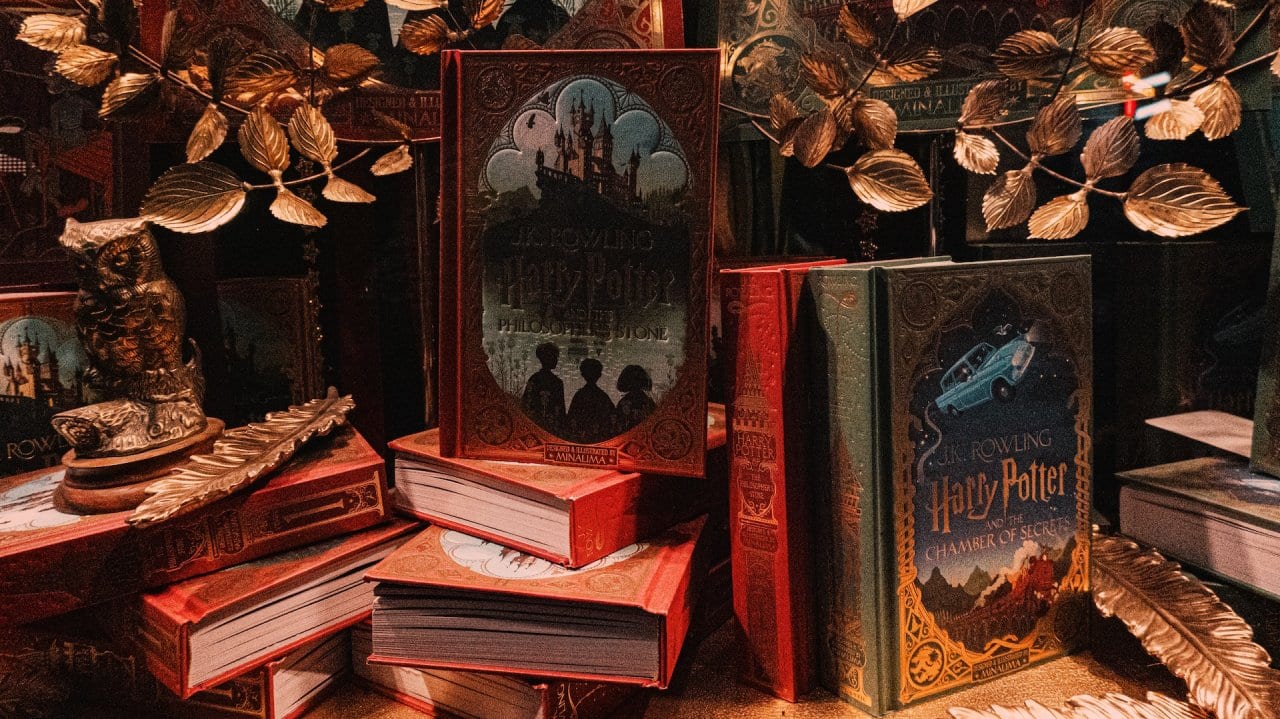 Many have read each Harry Potter book several times. (Photo by Samuel Regan Asante via Unsplash)
In the last few years, Rowling has been at the centre of various public rows about the wokeism and cancel culture dividing the West. She has faced rape and death threats and even the three principal actors in the Potter films—Daniel Radcliffe (Harry), Emma Watson (Hermione) and Rupert Grint (Ron)—appear to have distanced themselves from her. But she remains unbowed and her books—including the six adult detective novels featuring the social misfit and amputee sleuth Cormoran Strike—continue to be bestsellers.
There has never been a phenomenon like Harry Potter in the history of publishing and certainly not such a rags-to-riches story as Rowling’s. She has said several times that she had hit rock bottom in her life when she began writing. “But I still had a daughter, whom I adored, and an old typewriter and a big idea. So rock bottom became the solid foundation on which I rebuilt my life.” Her own real-life story seems as fantastic as Harry’s.
The world has much to be grateful to Rowling for. Singlehandedly, she widened the horizons for children all around the planet. And once the vistas open up and imagination is awakened, they cannot be shuttered.
Discover the latest Business News, Sensex, and Nifty updates. Obtain Personal Finance insights, tax queries, and expert opinions on Moneycontrol or download the Moneycontrol App to stay updated!

Find the best of Al News in one place, specially curated for you every weekend.
Stay on top of the latest tech trends and biggest startup news.