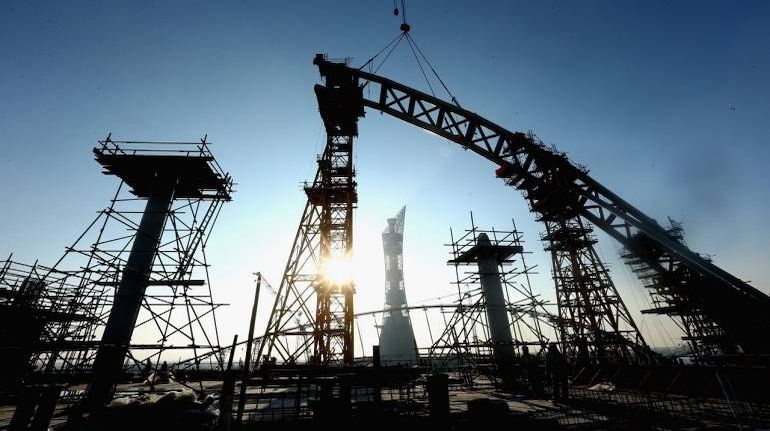
The 2022 World Cup finally kicked off in Qatar, amidst a fog of allegations involving FIFA corruption, human rights abuses, and maltreatment of migrant workers. Not to mention a distressingly outdated attitude summed up by the Qatari World Cup ambassador who proclaimed that homosexuality is “a damage in the mind”.
 Read more FIFA 2022 stories here
The World Cup is another milestone for a territory that has undergone several transformations in a comparatively short time. Originally a land of Bedouin nomads and fishing villages, it grew into a maritime kingdom, was remodelled into a British protectorate, and then emerged as an oil and gas-fuelled Gulf state.
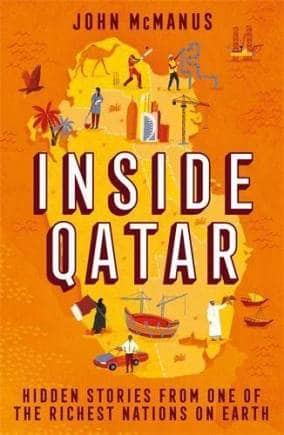
What is life like for those in Qatar today? That is what anthropologist and writer John McManus writes about in Inside Qatar: Hidden Stories from One of the Richest Nations on Earth. It deals with the people and places he came across during his year in Doha as a visiting fellow at Qatar University – an unpaid position, he hastens to add.
Among those whom McManus talks to are labourers, housemaids, IT consultants, teachers, PR managers, sports coaches, and – inevitably – taxi drivers. Almost all are from other countries, not surprising when you consider that 85 percent of Qatar’s population of three million comprises migrant workers. He also meets some Qataris, “the privileged few who struggle to make sense of the conservatism, opulence and diversity that is all around them”.
As with many other countries, there’s an informal status hierarchy. This is explained to McManus by a barista from Nepal. At the top, “of course, the Qatari”. Second: those from European countries and the US. Third: other Arab countries. “Fourth is Philippines,” the barista continues. When asked why, he replies: “Because their government is strong. The embassy is strong.” The fifth and last: “Always Nepal, India, Sri Lanka.”
The stories of many people McManus encounters reveal the human cost of global inequality. A manual worker from India with “a nasty-looking gash of around nine inches tracing up his inside arm” asks him for money for a flight back home. A Sri Lankan taxi driver has to work at least twelve hours a day, seven days a week. A West African migrant once employed in an oil company is desperate to upgrade his skills. Domestic workers from the Philippines are often overworked, exploited and unfairly dismissed.
The deck seems stacked, with the sponsorship system, unhygienic living quarters, impounding of passports, and wage theft. For McManus, the application of laws to check private contractors and enterprises is “less important to the Qatari government than its symbolic function of showcasing Qatar as being modern and on a path to reform”.
Yet, such workers are the grease that lubricates the system. Even at a falconry show presented as a solely Qatari pursuit, he finds that Bangladeshi helpers feed and water the birds, Indian veterinarians and anaesthetists give them endoscopies and injections, and Sri Lankan and Nepali staff patrol the tents and clean bird droppings.
It’s worth keeping in mind that, as McManus points out, labour abuse and other inequities are not exceptional to Qatar. Rather, “Qatar is simply a stark example of the perniciousness of contemporary global capitalism”. The country’s huge global holdings -- stakes in the Empire State Realty Trust, Canary Wharf, Harrods, and Sainsbury’s, for example -- and arms sales by the US and UK show just how enmeshed the system is.
Moving from work to play, it’s not just football that people in Qatar are enthused by. Cricket could well be the country’s best-loved sport, given the preponderance of people from South Asia. Drive around Qatar on a weekend morning, says McManus, and you’ll see hundreds of matches being played on scrubland and other impromptu pitches.
For the average Qatari, though, cricket “is just for Indian or Pakistanis,” laments the president of the Qatar Cricket Association. At a time when Qatar is trying to brand itself as a global sports hub, “the riches bestowed on events in golf, football, tennis -- even MotoGP -- stand in stark contrast to the neglect of cricket”.
This attitude is linked to the question of what it means to be a citizen of Qatar. With oil wealth and Arab nationalism, legacies of trading links with South Asia and British colonialism are downplayed. Tribal and patriarchal family bonds are important, and citizenship laws and cultural codes mean that diversity is managed through segregation, not integration.
The country’s patchwork of camps and compounds, writes McManus, reflects a deep fear: “if the elaborate sifting by ethnicity, race or gender is threatened -- if mixing is allowed -- then what is uniquely ‘Qatari’ will slip away.” This leads to small-c conservatism with traditional customs of falconry and dress, for instance, to maintain “familiarity amid all the flux”.
To keep pace with the outside world, much has been spent on positioning the country as a cultural and intellectual hub. Qatar’s events calendar encompasses literary, music and performing arts festivals, and much more. With Al Jazeera and the BBC-Doha Debates, it has tried to showcase itself as a centre for open dialogue. Yet, McManus says, “flick through the papers in Doha or turn on the car radio and the country’s stance on openness takes on a very different hue”.
Freedom of speech is restricted, and newspapers are full of official press releases. Penalties for crossing the line are harsh and there’s a culture of compliance, with public relations ruling the roost. As one official tells McManus: “You have the ability to literally call up any paper and get an interview or a feature article or a press release published without needing to pitch a story, just because you are a government entity – not even a government entity but a local company.”
 That being said, McManus points out that Qatar’s rank of 128 out of 180 in the 2021 World Press Freedom Index may be behind Hungary, Uganda and Afghanistan, but is ahead of India and Turkey. He also quotes anthropologist Neha Vora in saying that “there is a particular brand of Western academic who, normally with no knowledge of the Middle East, looks critically on projects like Education City [a multi-university campus] while remaining oblivious to their complicity in forms of exclusion and orientalism back home”.
Those from the West, typically well-remunerated employees of banks and consultancies, are especially visible in the country’s ritzy malls, golf courses and hotels. They enjoy the pleasures of Qatar “while disavowing their complicity in the racialised segregation that defines the place…[with] the preternatural ability to feel superior to Qataris while engaging in an obsequious chase for their patronage”.
Some, whether citizens or migrants, are trying to make a difference. McManus meets Maggie, a domestic worker from the Philippines, who brings together those like her to combat isolation and share information; and Wardah Mamukoya from India, who co-founded a collective to redistribute surplus food and recycle food waste.
There are others who try to create greater awareness of climate change, to which Qatar not only contributes, but is very vulnerable. José Saucedo of the Doha Environmental Actions Project organises beach clean-ups to highlight the menace of plastic pollution, and Neeshad Shafi of the Arab Youth Climate Movement lobbies government entities for solutions.
More than once, McManus emphasises that Qatar certainly doesn’t have a monopoly on exploitation, pollution and inequality. Rather, it is a place where these are more readily evident. That being said, if the test of a humane society is “how you look after your most vulnerable…Qatar absolutely fails”. In today’s world, not many countries pass.
Discover the latest Business News, Sensex, and Nifty updates. Obtain Personal Finance insights, tax queries, and expert opinions on Moneycontrol or download the Moneycontrol App to stay updated!
Find the best of Al News in one place, specially curated for you every weekend.
Stay on top of the latest tech trends and biggest startup news.