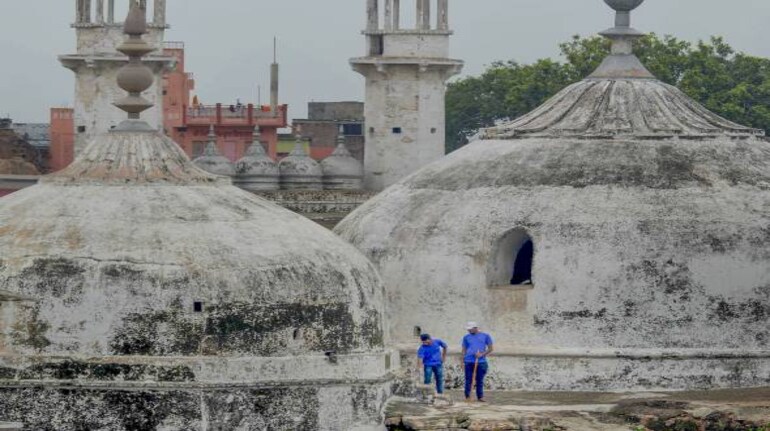
On February 27, the Hindu side filed a plea in the Supreme Court that it be heard before taking a decision on a likely plea to be filed against a recent Allahabad High Court order allowing puja in a cellar in a restricted area of the Gyanvapi mosque in Varanasi.
The Allahabad High Court judgment, which was passed on February 26, dismissed an appeal by the Gyanvapi mosque committee against a Varanasi district court order allowing Hindus to offer prayers in the restricted area called Vyas Ka Tehkhana.
However, this order is just one facet of the larger ongoing legal dispute between the mosque’s committee and a bunch of devotees of deities allegedly inside the mosque premises.
It has been argued for many years that the mosque, which was built in the 17th century by Mughal emperor Aurangzeb, sits on what was once the Kashi Vishwanath temple. At the heart of this dispute is a 33-year-old law that prevents legal cases of this nature.
Moneycontrol explains what the dispute is about, what has been argued, and what is pending in the Supreme Court.
The Gyanvapi disputeThe first suit filed in the dispute in the recent past was in 1991, seeking a declaration that the Gyanvapi mosque is the property of the ancient idol of Swayambhu Lord Vishveshwara and its devotees. It sought to restrain the mosque management from interfering with the rights of Hindus to conduct religious ceremonies and sewa pooja and remodel or reconstruct the mosque into a temple.
This case did not progress due to the Places of Worship Act, 1991, which was passed around the time of the Babri Masjid dispute. The act states that the religious character of a place of worship will continue as it existed on August 15, 1947.
In 2021, five women filed a suit in a Varanasi court seeking an order to be allowed to perform all rituals of Maa Shringar Gauri, Lord Ganesha, Lord Hanuman and other deities, which they claim exist inside the Gyanvapi mosque site. The court appointed an Advocate Commissioner to survey the disputed Gyanvapi site and submit a report.
The Allahabad High Court refused to set aside the order of the Varanasi court and the case ultimately reached the Supreme Court, where it is pending.
In 2023, the Varanasi court allowed an archaeological survey of the premises, and this matter also reached the Supreme Court. However, since the survey was not stayed, it was conducted in 2023 and the survey report was published on January 25, 2024.
In December 2023, the Allahabad High Court rejected pleas by the mosque committee challenging the maintainability of suits filed on the issue owing the Places of Worship Act and against the archaeological survey of the premises. Orders by the Allahabad High Court and the Varanasi court are currently under challenge before the Supreme Court.
What has been argued?Of the three main suits filed in the case, only the 1991 suit seeks that the land on which the Gyanvapi mosque is situated be declared as the property of the idol of Vishveshwara. The other two sought permission to pray to idols situated in the mosque complex.
The 2022 suit filed by Rakhi Singh and others sought the court’s permission to perform rituals to the idols of ‘Maa Shringar Gauri,’ which are allegedly in the other walls of the complex. Similarly, the 2023 suit filed by Shailender Pathak sought permission to pray at the Vyas Ka Tehkhana.
According to the mosque committee, the suits question the religious character of the mosque. The committee’s primary argument has been that the Gyanvapi mosque has existed in the present site for more than three and a half centuries - much before India's independence in 1947 - and hence the Places of Worship Act bars any litigation.
"It is a historical fact, and no dispute can be raised as to the continuous use of the mosque by the Muslims of the area,” the committee said.
According to the committee, the Kashi Vishwanath Temple is adjacent to the mosque and the temple administration as well as the mosque management have historically been acknowledging each another, including mutual agreements of land exchange for convenience.
What is pending in the Supreme Court?Three appeals against the Allahabad High Court's judgments are pending in the Supreme Court as of February 29.
The first petition filed in 2022 challenged the appointment of an advocate commissioner to survey the mosque.
The second filed in 2023 challenged the Allahabad High Court order to conduct the archaeological survey, and the order holding that the 2022 suit was maintainable despite the Places of Worship Act.
The third plea challenged a total of four orders of the Allahabad High Court from 1998 to 2021, holding that the 1991 suit was maintainable under law.
Discover the latest Business News, Sensex, and Nifty updates. Obtain Personal Finance insights, tax queries, and expert opinions on Moneycontrol or download the Moneycontrol App to stay updated!
Find the best of Al News in one place, specially curated for you every weekend.
Stay on top of the latest tech trends and biggest startup news.