





Jasdeep Dhillon took up the cause, pro bono, of a victim who lost his life in a road-rage incident in Delhi back in 2017. Initially believed to be a road accident, when the facts of the case emerged hinting at a possible murder, Dhillon was approached by the family of the victim. The lawyer took up the case pro bono, that is to say, he volunteered to provide free legal assistance.
Dhillon is also one among many lawyers who volunteered their services free for several protestors who participated in the farmers’ agitation in 2020-2021 and slapped with criminal charges. “The aim (to provide legal aid) is to also offer help to society and not just engage in corporate cases to make a living,” says Dhillon.
There are many like Dhillon. Sushant Mahajan has been rendering legal aid for roughly five of the six years that he has been practising law in Delhi. Aman Wadud, who has a legal practice in Assam, has made a conscious decision to dedicate 90 percent of his time to pro bono work. Ashutosh Dharmadhikari, a lawyer practising in Nagpur for over thirty years, has provided legal advice to hundreds of non-paying clients over the years.
The tribe of lawyers rendering legal aid, or legal services without any charge, has been growing.
Why pro bono?
Legal aid as a term is loosely used to refer to legal services provided without any charge, or, pro bono. There are various modes through which a lawyer can render legal services free of charge, either on an individual level, through organizations carrying out social work, or through the legal service committees set up under a statutory framework.
For most aspiring lawyers, their first encounter with free legal services happens during their time spent at law school. Across the country, most institutes offering full-time law courses not only run legal aid or allied programs on the side but encourage students to volunteer and partake in these activities. The college-run legal aid centres offer a degree of practical knowledge in advocacy for marginalized sections and occasionally may conduct training sessions for lawyers-in-the-making.
For any legal case to reach its logical end, the time taken is painfully long. The inability to afford a lawyer’s services for such long processes often not only intimidates but also deters people from attempting to take legal recourse for the execution of their rights. A large section of society also lacks the knowledge of what their rights are. To make people aware of their rights, legal awareness and advocacy programs and camps assume importance. To exercise those rights, affordable legal services are crucial.
While a few lawyers in the making are drawn to legal aid services at law school, many others venture into such work during the initial years of their legal practice.
Legal aid work as a stepping stone
“Some people opt to provide legal aid because they don’t have any legal work and one needs experience to get more work in this profession,” says Ashutosh Dharmadhikari. “And it’s not a bad thing… sometimes we need an opportunity and providing legal aid can give that opportunity.”
While it is a stepping stone for some to gain experience and advance their careers, for others, it comes from a sense of responsibility and moral obligation.
Drawing from his experience, Mahajan says: “Legal aid cases also help younger lawyers get a fair share of a chance to appear and argue before the courts.” Appearances before courts help lawyers secure recognition and, in turn, get more cases to build the practice. So, naturally, a chance to display legal prowess before the court is critical for any budding lawyer.
The statute governing formal and systemized free legal services puts in place certain eligibility criteria on who can avail free legal aid from the committees set up. However, for individuals volunteering pro bono work of their own accord, there are no limitations on the kind of cases they may take up. Right from securing bail for undertrial prisoners in criminal cases to fighting cases for protection of victims of domestic violence to sometimes taking up causes for the protection of fundamental rights of citizens, there is no limit.
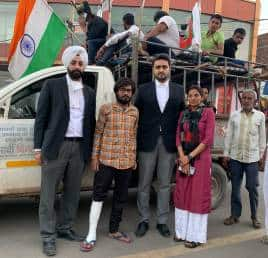 Jasdeep Dhillon (left) with labour rights activists Shiv Kumar and Nodeep Kaur after their release from custody during farmers' protest
“I sustain myself on 10 percent of the cases I take up,” says Wadud, who has made a conscious decision to dedicate 90% of his time to pro bono work. Wadud’s practice is based primarily in Assam, where he offers pro bono services for the cause of citizenship rights.
“Citizenship is the most basic right from which other rights emanate… and when this very basic right is in danger, the stakes are simply too high to not offer legal services pro bono,” Wadud says, explaining the rationale for his decision.
While Wadud champions the cause of citizenship rights, he says that even in other cases where monetization is not possible, it is the “responsibility of lawyers to render legal services free of charge.”
Dharmadhikari weighs in on the ethical responsibility of lawyers to say that a client ideally must never be turned away because of their inability to pay fees. “My associates and I decided to follow an ethic that anyone who comes to us for help does not go away without any,” he says. Through the three decades of his practice in Nagpur, Dharmadhikari has never turned a client away regardless of whether they can pay the fees or not.
It is the same for Anas Tanwir, who says he learnt from his grandmother to never refuse help to a person in need. This has shaped the way Tanwir carries out his legal practice, dedicating a majority of his time to pro bono work. Getting exposed to the need for legal aid early on in life, Tanwir now also runs an organization providing free legal services. Much like Wadud, Tanwir, too, has made a conscious choice to engage in cause-based lawyering even if it means his earnings shrink.
 Anas Tanwir holding a camp for raising legal awareness about NRC in Assam
Not without challenges
Regardless of the intent behind taking up legal aid work, the choice comes with challenges that go hand-in-hand with the positive aspects.
According to Anil Jaryal Thakur, a Delhi-based lawyer, mere recognition as a legal aid lawyer by courts can feel professionally rewarding. On the flipside, Wadud believes that cause-based lawyers often fall prey to being “branded” for doing only one type of case. “You are often not the first choice as a lawyer where other types of cases are concerned,” adds Wadud.
 Aman Wadud says that cause-based lawyers often get "branded"
Tanwir points out that sometimes establishing goodwill and trust with clients can be challenging as clients may be apprehensive about the quality of the service offered simply because it is “free”.
Moreover, financial constraints can play a huge role in discouraging lawyers from continuing legal aid work. Actively engaging in more pro bono work tends to affect practitioners financially. The “ethical charm” may sometimes wear off if sustenance of the lawyer becomes difficult, says Tanwir.
And yet, many lawyers, young and old, keep at it. Asked why this is so, Tanwir has a simple theory: “Because there are some genuinely good people out there.”
Shouldering a big responsibility
Dharmadhikari recounts being engaged in a criminal case concerning charges of left-wing extremism. A tribal youth killed in Maharashtra’s Gadchiroli region during an operation was labelled a Naxalite. After months of litigation, the deceased tribal’s name was eventually cleared of the allegations of Naxal involvement.
“We cannot bring the dead back but the least we can do is help the family get the dignity they deserve,” Dharmadhikari says. For lawyers, these are cases, but for stakeholders, these court rulings or even the legal processes are sometimes all-consuming.
According to Govind Manoharan of Godiyal and Manoharan Chambers, regardless of the reasons for which a lawyer takes up pro bono work, the standard or quality of the services must be high.
“Considering that the level of responsibility to be shouldered in pro bono cases is extremely high, young lawyers must not shy away from taking help and being led by more experienced lawyers. (This is) because for the clients that cannot pay, it is a complete leap of faith that they are taking,” Manoharan says. The relationship between the client and the lawyer in such cases “is based exclusively on trust”, he adds.
In a lawyer-client relationship, a fee is a basis on which a client can hold the lawyer accountable for the services. In pro bono cases, this medium of accountability is removed, placing greater responsibility on lawyers to ensure that they adopt a very serious approach towards the case, Manoharan explains.
This thought resonates with Thakur, who says that the high level of responsibility makes legal aid cases that much more demanding. Thakur, who has had a private practice of his own for about six years, has been empanelled with the Delhi High Court Legal Service Committee (DHCLSC) for the past year. Among his duties as a panel lawyer, he is required to conduct prison visits in Delhi’s central prison at Tihar on two days every week to render legal aid to prisoners eligible for it. With the legal aid committee duties streamlined, Thakur says he has to work around the time he has for his private practice to strike a balance.
For some others, a balance has to be struck between means of sustenance and legal aid duties.
Systemizing legal aid
The Legal Services Authorities Act of 1987 put in place a formal structure to help people from low-income groups and marginalized sections get free legal assistance. Legal services committees are constituted at district, state, and national levels, and lawyers are appointed to be on the panels of these bodies to render services. The beneficiary of the service pays no charge and the empanelled lawyer draws a nominal fee, which is disbursed from designated funds.
The process for lawyers to get empanelled on these committees involves several steps and is presumably detailed to ensure there is a certain degree of quality in the service provided by them.
But considering that the monetary returns from this practice are nil or nominal, why would lawyers want to get empanelled? “Empanelment with legal aid committees opens the doors for budding and committed lawyers to expand their area of work in various domains of law and gives them access to new clients and (legal) briefs to build a practice,” says Mahajan.
This is equally true for those offering free legal services through private organizations, NGOs, or even at an individual level.
Thakur adds that exposure to varied cases through legal aid offers a sharp learning curve for lawyers. “With every case, you can see yourself grow as a lawyer and the scope to learn is immense.” One can truly understand the intricacies of the legal and criminal justice system with the kind of exposure legal aid cases give law practitioners.
By formalizing legal aid, the legislation has not just opened avenues for lawyers to hone their skills but has taken a giant leap in the direction of ensuring access to justice is not denied to those who cannot afford legal help. The systemic approach towards free legal services is slowly but surely bridging the gap between the courts of law and the weaker sections of society.
Discover the latest Business News, Sensex, and Nifty updates. Obtain Personal Finance insights, tax queries, and expert opinions on Moneycontrol or download the Moneycontrol App to stay updated!

Find the best of Al News in one place, specially curated for you every weekend.
Stay on top of the latest tech trends and biggest startup news.




