






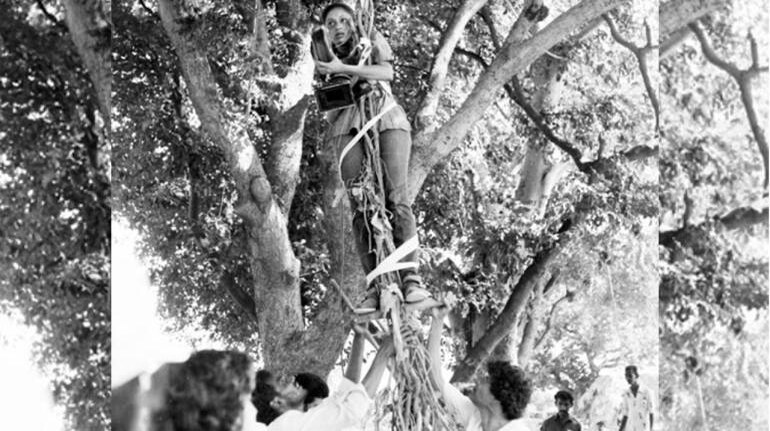
When BR Vijayalakshmi hoisted herself and an Arriflex 2C on to the roots of a banyan tree in 1988, the young cinematographer was also rising above stereotypes about a woman’s place on the movie set.
The 1988 Tamil film Therkathi Kallan’s lead stars were going to oscillate Tarzan and Jane-style in rural Tamil Nadu for a song, and the film’s makers wanted Vijayalakshmi to be tree-borne, too. There were many ways to execute that shot, but the dance director had his heart set on filming from the rope-like roots. “A cinematographer has to translate the director’s vision on the screen. You can’t say no to risks. Especially if you are a woman, or they will say you are refusing because you are a woman,” the cinematographer says over the phone from Chennai.
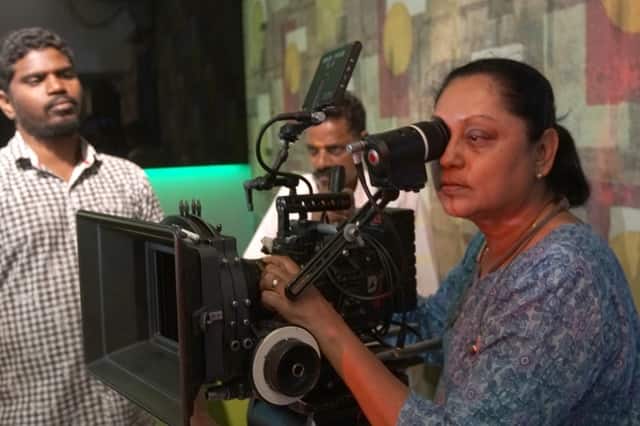 Cinematographer BR Vijayalakshmi on a shoot, years before she quit the film industry. (Photo courtesy BR Vijayalakshmi)
Revisiting the film today, the lyrics that play during the scene strike one as befitting. “Ambala pozhappu pombala paaka mudhiyaadhaa (Why can’t a woman do a man’s job)?” Vijayalakshmi had been doing what was considered a “man’s job” since 1985, when she became India’s — and Asia’s — first woman director of photography. Before that, women seldom got access to technical roles, camera work in particular, as it was believed men uniquely possessed the muscle required for handling equipment.
In the following years, that theory has been rubbished by the achievements of women in the field, who show that cinematography is not so much about physicality as about having an artful eye. Most recently, there is Kartiki Gonsalves who, apart from directing The Elephant Whisperers, is among this Oscar-nominated short film’s four cinematographers. Or take Zee5 series Naxalbari-fame Modhura Palit, a 2019 winner of Cannes’s Angénieux ExcelLens special encouragement award for promising cinematographers, who was named among 2023’s Berlinale Talents.
Today, the membership of the Indian Women Cinematographers Collective (IWCC) has risen to about 150. But prolific as they are, women are a minority in cinematography, estimated to account for no more than 5 per cent of all professionals. This is in line with the global picture. As of 2014, the UK, France, Spain and Italy all had women making up less than 10 per cent of active cinematographers. Only three women have ever been nominated for cinematography so far at the Academy Awards — in 2018, 2022 and 2023.
Fighting to call the shotsWomen come to cinematography through various routes — by default, by accident, by design. Vijayalakshmi, daughter of director BR Panthulu, belonged to a film family but had never handled a camera until cinematographer Ashok Kumar brought her in as a last-minute assistant. Cinematographer Priya Seth had an interest in painting, and decided to combine that with light and film after a high-school internship at UTV. Over the last five decades, women have consistently apprenticed with and assisted male cinematographers but that has not always translated into opportunities to lead cinematography. In fields dominated by men, it is said women have to work twice as hard and be twice as smart to get half as much credit as their male colleagues.
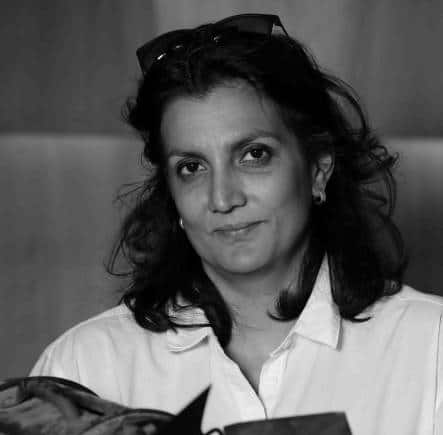 Cinematographer Priya Seth. (Photo courtesy Priya Seth)
Bias in the industry tends to be subtle. “People won't say anything to your face but you just don't get that foot in the door for certain jobs, certain production houses. It leads to so much insecurity and self-doubt. Am I good enough or will I ever be good enough?” says Mumbai-based Seth, who has shot more than 1,000 advertisements and four long-format movies including Airlift(2016), Chef (2017) and the forthcoming Ishaan Khatter and Mrunal Thakur-starrer Pippa. After New York-trained Seth broke into films with the indie Barah Aana in 2009, the world did not open up like she had expected. “I didn’t recognise that, maybe, my gender was a factor. That realisation came only in hindsight, five-10 years ago, when I got older and wiser. I saw that I was not worse than any of my male peers and everyone else got a break.”
Ashwini Kaul, who teaches cinematography at Whistling Woods International, agrees. “The industry is changing with new working environments like Web-series and content in different languages. But it needs to be more receptive,” he says. “There is still resistance in entrusting a woman cinematographer with a full Web-series or ad film or feature film.” He reckons women will not be held back for long. “My students want to shoot and direct their own films. They see themselves as director-DoPs.”
Thanks to a foundation course where they learn to fix camera rigs and patch cables, and a process to reassure parents from outside Mumbai about safety, more women are enrolling at Whistling Woods, says the institute’s president Meghna Ghai Puri. Its technical courses, including the cinematography specialisation, have an average female to male ratio of 40:60. In her observation, women candidates at the film school take a distinctly artistic approach to image-making.
 Cinematographer Sraiyanti Haricharan (Photo courtesy Sraiyanti Haricharan)
In other instances, women have experienced unsubtle bias. When cinematographer Sraiyanti Haricharan was starting out, she shot a film for a male documentarian. As she sat down to adjust the camera for a frog’s-eye view shot, he critiqued her posture. “I asked him: Do you want a shot or to tell me how to sit on the ground?” Kochi-based Haricharan, 29, has since gone on to direct documentaries of her own, which led to a chance to co-shoot Gargi, 2022’s acclaimed Tamil procedural drama starring Sai Pallavi.
Meghana Basavaraju, a documentary cinematographer, has witnessed men struggling to take orders from a woman. On a set she was working on, any time she instructed a crew member to do something, he would cross-check with a male colleague before going ahead. Bengaluru-based Basavaraju, 30, graduated from film school in 2015, as the only girl in a class of 14. There was no hostel for women on campus. “I was put up in a separate flat. But the boys’ hostel is where all the meetings and discussions happened. I had to smuggle myself into the building just so I would not lose out on that.”
Notes on the new cinematographBeing a small and scattered group can feel lonely. So in 2017, women DoPs across the country banded together to form the IWCC. “Everyone wants somewhere to belong because creative work is fragmented and quite isolating. We realised we need to get a pulse of what is going on with female cinematographers,” says Seth, who was among the founding members, together with Fowzia Fathima, director of photography for films such as Mitr, My Friend (2002), directed by Revathy, with an all-woman technical crew. The group offers professional information, personal help and psychological support to members.
The answer to building a secure work environment on set is to have diverse crews. “If there is just one woman in the crew, it is overwhelming,” says Haricharan. In cinema forums, there has been talk of having committees to keep in check any unfair treatment of minorities — based on caste, gender, religion, and class. Diversity also contributes to different-looking films, Haricharan notes. “Our lived experiences, the way we grow up, the things we have seen, are different from men. And the way women cinematographers look at the world very much involves that.”
 Cinematographer Meghana Basavaraju. (Photo courtesy Meghana Basavaraju)
Particularly in documentary scenarios, being a woman can be an advantage, adds Basavaraju. She recently returned from sub-zero conditions, in Kargil, where she was filming girls from conservative Muslim families who play ice hockey for director Nupur Agrawal's next documentary. She has also been a one-person crew walking alongside a female protagonist who was covering the coast from Mangaluru to Kanyakumari on foot. “Other than in aggressively male spaces, I can take the liberty to get really close to the subject. Men don't find me intimidating, women see me as one of them. Whereas men may see another man as a threat, and no woman will feel totally comfortable with a male cinematographer.”
Having quit cinematography for a corporate role now, Vijayalakshmi looks back fondly on her career. The pioneer worked with such southern stalwarts as Mahendran, Fazil, and P Padmarajan, and shot with stars, including Rekha and Jeetendra. Even so, four years into her career, a senior producer had refused to rope her in because he did not think a woman can shoot all alone. “Later, after reading the review for one of my films, that same producer congratulated me and said my work was good.” Another day, another stereotype broken.
Discover the latest Business News, Sensex, and Nifty updates. Obtain Personal Finance insights, tax queries, and expert opinions on Moneycontrol or download the Moneycontrol App to stay updated!

Find the best of Al News in one place, specially curated for you every weekend.
Stay on top of the latest tech trends and biggest startup news.




