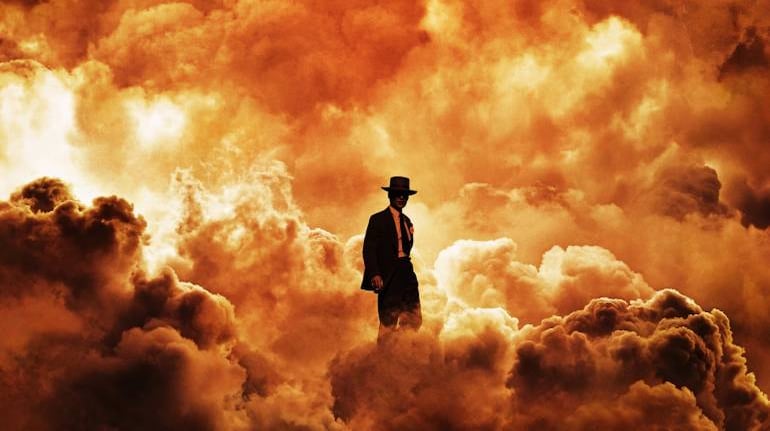
To execute the apocalyptic mushroom cloud for the trinity atomic blast in Oppenheimer, the VFX artists from the visual effects company DNEG decided to go a bit old school. With Christopher Nolan, old school is always a good thing. He is as dead against using computer graphics (CGI) in his movies as he is bullish about using celluloid instead of ubiquitous and easy-to-use digital cameras.
The DNEG artists used an old Hollywood in-camera trick: Forced perspective. Forced perspective is a technique that uses the space between subjects to manipulate the viewer's perception of the space and distance between the two objects to create an optical illusion. "We don't call them miniatures; we call them 'big-atures,'" Nolan explained in an interview recently. It’s set up as big as possible, and then the scale is reduced to make it manageable. The explosion of the atomic bomb, the intense blaze, was a combination of gasoline and propane. Aluminum powder and magnesium were then added to the mixture to mimic the instant blinding flash that so many records say accompanied the nuclear blast. Young techies and VFX art aspirants are trying to replicate it, and it’s a new trend on social media and WhatsApp forwards.
 Merzin Tavaria, president - global production and operations, DNEG.
The DNEG artists and technicians behind the blast in Oppenheimer were in for one of the biggest marvels of their careers. The UK-based VFX company Double Negative became DNEG after it merged with Prime Focus, India’s leading post-production and VFX company that came into being in the mid-1990s and over the course of 15-plus years, became a conglomerate of sorts, also acquiring Ronnie Screwvala’s USL. They currently have 20 studios and offices worldwide, including in Los Angeles, Vancouver, London, Barcelona, Budapest, Sydney, Pune, Bangalore, Trivandrum, Goa, Chennai and Mohali. DNEG has won seven Best Visual Effects Oscars, for Inception (2010), Interstellar (2014), Ex Machina (2015), Blade Runner 2049 (2017), First Man (2019), Tenet (2020) and Dune (2022). They employ around 10,000-plus professionals globally, and their market capitalization figure, as of August 18, 2023, is Rs2,739 crore.
Galvanizing the growth of Prime Focus and witnessing its meteoric success is Merzin Tavaria, who, along with its bullishly innovative and inspired CEO Namit Malhotra and two others formed the company in a garage in the mid-1990s. Tavaria, 50, is now at the helm of managing Prime Focus’s VFX artistry and businesses around the world, a majority of which currently comes from Hollywood. As president, global production and operations, DNEG, Tavaria is at the forefront of influencing and directing how India’s VFX innovation and toil go from here.
Tavaria is a Parsi from Byculla. In the early 1990s, after completing a B.Com degree from KC College, Mumbai, he learnt computers—yes, it was a thing at that time, to pay money to learn computer operation—and then started teaching a software for 3D animation at Compifield, Warden Road. Namit Malhotra—son of Naresh Mahotra, who was already in the films business as producer, renting film cameras and handling post-production—came to study at Compifile to learn the new technology, 3D. “This was a very new age thing at that time,” Tavaria says. With three of his students there, Namit Malhotra, Huzefa Lokhandwala and Prakash Kurup, Tavaria started a “techno-creative” post-production start-up at a garage in the building where Malhotra lived. “At that time, we were consumed in a do-or-die kind of passion. We couldn’t afford to get an Avid, the editing machine that had the latest technology at that time. We edited on Media 100, a cheaper cousin of Avid. It was arduous, footage would sometimes just vanish. But we kept on going, day and night,” Tavaria recalls. “It was Namit’s bullish vision. As CEO, he would commit to the impossible in terms of creativity as well as process and timelines, and we would be gung-ho about implementing it.”
What still sets Prime Focus apart is Malhotra’s same bullishness. “We are sometimes evolving, adapting and innovating week after week. In 2010, we committed to do a difficult 2D to 3D conversion job for the Hollywood movie Clash of the Titans in eight weeks. We recruited 300 people in 10 days for the job—basically anybody who knew fairly well how to use a computer! And the job was done in that time.” Among other conversion jobs that Tavaria’s team has done is for James Cameron’s Avatar.
Tavaria has witnessed, largely through the efforts of his own company, that VFX work by Indian technicians is no longer about doing labour-intensive back-end work. After the acquisition of Double Negative, Prime Focus and DNEG are responsible for all the work from 3D modelling, rigging, animation, effects, rendering, and more. “Even when we started, we did not start like artists. We started like entrepreneurs. I have myself done a lot of VFX work, but I owe my success there entirely to technology. I am not an artist, and you don’t need to be one to be creative. With the right tool, creativity can be achieved. A child with a ruler and pencil will do a straight line for sure, right?”
There’s only one thing constant in Prime Focus’s rise to the top: Every few years they have reinvented. If there was anything new, they would jump into it. At this point in film history, like everything else in human civilization, artificial intelligence (AI) is the disruptor and Tavaria is confident AI will teach them something they don’t know yet. “AI is already being used in a lot of our work in visual effects, animation, stereo conversion, virtual production, art, motion graphics as well as visualization. But the momentum is big and we expect lots to change. It will require restructuring, somewhere down the line, in a few months or years, I don’t know yet.”
Tavaria says even the most sophisticated AI tools need human execution, so the roles of people in VFX companies is set to change. The biggest advantage will be minimizing timelines for processing. Sometimes a small VFX job can take up to 10 hours. AI is set to change that. “With talent, even now, we train newbies for our jobs. And sometimes after the training period, they leave for better opportunities. So we wanted to take ourselves to smaller cities where we hire talent and give them jobs there. In places like Chandigarh, Chennai, Goa, we are working with locals. And the same with our international operations,” Tavaria says.
 The company's next big Bollywood project is Brahmastra 2.
He believes what it means to be a VFX professional or artist in India today is to up their visual intelligence and ideas for innovative visualization so much that their jobs can’t be automated. That’s not just hard, but it can be an impossible route for beginners. “Fifty to 60 percent of our workforce are in high-end creative jobs. The end product in VFX is as dependent on technology as on the person executing that technology to create the effect. Sometimes, the creative vision of the person in charge is impossible to miss. How can AI automate that?”
Prime Focus started its VFX wing only in 2002, next to its headquarters in Khar, Mumbai. Tavaria took 10 people away from the parent company and started it. The work piled up immediately, and in a few years, they started working with Double Negative talent on Hollywood projects. What started with ads, TV serials and music videos in the 1990s, became a VFX conglomerate and Prime Focus went public in 2006. In 2008, recession hit, and the stock never found the euphoric rise that the company has otherwise managed. The stock was trading at Rs 90.70 at end of trade on August 18, 2023.
In 2015, Prime Focus took on the second-largest VFX-driven cinematic spectacle to have come out of India, Dharma Productions’ Brahmastra, directed by Ayan Mukerji. The first was Bahubali, which had VFX that can match the best in the world—by Pete Draper, at the Hyderabad-based VFX studio Makuta. DNEG was part of the team of RRR.
“There is of course the realization that big budgets play the most important role in VFX, and Indian producers will have to be willing to put in that kind of money. That’s why, so far, homegrown projects driven by VFX is not so common in our film industries,” Tavaria says. Indian projects now contribute 5-10 percent of their business.
Brahmastra 2 will be their next big project. Malhotra is also producing what’s being touted as the most expensive Indian film, Ramayan, with an estimated budget of Rs750 crore. Ramayan is a culmination of Prime Focus’s—and its CEO’s—“techno-creative” journey. “We never had a five-year plan. I am hooked to the constant roller-coaster. Technology is disruptive, and that keeps us going. The next decade will be momentous for VFX in India,” Tavaria says.
Discover the latest Business News, Sensex, and Nifty updates. Obtain Personal Finance insights, tax queries, and expert opinions on Moneycontrol or download the Moneycontrol App to stay updated!
Find the best of Al News in one place, specially curated for you every weekend.
Stay on top of the latest tech trends and biggest startup news.