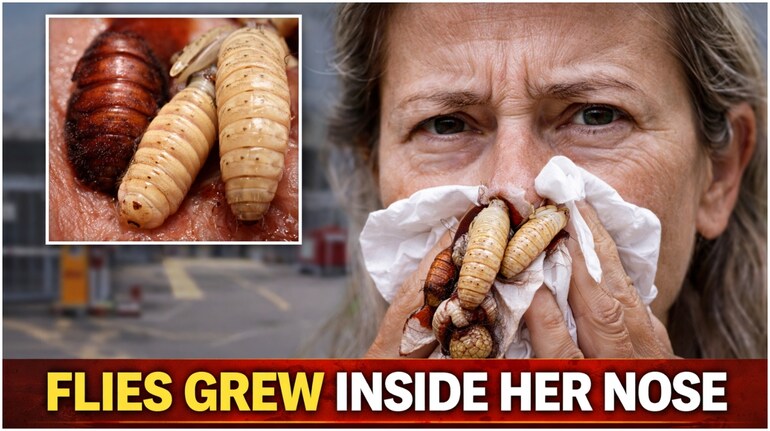
A 58-year-old woman in Greece has become the subject of an unusual medical case after researchers identified multiple developmental stages of a parasitic sheep bot fly within her nasal cavity, including a pupal form previously considered highly unlikely in humans.
The case, documented in the journal Emerging Infectious Diseases, was examined by a team led by Ilias Kioulos, a medical entomologist at the Agricultural University of Athens. Their findings challenge long-standing assumptions about how far the parasite can develop in accidental human hosts.
The sheep bot fly, Oestrus ovis, typically targets sheep, depositing larvae in the animals’ nostrils. In their natural host, these larvae migrate into the sinus passages, where they feed, grow, and progress through successive developmental stages before exiting the body to complete their life cycle in soil.
Historically, it has been understood that when humans are exposed, the larvae rarely progress beyond the earliest stage. However, in recent years, isolated reports have described more advanced development. The Greek case extends this further, with researchers identifying not only late-stage larvae but also a pupa and a puparium — the hardened casing associated with this stage.
According to the report, the woman worked outdoors on a Greek island in proximity to grazing livestock. She recalled being surrounded by flies on a particularly hot and dry day in September.
Approximately one week later, she began experiencing facial discomfort. Over the following two to three weeks, she developed a cough but reported no other significant symptoms during that period.
In October, the situation escalated when she sneezed and observed what she described as “worms” emerging from her nose. These were later confirmed to be advanced-stage larvae of the sheep bot fly.
Medical intervention followed, during which surgeons removed a total of ten larvae at different stages of development, along with a pupa. Laboratory analysis, including genetic testing and DNA sequencing, confirmed the species as Oestrus ovis. Visual examination also identified two third-stage larvae and the puparium.
The presence of a pupa in a human nasal cavity is particularly notable. Researchers stated that such development had previously been regarded as “biologically implausible”.
Explaining this view, the authors wrote: “The paranasal sinus environment does not meet temperature and humidity requirements for pupation, and host secretions, immune responses, and resident microbiota create a hostile milieu for pupal development.”
Despite these constraints, the parasite in this case progressed further than expected. The research team proposed possible explanations, including the initial number of larvae and anatomical factors unique to the patient.
“From a purely anatomic perspective, we hypothesize that the combination of high larval numbers and septum deviation impeded normal egress from the nasal passages, permitting progression to the [third larval stage] and, in 1 instance, pupation,” the authors wrote.
In practical terms, this suggests that the volume of larvae, combined with a significantly deviated nasal septum, may have restricted their exit, allowing some to remain in place long enough to continue developing.
The researchers also raised the possibility, though not confirmed, that the species may be adapting in ways that allow for extended development in human hosts.
They noted that the outcome could have been more severe. In animals, when advanced larvae become trapped in the sinus cavities, they may deteriorate in place, potentially leading to complications such as secondary bacterial infections.
In this instance, the woman received timely treatment, and the organisms were successfully removed.
The authors concluded by advising clinicians to remain alert to such infections, particularly in regions where livestock exposure is common, noting that sheep bot flies are distributed widely across different parts of the world.
Discover the latest Business News, Sensex, and Nifty updates. Obtain Personal Finance insights, tax queries, and expert opinions on Moneycontrol or download the Moneycontrol App to stay updated!
Find the best of Al News in one place, specially curated for you every weekend.
Stay on top of the latest tech trends and biggest startup news.