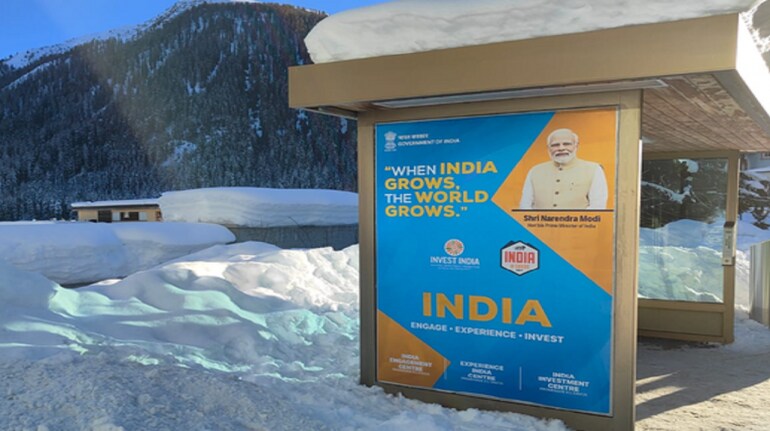
S4 Capital's Martin Sorrell is not alone in expressing optimism about India's growth trajectory at the World Economic Forum (WEF) in Davos. The gathering of global leaders has become a focal point for assessing the potential, opportunities, and challenges that await in India's economic landscape.
Despite an air of pessimism prevailing among policymakers and global corporate leaders due to ongoing geopolitical risks, inflationary pressures, and rising interest rates, many have highlighted the underlying fundamentals that favour India's growth.
“There is a lot of optimism about India. If you look at the fundamentals like demographics, easing inflation, spending power, export, service sector, a lot of things are going strong for India. There is confidence among people, which is driving the growth,” said Ling Hai, President, International Markets at Mastercard.
PwC chairperson Bob Moritz put spotlight on India’s massive digital infrastructure especially in areas like banking, healthcare and education.
“India prepared previously for the digital revolution and that's going to help it take a next leap forward with AI,” he said.
“The reality is the country actually has put in a tremendous amount of infrastructure…That's starting to come through right now and solidifies the foundation whereas other countries are not as fit for purpose as where India is right now. AI is really good in terms of speed and scale. And if you think about the scale, you have India. It will be very much additive… which I think solidifies the confidence level that we have for India as a country,” he added.
On December 18, the International Monetary Fund (IMF) said it expected India's growth “to remain strong, supported by macroeconomic and financial stability”, projecting that the country's gross domestic product (GDF) will expand by 6.3 percent in the financial year between April 2024 and March 2025.
Advertising guru Martin Sorrell added that amid the geopolitical issues involving the US and China, the Russia-Ukraine situation, and the intense conflict in the Middle East, India has emerged as the go-to market and an alternative to China in Asia.
“Three of the top five countries will be in Asia by 2050. India will be at number three. Countries like Japan will continue to be important but India, Indonesia, Vietnam, Thailand, Malaysia, among others is what I call the new Asia which is really coming to perform,” he added.
Tapping on India’s burgeoning consumers, global firms like Ikea have announced to bring down prices for its products in the market.
“We planned to invest Rs 10,500 crore which we have done already. We have achieved 50 percent gender equality. So, we had promised to source 30 percent locally which we have achieved. So, up to now, the step number one has been achieved which is to prove that India loves IKEA and IKEA loves India. And we are now moving to the next phase where we really want to expand." Juvencio Maeztu, Deputy CEO and CFO, Ingka Group, the company that runs IKEA, told Moneycontrol.
Meanwhile, Chip War author Chris Miller is expected to meet Union Minister Ashwini Vaishnaw at Davos to talk about India’s semiconductor strategy.
He said India needs to develop its own profitable semiconductor firms that become world leaders and can keep investing in chips for the long-term rather than just depend on government subsidies.
On Davos grounds, India left no stone unturned to reinforce its status as a preferred investment destination. Themed as ‘Credible India’, it has four dedicated spaces, including India Investment Centre designated for Government-to-Business (G2B) and Business-to-Business (B2B) networking, hosting roundtables, and facilitating sessions.


Discover the latest Business News, Sensex, and Nifty updates. Obtain Personal Finance insights, tax queries, and expert opinions on Moneycontrol or download the Moneycontrol App to stay updated!
Find the best of Al News in one place, specially curated for you every weekend.
Stay on top of the latest tech trends and biggest startup news.