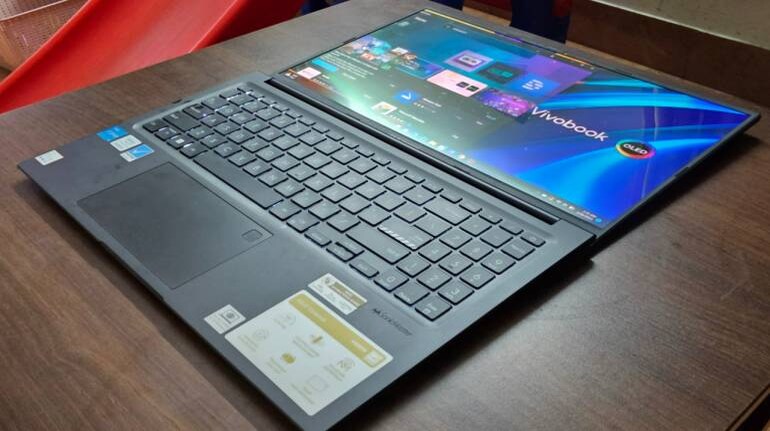
The Asus Vivobook laptop series has always provided users excellent value for money. However, in the last year or so, Asus has been pairing its value-added Vivo laptops with vibrant OLED displays, delivering budget laptops with some of the best screens in the business.
And a perfect example of this excellent combination is the Vivobook 15 OLED. With a price tag of Rs 49,500, the Asus Vivobook 15 OLED brings a ton of excellent features in an affordable package. But can it cut it in a highly competitive sub-50K laptop market? Let’s find out!
Design
In terms of design, the Vivobook 15 OLED features a standard design that is not too dissimilar from Vivobook of the past. The notebook comes in a single matte Indie Black colour option that looks sharp but was quick to pick up fingerprints and smudges. Considering its affordable pricing, the Vivobook 15 OLED uses a plastic chassis that feels sturdy, so if you are worried about the laptop feeling cheap, don’t be. Additionally, there’s a MIL STD 810H standards for some durability, although we didn’t feel the need to test it.
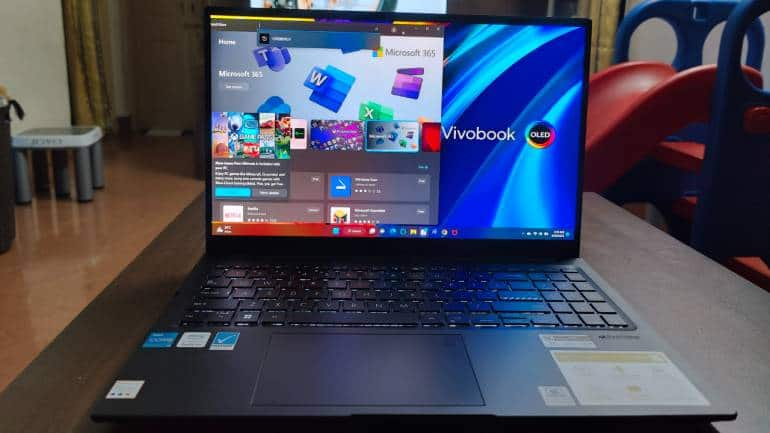
The Vivobook 15 OLED weighs around 1.7kg and measures just under 20mm thick. While the laptop is on the chunkier side, it isn’t too heavy for use on the move. The laptop has the Vivobook logo on the lid, which, which is made of metal, although there was considerable flex on the screen. Speaking of the screen, it does go back 180 degrees. For an affordable consumer notebook, the Vivobook 15 OLED is well-built but doesn’t stand out in terms of design.
Ports
The new Vivobook OLED laptop has a ton of ports, there are two full-size USB Type-A ports on the left. All the rest of the ports are located to the right of the laptop, these include a USB Type-C port, another USB Type-A port, a 3.5mm audio jack, a MicroSD card slot, an HDMI port, and a power output.
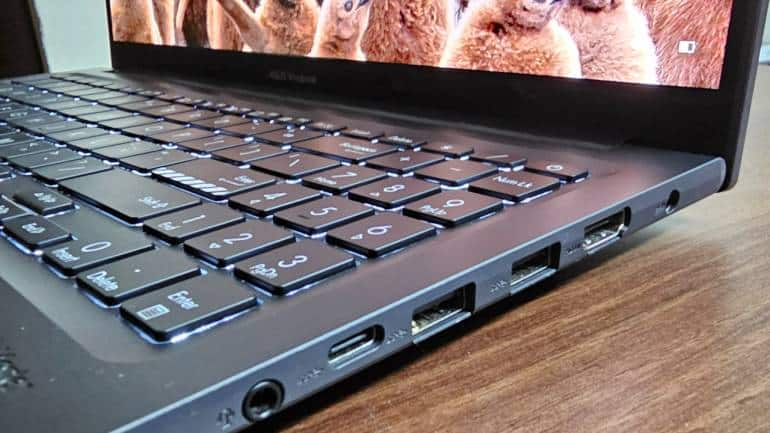
Wireless connectivity options on the laptop include Wi-Fi 6 and Bluetooth 5.0. For a consumer notebook, the Vivobook has a ton of ports, although we wouldn’t mind sacrificing one of the full-size USB ports for another Type-C port.
Keyboard & Trackpad
The new Vivobook opts for a chicklet style backlit keyboard with a large trackpad. The keyboard has three levels of backlight brightness allowing you to easily type in the dark. We found both the key travel distance and spacing between the keys to be adequate, making the overall typing experience quite comfortable. Another ‘pro’ in Asus’ favour is the addition of a Numpad.
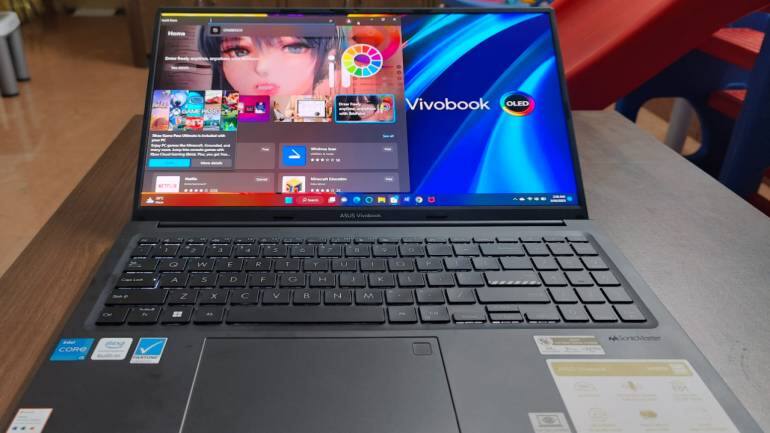
Moving on the trackpad that is quite spacious, although it is made of plastic instead of glass. However, it was still smooth and responsive to use in the absence of a mouse. While the touchpad was quick for navigation, its flimsy build was called into question while clicking down on it.
Display
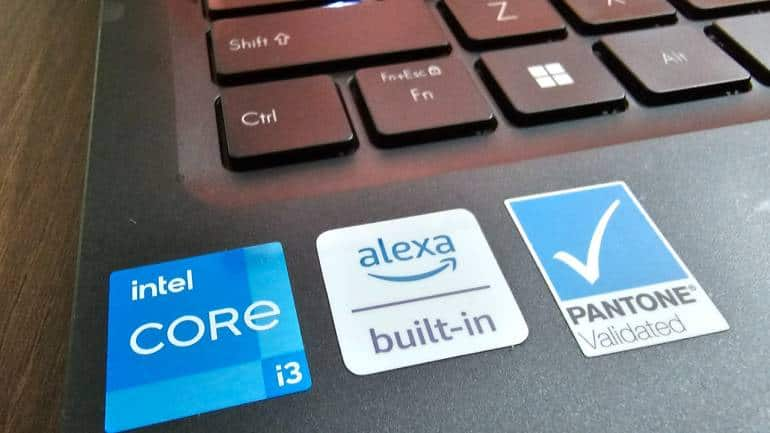
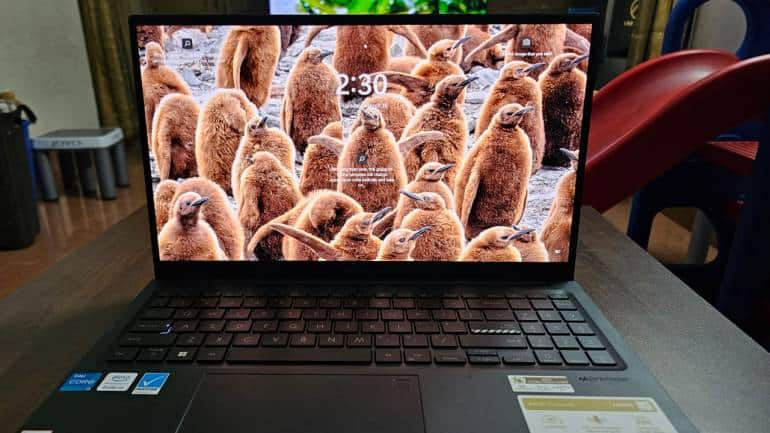
The biggest highlight of the Vivobook 15 OLED is its 15.6-inch Full HD OLED display. The panel boasts a 60Hz refresh rate and a 0.2ms response time. The screen features a 100 percent DCI-P3, a 100 percent sRGB coverage, and is Pantone Validated. Additionally, the OLED display boasts a peak brightness of 600 nits and is easily usable outdoors. The screen features Display HDR True Black 600 and is TUV Rheinland Flicker Free and Low Blue-light certified. The panel reproduced vivid colours with crisp details, punchy contrast, and deep blacks. The display had good viewing angles but the 16:9 aspect ratio did feel a little dated.

While the bezels here aren’t the slimmest, they are uniform and give you plenty of screen real estate. The OLED panel makes the Vivobook excellent for content consumption and photo editing, making it the laptop with the best display under Rs 50,000. While the Vivobook has the best screen in the segment, the same cannot be said about the speakers, which are pretty average. The speakers are serviceable and are loud enough to fill a mid-size room, although they lack bass and don’t sound too clear at high volumes.
Performance
When it comes to performance, the Vivobook is equipped with a 6-core 12th Gen Intel Core i3-1215U CPU paired with integrated UHD graphics. Our model of the Vivobook came with 8GB of DDR4 RAM and 512GB of M.2 NVMe PCIe 3.0 SSD storage. Storage is further expandable up to 2TB, while the 8GB of RAM can be upgraded to 16GB. So how does the Vivobook performance in the real-world, let’s find out.
In Geekbench 6, the Vivobook managed a single-core score of 2051 points and a multi-core score of 5129 points. In Cinebench R23, the notebook scored 1485 points in the single-core test and 5444 points in the multi-core test. We further ran a Cinebench 10-minute stress test as well, scoring a single-core score of 1655 points and a multi-core score 5021 points. Benchmarking results aside, the Core i3 processors handles everyday multitasking well enough.

We did run an Android title, Raid: Shadow Legends on the laptop simultaneously while working on MS Word and Google Chrome and the laptop ran smooth enough. However, we did have to run the game on ‘Medium’ graphics. In our experience, the laptop runs regular apps, web browsing, and running MS Word and Excel without any hitches. But if you are planning on doing any kind of gaming, we’d recommend looking elsewhere as even casual gaming will be an issue on our version of the Vivobook 15 OLED. That being said, the laptop is prefect for everyday productivity tasks and e-learning.
Battery
The Vivobook 15 OLED packs a 50Whr battery that lasts for little over four hours on a full charge. My usage included opening MS Word and having three to four tabs on Chrome running simultaneously. Additionally, I also had the screen on 50 percent brightness. We found that the battery life was more-than sufficient for short flights with a few battery saving tweaks. The laptop supports 65W charging, which is reasonably fast but doesn’t support USB Type-C charging.
Verdict
The Asus Vivobook 15 OLED has all the makings of a reliable affordable laptop. While the notebook does feature a standard design, its build feels pretty sturdy for a laptop under Rs 50,000. The notebook also offers a comfortable keyboard, tons of ports, and decent speakers. However, I did find battery life to be slightly underwhelming, while the trackpad also felt lacking. The obvious ‘Pro’ here is the addition of the OLED screen, which makes the Vivobook 15 OLED the laptop with the best display in the segment. But the best display does come at the cost of performance, although it does seem like a minuscule amount.
We’d have preferred Intel’s UHD graphics, which are seem on some Asus laptops at this range. But the 12th Gen Core i3 processor here does a solid job when it comes to multitasking and light photo editing. You could add some extra RAM to speed things up a bit, although the sacrifice in performance seems miniscule to the quality of the display used on the Vivobook 15 OLED. Overall, the Vivobook 15 OLED is an excellent everyday laptop for daily productivity tasks on MS Office or e-learning. And to top it all off, it has one hell of a screen, earning it an easy recommendation in our books, i.e., if you don’t mind lackluster battery life and a slightly chunky build.



Discover the latest Business News, Sensex, and Nifty updates. Obtain Personal Finance insights, tax queries, and expert opinions on Moneycontrol or download the Moneycontrol App to stay updated!
Find the best of Al News in one place, specially curated for you every weekend.
Stay on top of the latest tech trends and biggest startup news.