One important thing: Google today argued at the National Company Law Appellate Tribunal (NCLAT) that the Competition Commission of India's (CCI) Android antitrust order was flawed.
- The tech giant's lawyer claimed that the antitrust body's director general (DG) had asked device makers leading questions, indicating preconceived notions on the issue
- It also alleged that the DG had not conducted a proper consumer survey before submitting his findings to the CCI
In today’s newsletter:
- Lack of transparency costs influencers
- Why fintechs are chasing PA licenses
- Charlie Munger says crypto fans are idiots
Was this newsletter forwarded to you? You can sign up for Tech3 here
 Top 3 stories
Lack of transparency costs influencers

Attention influencers! Here's a tip, and perhaps your next week's content idea.
Mindless scrolling and content consumption are not in the picture anymore! In a recent report, the Advertising Standards Council of India (ASCI) noted that the majority of consumers avoid influencers who lack transparency.
Tell me more
According to the report, the key reasons why consumers trust influencers on social media are transparency and honesty, followed by relatable content and personal stories. Here are some key findings:
- 43% of consumers stayed away from influencers when they sensed a lack of transparency
- 42% did not trust influencers if they had repetitive content
- 41% of consumers stayed away due to over promotion
Good news for brands using influencer marketing
Nearly 90% of respondents to the ASCI survey claimed to have made at least one purchase based on an influencer's recommendation, while 61% claimed to have made three or more purchases.
However, both brands and influencers must adhere to proper disclosure and transparency when marketing products.
- The ASCI guidelines were published in May 2021, and the Central Consumer Protection Authorities now require the disclosure of material connections between brands and influencers. As a result, nondisclosures are potentially illegal
Why fintechs are chasing PA licenses

What is a PA license?
The RBI issued the PA guideline in March 2020 to protect the welfare of citizens like you and me, as well as businesses.
- It was highlighted that the payment gateways need a license to acquire merchants and provide them with digital payment acceptance solutions
- The main eligibility to comply with RBI guidelines and receive the “in-Principle authorisation to act as a payment aggregator,” a fintech firm must have had a net worth of Rs 15 crore by March 2021, Rs 25 crore by March 2023, and Rs 25 crore at all times thereafter
PA application rejected! A cause for concern?
No. The rejection is not a cause for concern. Because it is not the final license, but rather an in-principle approval.
In fact, the RBI stated that firms whose applications are returned may reapply within 120 days of the date of return. So that's a relief! However, according to several industry experts, the most important scrutiny happens after a firm receives an in-principle approval.
- Within the list of companies that received an in-principle approval, the RBI noted that Cashfree and Razorpay cannot onboard new merchants until further notice
- According to sources, in order to obtain the full license, each player must submit a systematic audit report as well as other compliances
Go deeper
Charlie Munger says crypto fans are idiots

It's no secret that Charlie Munger doesn't like cryptocurrencies, and he's made that clear on multiple occasions.
Driving the news
In an interview, the Berkshire Hathaway Vice Chairman made some strong statements on crypto yet again and said anyone who opposes his position on such assets are “idiots.”
"Sometimes I call it crypto crappo, sometimes I call it crypto sh-t. It’s just ridiculous that anybody would buy this stuff," Munger said.
Munger also expressed dissatisfaction with the fact that digital currency was allowed in the US in the first place.
The timing
Munger's remarks come as global regulators tighten their grip on the crypto industry, following the collapse of several major companies, which resulted in billions of dollars in losses for investors.
Earlier this month, Munger said crypto is “not a currency, not a commodity, and not a security,” in an opinion piece in The Wall Street Journal.
"It’s a gambling contract with a nearly 100% edge for the house, entered into in a country where gambling contracts are traditionally regulated only by states that compete in laxity," Munger said.
These remarks, however, do not appear to have had an effect on the cryptocurrency market, which is currently on the rise. Bitcoin has surpassed $24,000, its highest level since August of last year.
Today in tech history: IBM Portable PC introduced
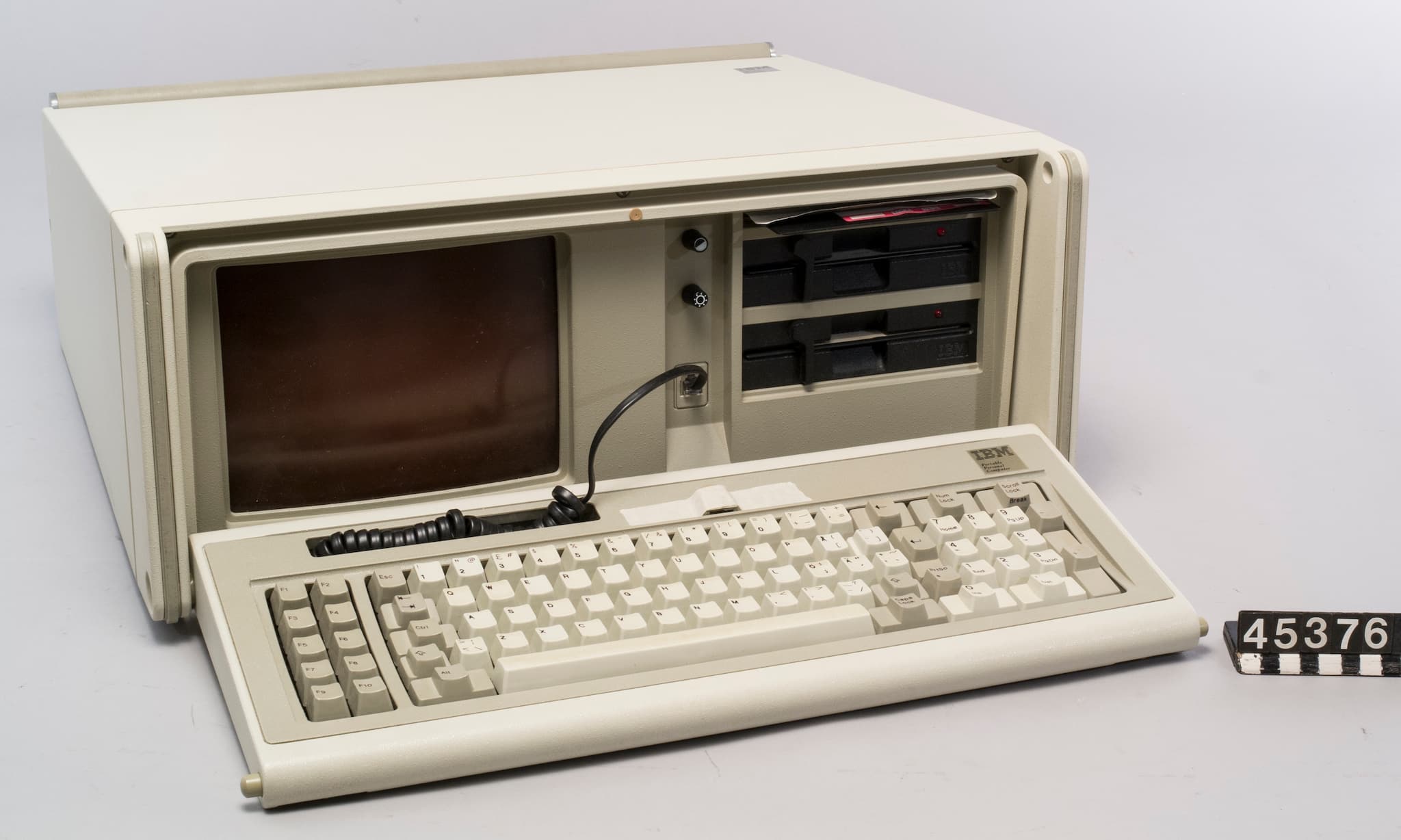
On this day in 1984, IBM unveiled the IBM Portable Personal Computer, which came equipped with a 4.77MHz Intel 8088 processor, 256KB of RAM, a 9-inch monitor, a 5.25-inch floppy drive, and the DOS 2.1 operating system.
Although it was titled as "portable," it weighed a hefty 30 pounds and carried a price tag of $2,795.



 PREVIOUS
 Tweet of the day
 QUICK HITS
 GLOBAL PICKS