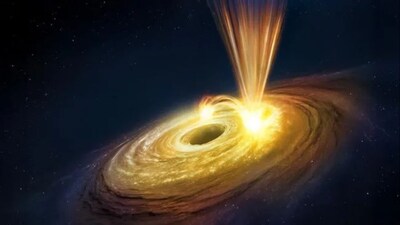
Astronomers spotted a distant supermassive black hole launching record-speed winds after an intense X-ray flare, revealing magnetic forces at work and offering fresh clues about how violent galactic centres evolve.
3I/ATLAS is the third-known interstellar object to enter our solar system. It was discovered on 1 July 2025 by the ATLAS telescope in Chile, travelling at over 210,000 kilometres per hour.
Explore 10 jaw-dropping black hole wallpapers captured by NASA. These cosmic visuals reveal the mysterious beauty of space, perfect for anyone fascinated by the universe’s most powerful and puzzling objects.
K2-18b is a “sub-Neptune”, bigger than Earth but smaller than Neptune. It was first discovered in 2017.
The image, captured by Webb, showcases a rare gravitational lensing effect in the galaxy cluster MACS-J0417.5-1154. This cluster, acting as a massive lens, distorts and magnifies distant galaxies, creating intriguing visual distortions.
Yesterday, NASA kickstarted its latest mission to look for black holes in the universe, when it saw the Nuclear Spectroscopic Telescope Array (NuSTAR) launch over the central Pacific Ocean at 9 a.m. PDT (noon EDT) Wednesday.