-
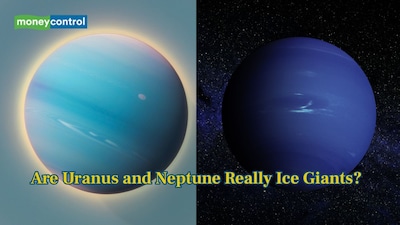
Are Uranus and Neptune really ice giants? Here's what study says
New research suggests Uranus and Neptune may not be true ice giants, with rocky interiors dominating instead, challenging long-standing models of planetary formation and classification.
-

Scientists revisit old theory: Are tiny ancient black holes passing through our bodies unseen?
A provocative theory is gaining new support today. Scientists suggest atom-sized black holes may move through Earth. These primordial black holes likely formed after the Big Bang.
-
Double star Eta Cassiopeiae could host habitable worlds-Here is what scientists think
Eta Cassiopeiae, a nearby double star system, may host stable Earth-sized planets. Its lack of giant exoplanets makes it ideal for habitability studies.
-
Skywatching in July 2025: What’s up in the sky in July this year?
From a super distant Earth-Sun rendezvous to Mercury shining in the evening sky and a stunning Buck Moon lighting up the night, there’s plenty to look forward to.
-
For first time, Webb telescope discovers an alien planet
Webb has directly imaged a young gas giant planet roughly the size of Saturn, our solar system's second-largest planet
-
‘Flower Moon’ 2025 to rise soon: When, where and how to watch May’s Full Moon
This year, the Flower Moon will look slightly different. The Moon will appear about 14 per cent smaller than usual.
-
What Earth looks like from different planets in the Solar System
Have you ever wondered how our home planet, Earth, looks from other planets in our solar system? Let's take a cosmic journey to explore the breathtaking views of Earth from our celestial neighbors.
-
The 'Mars Triangle' meets the 'Winter Triangle' in the night sky: How to witness this beautiful celestial event
February's night sky offers a treat for stargazers, with the Winter Triangle and a temporary Mars Triangle shining bright, providing a unique celestial sight.
-
Massive ocean of water discovered on Mars! | Hidden Below the Surface
Scientists have uncovered a colossal reservoir of liquid water beneath Mars' surface—enough to fill an ocean! Discover how NASA’s InSight Lander revealed this incredible find and what it could mean for the search for life on the red planet. Watch now to learn about the challenges of accessing this hidden treasure and what’s next for Mars exploration!
-
Pluto’s planetary status remains in question 94 years after discovery
Even though Pluto was called a planet after its discovery, its planetary status has always been under scrutiny after the International Astronomical Union relegated Pluto from the planet club.
-
Astronomical breakthrough: Seven planets 'larger than earth' discovered
The discovery is a result of meticulous analysis of data obtained by NASA's retired Kepler space telescope.
-
After moon mission, ISRO eyes Venus, exo-planets: Somanath
On the need to study Venus, the ISRO chief said the planet also has an atmosphere with atmospheric pressure 100 times that of Earth near the surface.
-
Amitabh Bachchan shares video of 5 planets aligned: 'Beautiful and rare'
5 planets align: Star gazers were up for a treat on Tuesday as five planets, Mercury, Jupiter, Venus, Uranus and Mars lined up near the moon.
-
5 planets to be visible in the night sky today. Here's how you can watch the rare alignment
The celestial treat will be visible from anywhere on earth but those in the northern hemisphere might have a better view, Rick Fienberg, senior contributing editor of Sky & Telescope magazine has said
-
In Pics | How Saturn got its rings — all you need to know about the new theory
Since their discovery nearly 400 years ago, the origin of Saturn's rings — their age and how they came to be — have remained largely a mystery. Until now. We take a deep dive into the new theory on the origin of concentric rings of Saturn.
-
The Juicy Secrets of Stars That Eat Their Planets
Stars come in many varieties, including simmering dwarfs and brilliant hypergiants. The life expectancy and ultimate fate of a star — and, therefore, any planets orbiting it — is tied to its mass: Red dwarfs may live for trillions of years, whereas massive stars blow up within a few million.
-
View these five planets on July 19 without equipment
All you will need to do is wake up at the break of dawn; you will not require any additional equipment to view this breathtaking sight
-
10-million-year-old star possibly making new planets
Scientists have discovered that an old star - 176 light years away from Earth - thought to be past its prime may still be creating new planets.
-
Our galaxy contains 100 billion planets
Our galaxy contains at least 100 billion planets - approximately one for every star - and many of them could harbour life, a new study claims. Contrary to previous belief, the latest research by astronomers suggests star systems with planets are actually the norm across the cosmos.
-
Two baby planets guzzle gas from a 'parent' star found
For the first time, scientists have observed the birth of two giant planets emitting gas as they orbit their parent star. Seen by Earth's largest radio telescope, vast streams of gas flowing through a gap in a disc of material around a young star seem to support theories of how the planets grow.
-
NASA releases video on apocalypse 10 days early
US space agency NASA is so confident that the apocalypse will not happen Dec 21 as predicted by the Mayan calendar that it has released a video ...
-
World not ending next month: NASA
Some of us may fall for all that talk about the end of the world coming on December 21, 2012, but the scientists at NASA are intent on doing away with the rumours.
-
Aliens may find Earth boring: UK astronomer
Fearing an alien invasion? It is not likely to happen! The discovery of planets supporting alien life may be possible within the next 50 years, however, it is likely that extra terrestrials will find Earth too "boring" to bother with, renowned UK astronomer Sir Patrick Moore has claimed.
-
India witnesses the last Venus transit of the century
One of the more rare celestial events to take place this century, the Venus transit had Indians, the country over ...
-
Two more Earth-sized planets - Kepler-20e, Kepler-20f spotted
NASA, like we've been reporting has been throwing some fabulous discoveries with its Kepler mission. For those ...