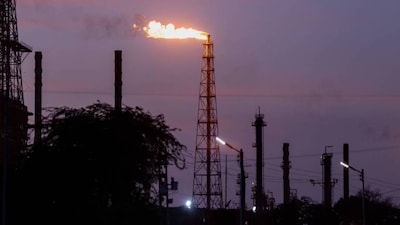
Brent futures rose $1.34, or about 1.7%, to $78.76 a barrel by 1349 GMT. US West Texas Intermediate crude (WTI) was at $74.1, up $1.2, also roughly 1.7%.
Asked about the mechanism to allocate production among OPEC and non-OPEC members following an agreement on Saturday to raise supply by returning to 100 percent compliance with previously agreed output cuts, Bakhit al-Rashidi said:
The top oil producer in OPEC, Saudi Arabia, favours extending the output curbs by nine months rather than the initially planned six months, to speed up market rebalancing and prevent crude prices from sliding back below $50 per barrel.
Oil supplies fell by around 1.5 million barrels per day last month, including by 1 million bpd for OPEC, leading to record initial compliance of 90 percent with a six-month output-cut deal reached in December by big producers to boost prices.
Rising oil prices will lead to higher inflation in the eurozone over the next two years than previously expected, a European Central Bank survey said today.
Countries complying with the Opec and Non-Opec countries' agreement is also going to decide crude prices. He says most countries have cut output by around 2.5-4 percent, but only time will tell if they continue to do so over a long period of time.
The company's net profits for the third quarter of current fiscal beat street expectations at Rs 8,802 crore. The gross refining margins (GRM) on the other hand, dissapointed at USD 10.80 per barrel.
The first month of implementation will be key to understand whether everyone will respect the deal, but according to analysts full compliance is very unlikely.
OPEC agreed last week to reduce output by around 1.2 million barrels per day beginning in January in a bid to reduce global oversupply and prop up oil prices. It hopes non-OPEC countries will contribute a further 600,000 bpd of cuts to the effort. Russia has said it will reduce output by around 300,000 bpd.
The ministry told AFP that Russian Energy Minister Alexander Novak would be taking part in the meeting, which comes after Moscow said it was ready to reduce crude output by 300,000 barrels a day in the first half of 2017.
While crude production agreed to by the OPEC is at the higher end of market expectations, Azlin Ahmad, Editor - Crude Oil at Argus Media believes an immediate price jump is not expected as actual cuts will be implemented only post January.
"We think even without an OPEC deal, prices are headed higher and that's purely because of fundamentals," Miswin Mahesh, oil analyst at Barclays, told CNBC on Friday.
OPEC member Venezuela and top non-OPEC producer Russia had been the main proponents of the output freeze deal, in the making since February, until it collapsed on Sunday in Doha after Riyadh said it would not sign unless Iran took part.
Brent crude has been trading around USD 36 per barrel and WTI Nymex has been around USD 34 per barrel mark.