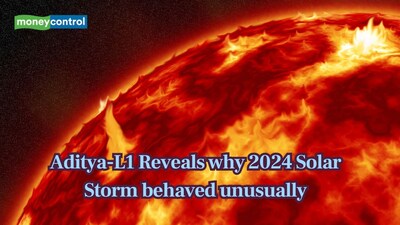
India’s Aditya‑L1 mission, revealed why the 2024 solar storm was unusually powerful. Scientists mapped magnetic reconnection inside colliding coronal mass ejections, improving storm predictions.
The aurora forms when charged solar particles arrive suddenly. These particles strike Earth’s atmosphere at huge speeds.
According to the National Oceanic and Atmospheric Administration (NOAA), a large coronal hole on the sun is releasing a powerful stream of solar wind towards Earth.
Last weekend, the sun released two separate eruptions, each hurling a coronal mass ejection (CME) towards Earth.
Aurora chasers are on high alert as a minor geomagnetic storm is expected to hit Earth soon, potentially triggering spectacular northern lights displays in the northern hemisphere.
A geomagnetic storm watch has been issued for Christmas Day, potentially bringing a spectacular aurora borealis display to the skies, making for a magical holiday evening.
A severe G4-class geomagnetic storm expected to hit Earth on October 10, triggered by a coronal mass ejection from a powerful solar flare. NOAA warns of disruptions to power grids, satellites, and GPS navigation.
A powerful X-class solar flare has sparked a geomagnetic storm warning. The flare, classified as X7.1, erupted from the Sun on October 1, 2024.
NASA astronaut Matthew Dominick has shared a timelapse video from the ISS, showing the Moon setting against a backdrop of vibrant red and green auroras.
Earth was struck by a massive solar storm on Monday. While this storm brings a spectacular display of colourful auroras or Northern Lights, it’s also causing disruptions in communications, satellite operations, and putting stress on power grids.
The geomagnetic storm headed towards the planet can damage high-latitude power systems, affect the power grid and spacecraft in orbit.
A strong geomagnetic storm is set to hit Earth on March 31, triggering auroras that would likely be brighter and visible farther away from Earth’s poles. A look at how solar storms lead to these dazzling display of lights on Earth.
The strongest geomagnetic storm in more than six years was forecast to hit Earth's magnetic field on Tuesday.