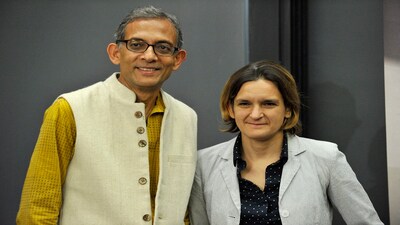
The nobel economists' move comes at a time when academics in the U.S. have expressed growing concern over cuts to research funding and political hostility toward universities under President Donald Trump’s administration.
The share of the persons aged 60 and above in the population is projected to reach 18 percent by 2036 from 9 percent in 2011.
Esther Duflo said India was already in a position to start universal basic income quickly as it had the Jan Dhan accounts-Aadhaar-mobile system in place.
Banerjee and Duflo, along with fellow economist Michael Kremer, brought an experimental approach to economics to focus on poverty, and in particular, how the poor make decisions. This approach,while popular in medical research, is a pioneering effort on part of the Nobel prize winners to use randomized control trials in economic studies.
The economist suggested the government should consider direct cash incentives to boost demand.
Their papers combine theory and data in an unmatchable way, turning the traditional worldview on its head
One hopes that in future, the Nobel committee expands the scope of the prize to scholars and researchers outside the standard choices
This year’s winners of the Economics Nobel prize shun clichés about poverty to focus instead on practical solutions arrived at after field experiments among the poor
Talking about schemes that are already in place in India, the economist said NREGS seems to be a rather solid success in the sphere of rural development.
The states which are not run by the UPA will take the money but focus on its flawed implementation to claim their own food security idea would have done better and that the Congress was insincere about the idea anyway. The Congress-run states, on the other hand, will have to defend the scheme despite its flaws.
Eradicating poverty is perhaps the highest priority of the Indian government and although statistics claim great success the truth is we still have hundreds of millions living in dire circumstances.