




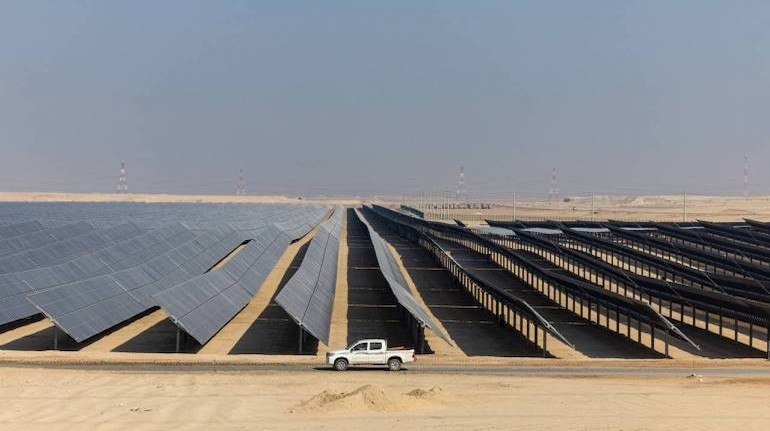
Despite adding renewable energy (RE) capacity at a fast pace, India's electricity generation from such sources has remained fairly low, according to a report by the Institute of Energy Economics and Financial Analysis (IEEFA) released on July 13.
The report - Integrating Higher Share of Variable Renewable Energy in India - stated that between 2016 and 2022, renewable energy
share in India's total electricity generation grew only by 6.5 percentage points, while its share in the total capacity addition grew by 13.6 percentage points.
Charith Konda, the author of the report and IEEFA's Energy Finance Analyst, said the gap between the existing RE capacity and its actual usage in meeting the country's power demand is due to the inability of the Indian power system to accommodate higher shares of renewable energy.
Also read: India's power consumption grows by 4.4% to 139.23 billion units in June
India’s power market structure, where distribution companies procure close to 90 percent of the power generated through long-term power purchase agreements, limits grid flexibility in absorbing higher shares of variable renewable energy. The majority of power generated by India’s large (more than 210 GW) existing coal power fleet has fixed long-term contracts with distribution companies, which is why discoms invariably opt for thermal power, Konda explained.
Also, coal-fired power plants cannot be ramped down easily and hence, are less flexible, which means they have to operate at higher plant load factor to maintain the health of the plant equipment. As a result, the grid is mostly occupied by coal-fired electricity.
Another reason is the seasonality of wind power generation and concentration of wind power generation assets in six states, which leads to grid congestion in high wind power generation seasons. It results in the curtailment of wind power. Also, the variable nature of solar and wind power makes them non-dispatchable power sources and
hence not ideal for providing on-demand electricity unless supported by adequate energy
storage capacity, which currently is expensive and exists in a very small scale.
The report recommends four ways for India to address this wide gap between RE capacity and actual RE generation – 1. introducing demand-side measures like time-of-use (also known as time-of-day) tariffs; 2. developing a well-connected national grid; 3. deploying various energy storage options for grid balancing services; 4. converting its fossil-fuel powered fleet to operate in a flexible manner.
Also read: The dismal state of power discoms threatens India’s energy dreams
"Demand-side measures and expanded transmission network will help in reducing grid balancing needs and will also help in integrating renewable energy. Energy storage technologies can provide a variety of grid balancing services," the report stated.
ToU or ToD (time-of-day) tariff helps manage peak loads. Usually, under ToD, power tariffs are higher during peak power consumption hours, and lower during off-peak hours. This acts as an indirect incentive for consumers to shift their electricity consumption more toward off-peak hours.
India's electricity generation grew from 1,376 billion units in the financial year (FY) 2018-19 to 1,624 billion units in FY2022-23 at a compounded annual growth rate (CAGR) of 4.4 percent. The average annual power deficit (the gap between power generation and demand) was 0.5 percent, with the average peak deficit at 1.4 percent during the period. But in FY 2022-23, India’s peak power deficit reached a high of 4 percent as the country struggled to meet the demand during the summer.
Looking ahead, the Central Electricity Authority (CEA) expects the country's electricity demand to
grow at an annual rate of about 6 percent in the next decade (2022-2032).
“For India to meet growing electricity demand while addressing climate concerns, increased integration of clean energy, including variable renewable energy is essential," Konda said.
"While raising non-fossil fuel power's installed capacity share to 50 percent by 2030 may be relatively easier to achieve, reducing the emissions intensity of its economy by 45 percent by 2030 from 2005 levels requires increased integration of variable renewable energy in the power system,” he said.
Discover the latest Business News, Sensex, and Nifty updates. Obtain Personal Finance insights, tax queries, and expert opinions on Moneycontrol or download the Moneycontrol App to stay updated!

Find the best of Al News in one place, specially curated for you every weekend.
Stay on top of the latest tech trends and biggest startup news.




