






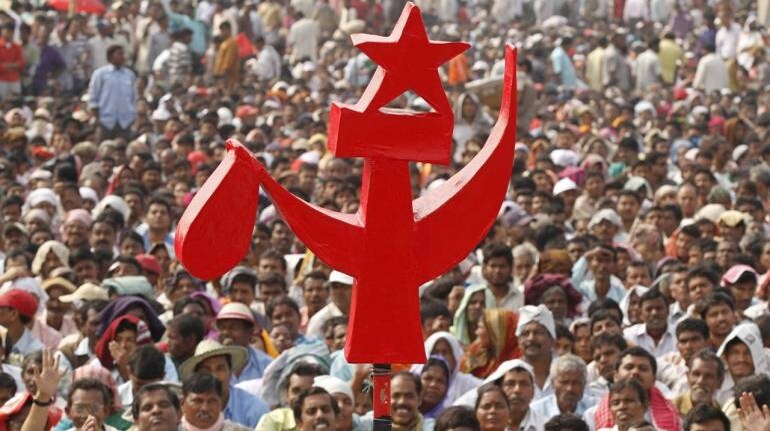
The Communist Party of India, established in 1925, is one of the oldest existing political parties and is the only party in the country’s electoral history to use the same symbol of corn and sickle since the first general elections of 1951-52. On Monday, the Election Commission revoked the national party status of CPI and a few other parties, while granting the same to Delhi chief minister Arvind Kejriwal’s Aam Aadmi Party founded in 2012.
Contrasting FortunesTo be fair, CPI, which was the second largest party in the 1951-52, 1957, and 1962 Lok Sabha elections, had lost much of its base years ago. The split in CPI in 1964 leading to the formation of CPI(Marxist) was the major blow to the party. A large section of CPI leaders and its base went to CPM, which somehow has been able to retain its national party status.
Presently, CPI has only two MPs in the Lok Sabha while CPM has only three. CPI lost the status after losing the state party status in West Bengal and Odisha. Some of the well known parliamentarians of CPI like Hiren Mukherjee, Geeta Mukherjee, Indrajit Gupta and Gurudas Dasgupta were from West Bengal and today the party doesn’t even have state party status there. It is now a state party only in Kerala, Tamil Nadu and Manipur.
On the other hand, AAP got the national party status after acquiring state party status in Gujarat following the 2022 assembly elections, after securing state party status in Delhi, Punjab and Goa earlier.
AAP’s Smart PoliticsThe main agenda of AAP in elections has always been centred on welfarism with focus on electricity, water, health and education. However, the party's welfarism has often faced criticism due to its politics of free electricity and free water as this puts a burden on the state's exchequer. After all, nothing comes for free.
Importantly, the slogans focussing on basic issues like land to the landless, health, education etc have traditionally been the politics of the Left. One important difference is that the Left focussed on state control of education and health while AAP projected better delivery of these services. The Left, in consequence, failed to attract the masses while a party like AAP came to power in Delhi twice – in 2015 and 2020 – and in Punjab last year banking on these issues.
AAP is a party run with a cult built around one individual – Arvind Kejriwal, who is the party’s national convenor. He has been the party’s face across the country. The Left was never personality driven. And today it lacks a single national leader. Even Kerala chief minister Pinarayi Vijayan and former Tripura CM Manik Sarkar are confined to their home states.
Left’s Missed OpportunitiesNot only this, the Left’s failure to deal with the issue of religion in a religious country and caste in a hierarchical society like India has only negatively affected it – but the Left, as usual, always denies this. Aware of the country’s religiosity, AAP has always taken a soft approach on religion. From organising live Diwali Puja in 2020 to promising free pilgrimages to religious places like Ram Temple of Ayodhya, Kejriwal lately hasn’t been hesitant to showcasing his Hindu religious card.
This is being done to blunt the BJP’s attack of AAP “being anti-Hindu”. Not only this, after the party’s defeat in the Lok Sabha polls in 2019, AAP avoided criticising Prime Minister Narendra Modi directly as the latter remains popular due to the success of his government’s welfare schemes. The party, instead, focused more on projecting its Delhi model of welfarism.
Should CPI, CPM Reunite?On the other hand, the Left leadership’s concern with stopping Modi from becoming PM instead of arresting its own decline doesn’t help either cause. The Left has often shied away from sharing power at the Centre. CPM prevented its own stalwart Jyoti Basu from becoming prime minister in 1996 in the United Front government. CPI, however, joined the two short-lived UF governments with its leader Indrajit Gupta becoming the home minister of the country. The Left dominated by CPM supported the UPA-I government but didn’t join it – as a result, it lost another crucial opportunity to showcase its alternative model at the national level.
The Left’s failure to properly address the issues of caste led to it losing much of its support in the crucial Hindi belt, where it had pockets of influence, after the rise of Mandal politics. However, CPI had started losing support in the Hindi belt for its wrong decision to back the Emergency brought by Indira Gandhi's government.
Now with CPI losing the national party status, the idea of reunification between the two communist parties – CPI and CPM – is likely to get more attention. But the fact is until and unless the Left finds support among the youth, middle class and women voters, its situation is unlikely to improve, even if there is reunification of CPI and CPM.
Sagarneel Sinha is a political commentator.Views are personal and do not represent the stand of this publication.Discover the latest Business News, Sensex, and Nifty updates. Obtain Personal Finance insights, tax queries, and expert opinions on Moneycontrol or download the Moneycontrol App to stay updated!
Find the best of Al News in one place, specially curated for you every weekend.
Stay on top of the latest tech trends and biggest startup news.




