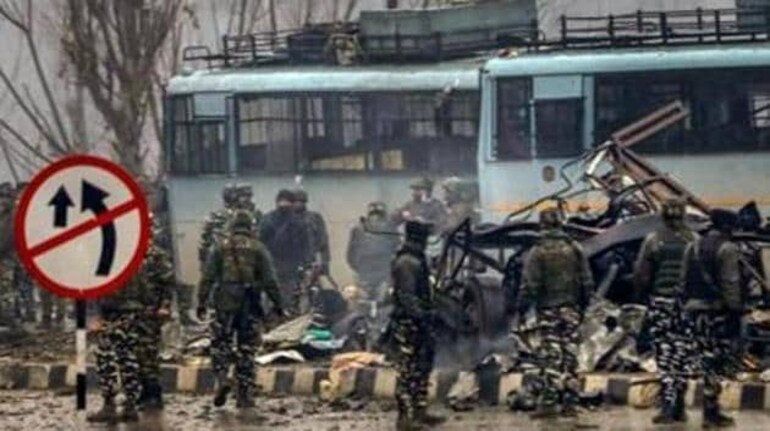
Three years ago, on this day, a suicide bomber had rammed an explosive-laden vehicle into a Central Reserve Police Force (CRPF) convoy on Srinagar-Jammu national highway in Lethpora, Pulwama. The attack killed 40 troopers.
It was the deadliest militant attack on Indian security forces in Kashmir since the insurgency started in 1989.
Moments after the suicide attack on February 14, 2019, the Pakistan-based militant outfit Jaish-e-Mohammed (JeM) claimed responsibility for the attack, hailing the work of Adil Ahmad Dar, a 20-year old militant from south Kashmir’s Gundbagh village of Pulwama.
The attack brought the two nuclear-armed powers, India and Pakistan, to the brink of war. Thankfully, the two nations managed to avoid that catastrophe.
A 12-member team of the National Investigation Agency (NIA) was tasked with cracking the deadly attack. The NIA investigation established and confirmed the active role of Dar behind the attack. The agency filed a 13,500-page chargesheet in a special court against 19 people including Jaish chief Masood Azhar for planning and carrying out the attack.
The Pulwama attack however changed Kashmir on many fronts.
Valley under strict watch
It began with the central government imposing a five-year ban on Jamaat-e-Islami (JeI), accusing it of supporting militancy in the region.
A massive crackdown on the JeI, a socio-political and religious group, and its leaders began days after Pulwama attack with J&K police arresting over 100 cadres.
The central government justified the ban by accusing the group of indulging in activities intended to disrupt the territorial integrity of India. “The ban on JeI was pivotal because it reduced the civilian uprisings, civilian protests and stone pelting incidents in the Valley. The ban on JeI was the first step to control the ground situation in Kashmir,” a Kashmir-based senior journalist contributing to international media told Moneycontrol.
Similarly, the government also banned the Jammu and Kashmir Liberation Front (JKLF), headed by the separatist leader Yasin Malik, currently languishing in jail in connection with terror-funding cases.
JKLF was banned under the Unlawful Activities (Prevention) Act (UAPA), with the government accusing it of “supporting extremism and militancy”, indulging in “anti-national activity” and killing Kashmiri Pandits in 1989 leading to their exodus from the Valley.
Three months after Pulwama attack, in May 2019, Prime Minister Narendra Modi’s Bharatiya Janta Party (BJP) won 2019 Lok Sabha elections and retained power for the second time. The BJP won with a thumping majority in the Lok Sabha election, bettering its performance in the 2014 polls.
Many opposition leaders including former J&K Chief Minister Farooq Abdullah and former External Affairs minister K. Natwar Singh stated that Pulwama attack helped Modi and BJP win elections with a bigger majority. Another senior Kashmiri journalist, who has covered the Kargil war, seconded that view. “The attack happened closer to the elections. With the majority mandate, the BJP government is continuously imposing their narrative in J&K,” the journalist said.
In August, barely three months after returning to power, the central government abrogated Article 370 that provided special status to J&K and bifurcated the erstwhile state into two Union Territories, J&K and Ladakh.
For the first time after seven decades, the Indian Constitution and all the 890 Central laws became fully applicable to J&K.
Nearly all of Kashmir’s mainstream political leaders including three former Chief Ministers—Farooq Abdullah, Omar Abdullah and Mehbooba Mufti were detained hours before the central government nullified Article 370.
After nearly eight months, in March 2020, Farooq and his son Omar were released; and Mufti was released few months later still, in October 2020.
Counter-insurgency gains pace
Post-Pulwama, Kashmir Valley witnessed the biggest coordinated counter-insurgency operations in recent years with main targets being top militants and commanders operating in the region.
The combat operations against Azhar’s outfit JeM, Zakir Musa-led Ansar Ghazwat-ul-Hind (AGH), Lashkar-e-Taiba and Hizbul Mujahideen intensified.
According to official sources, since the Pulwama attack, around 500 militants have been killed in J&K and nearly 600 militancy-related incidents also took place.
The security forces managed to kill all the top militant commanders in the region. This dealt a heavy blow to the militant groups. For instance, after the killing of Al Qaeda-affiliated AGuH founder Zakir Musa in May 2019, the outfit was wiped out from the region.
Read also: Heritage tourism back in J&K after two decades
Restricted movement
On the other hand, security forces deployed in the region took various measures to prevent Pulwama type attacks on Srinagar-Jammu national highway. “For the past three years we have been ensuring minimum convoy movement. But incase of necessary movement on highway only 40 vehicles move in smaller contingents, to prevent militant attacks,” a Srinagar-based CRPF official told MoneyControl.
He added that to facilitate the movement of convoys, the movement of civilian vehicles are restricted on national highways even after three years of Pulwama attack. “Earlier, convoys and civilian transport would move alongside but now the civilian traffic is blocked during the movement of convoys," said the official.
The government also tightened its noose on alleged militant sympathisers with a number of them being booked under Public Safety Act (PSA) and UAPA.
Since 2020, a number of government employees found involved in anti-India activities or having militancy links have been terminated from their services.
Read also: With security bunkers and frisking points, its ninetines once more
With this heavyhanded crackdown, the security forces have also managed to reduce stone pelting incidents in the Valley. Director General of Police Dilbag Singh claimed that 87.13 percent dip in incidents of stone-pelting were seen in the year 2020 compared to 2019.
On his visit to Kashmir in October last year, Home Minister Amit Shah said that due to professional dealing of the situation, the stone-pelting incidents were brought to almost zero at present.
Former J&K Director General of Police (DGP) SP Vaid told MoneyControl that a strategy that combined the strengths of the government, security forces and police seem to have worked. “Kashmir has changed due to combined strategy and actions in the form of surgical strikes, revocation of Article 370, relentless anti-militancy operations by security forces and J&K police," he said.
Vaid attributed the reduction of stone-pelting incidents to action against terror financing and militancy, and denying requests to hand over the bodies of militants.

Discover the latest Business News, Sensex, and Nifty updates. Obtain Personal Finance insights, tax queries, and expert opinions on Moneycontrol or download the Moneycontrol App to stay updated!
Find the best of Al News in one place, specially curated for you every weekend.
Stay on top of the latest tech trends and biggest startup news.