What can be said about a 136-year-old political party, which has ruled India for the better part of the last seven decades, and which is now seemingly rudderless, as well as in the throes of change, both at the same time?
On one hand, the situation in Punjab, triggered by the ouster of Chief Minister Amarinder Singh and the antics of Navjot Singh Sidhu have made the Grand Old Party (GOP) the butt of ridicule and social media-inspired memes.
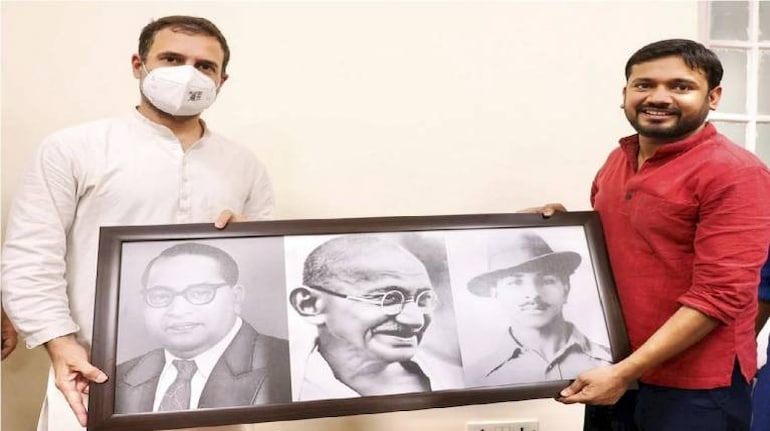
On the other, there is evidence of generational change taking place – the old guard being replaced by the Young Turks in the states. CPI’s stormy petrel Kanhaiya Kumar looks set to take over a non-existent Congress in Bihar, while Jignesh Mewani will rally the party in Gujarat; Amarinder’s ouster has led to a younger Charanjit Singh Channi taking charge in Punjab with Sidhu in tow, while Sachin Pilot is getting the Congress High Command’s undivided attention after a long time in Rajasthan.
Add to it a third strand – an influential group inside the party, christened the Group of 23 or G-23, seeking reforms that the party, mauled by the BJP at two successive Lok Sabha elections, could well do with.
The situation defies conventional political logic. While it may seem as if the party is on a fratricidal course, there appears to be little doubt that Congress is also amid a churning. The two seemingly contradictory positions are indeed baffling at this stage.
``There are times in history when political developments defy any logic. This can be said about the Congress today,” says political scientist Badri Narayan, Professor, Govind Ballabh Pant Social Science Institute, Allahabad.
It is particularly difficult to arrive at a conclusion when no data is available, and tweets and speculation are the only guide, without any formal communication from the party leadership, he tells Moneycontrol.
Open battle
On September 30, Congress leader Kapil Sibal’s presser brought out of the closet to public view the year-long jostling within the party over its presumed leadership. This open battling, in an extremely competitive political marketplace like India, is serious anathema.
While Sonia Gandhi is the interim president – 28 months have passed since the Congress had a regular president – the real decision makers appear to be the siblings Rahul and Priyanka. So typically, there is no one to take the blame for the current Punjab fiasco and for the tiny revolts brewing in various state units like Chhattisgarh.
At the briefing, Sibal demanded organisational reform, while signalling that they would stay within the party and confront the BJP – unlike some so-called family retainers, who have deserted in recent times.
Equally, there appears to be no let-up in the internal feud in the Congress with senior leaders coming out in strong defence of the top leadership, slamming Kapil Sibal and other dissenting veterans of the group of G-23; the protestors, in turn, condemned the attack on the house of the former Union minister here calling it `orchestrated hooliganism'.
Senior leaders Ghulam Nabi Azad, P Chidambaram, Anand Sharma, Bhupinder Singh Hooda, Shashi Tharoor, Vivek Tankha and Raj Babbar were among those who rallied behind Sibal, with Sharma asking Congress president Sonia Gandhi to take strong action against those involved in the attack. Naturally, social media is the conduit they took to voice their concerns.
Amid the turmoil and multiple desertions, the party's chief spokesperson Randeep Surjewala said the Congress Working Committee (CWC) will meet `very soon’, a day after some G-23 leaders demanded such a meeting.
At a briefing in Ahmedabad, Congress spokesperson Pawan Khera cautioned party leaders against going public with internal matters as it hurts ground-level workers, while saying the party gives enough freedom to its leaders to express their views.
Rashid Kidwai, senior journalist, and Visiting Fellow at ORF, who has written a biography of Sonia Gandhi, explains the party’s predicament: ``There is a huge mass of disgruntled people in the party, who want change. Restructuring inside a political party is done from a position of strength. Here, the party leadership can only restructure from a position of weakness. The Congress party is too complex, carrying together diverse elements. Historically, it has been resistant to change.”
In the past, he says, Congress leaders have challenged the leadership, which requires 10 or 15 per cent signatures of party members. So there have been Rajesh Pilot and Jitender Prasad, who took on the leadership, no matter the result. Now it is not happening, despite the scale of discontent, says Kidwai.
(This is part one of a three-part series. Click for part two and part three.)
Discover the latest Business News, Sensex, and Nifty updates. Obtain Personal Finance insights, tax queries, and expert opinions on Moneycontrol or download the Moneycontrol App to stay updated!
Find the best of Al News in one place, specially curated for you every weekend.
Stay on top of the latest tech trends and biggest startup news.