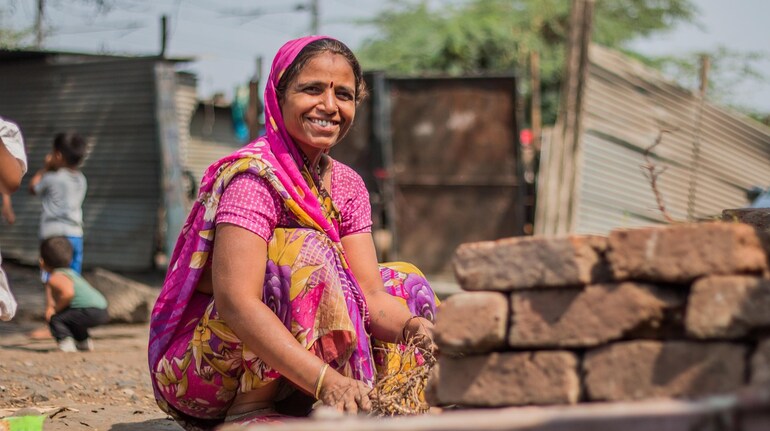
During my latest trip to my ancestral village in the Muzaffarpur district of Bihar, I saw a woman walking with a passbook in her hand. I got a bit curious and asked her about the small passbook that she was carrying. She proudly revealed that the small passbook she was carrying was her Jeevika passbook, containing all her savings and any loans from the group.
Jeevika passbook, where all her savings as well as any borrowing from the group are mentioned. Having worked on women’s economic empowerment with the SEWA movement for about two decades, I tried to find out more about the Jeevika program in the village and thereafter in the entire state.
After an initial conversation with a few other women in the village and with some secondary research, I realised that Jeevika under the Bihar Rural Livelihoods Program has gone beyond a project or a program and has taken a shape of movement where about 13 million women from all villages in Bihar have joined Self-Help Groups (SHGs) and have changed their lives silently over the years. Without making much noise about their socio-economic transformations, ‘jeevika didis’ have led the way and turned this government program into a movement that has touched almost every rural household in Bihar.
Founded in 2006 as a pilot in five villages, Jeevika has taken a big leap in less than two decades. According to a World Bank report, more than 12 million rural women participated in 1,004,373 SHGs, and more than 60,000 village organizations were formed between 2007 and 2020. While SHGs are the basic form of association for rural women, where they come together as a small group for monthly savings and low-cost borrowing from commercial banks and for exploring livelihoods together, village organisations are the federation of SHGs in a village. VOs provide on-lending support to the SHGs through the Community Investment Fund (CIF). The funds are mostly used for asset creation (building assets like livestock), food security, and paying debts to reduce high-cost loans.
Village organisations are further federated at the level of Block. These Block level federations function as apex organisations for the VOs and SHGs and act as microfinance institutions for lower-level VOs. They also support livelihood activities based on family-level assets. With sustainability as a focus, they make sure that VOs operate as sustainable economic and social entities. It also brings in partnerships to offer forward linkages to markets. As a support to connecting the produce of members of the SHGs, the federations help them connect with elite-dominated markets by connecting them directly with market services. This entire process leads to the creation of a sustainable social and economic ecosystem that is controlled by the community and SHGs, leading to sustainable development. As a result of the entire process, women are able to create a self-managed development process that leads to sustainable income generations and reduces dependency on high-cost debt.
Until the current year, this movement has formed over 10.58 lakh SHGs, which are further organised into 70,812 village organisations and 1,669 cluster-level federations. I call this a movement due to its exponential growth after its formative years. With 513 SHGs in 2007-08 and 31637 SHGs in 2010-11, the next decade added about 100,000 SHGs across the state and is expanding.
Jeevika ran several capacity-building programs for rural women, which helped them acquire various farm and non-farm-related skills that also increased their managerial abilities. Since 2009, more than 12,000 community-level professionals have trained 1.2 million farmers on improved practices to enhance the productivity of crops such as rice and wheat.
Between 2014 and 2020, more than 285,000 women small farmers formed commodity-based Farmer Producer Organizations (FPOs). Since 2015, 131,000 rural households have backyard poultry investments under the project, while 17,250 milk producers have market linkages through project-supported producer companies. Between 2017 and 2020, 1,119 women paraprofessionals called Pashu Sakhis provided animal health services for more than 16,000 goat-rearing households.
Between 2016 and 2020, 1,085 digital banking kiosks run by members of women’s self-help groups have carried out more than $350 million in digital financial transactions. Since 2016, the project has developed innovative community enterprise approaches (Rural Retail Marts) aimed at improving the income levels of rural women working as small traders and women-owned catering enterprises to improve services at public institutions such as hospital canteens and administrative offices. According to a World Bank report, Jeevika has mobilized 270,000 women small-farmers into commodity-based FPOs between 2014 and 2019.
Jeevika has not only brought forward women’s participation in microfinance and livelihoods; it has also helped them gain political participation. A report by Impact and Policy Research Review reveals how Jeevika has enhanced women's political participation in local governance. It highlights that women involved in Jeevika are more likely to engage in civic activities and contest local elections, thereby strengthening grassroots democracy. A study featured in the Indian Journal of Mental Health explores the positive effects of Jeevika on the mental well-being of rural women. The findings suggest that participation in SHGs under Jeevika contributes to improved mental health outcomes by fostering social support and economic independence. Jeevika Didis are being trained in drone operation to apply in agricultural practices.
While all these data show the magnitude of growth of this program, there is no doubt that it was women’s leadership in the villages that drove the movement. When I spoke with women in the village, I was told that their income level has gone up by 3-4 times in the last decade, and most of them said that they took credit from the bank three or four times, which helped them grow their businesses and earnings. Usually, the power dynamics change at the household level due to access to and control of finances.
Jeevika did give the power of finance and increased earnings to millions of women. Jeevika is one of the finest examples of collective strength in our times, and that is the reason why few other states have requested them to come and teach the model.
Women in Bihar have truly built a movement that has not only transformed their lives but is now also changing the lives of the next generation. These Jeevika didis have been silently contributing to the nation-building process against all odds by building their own movement silently but firmly.
(Dr. Sanjay Kumar is the Founder of the Indian School of Purpose & Impact and former Country Director of Harvard Mittal Institute)Discover the latest Business News, Sensex, and Nifty updates. Obtain Personal Finance insights, tax queries, and expert opinions on Moneycontrol or download the Moneycontrol App to stay updated!
Find the best of Al News in one place, specially curated for you every weekend.
Stay on top of the latest tech trends and biggest startup news.