




What’s America’s biggest greenhouse-gas polluter?
Is it Exxon Mobil Corp or Peabody Energy Corp, the country’s largest producers of oil and coal? Perhaps General Electric Co, Boeing Co or General Motors Co, whose turbines, aircraft and cars consume tens of millions of tons of fossil fuels every day? Maybe Duke Energy Corp or Berkshire Hathaway Energy, owners of America’s biggest coal-fired power fleets?
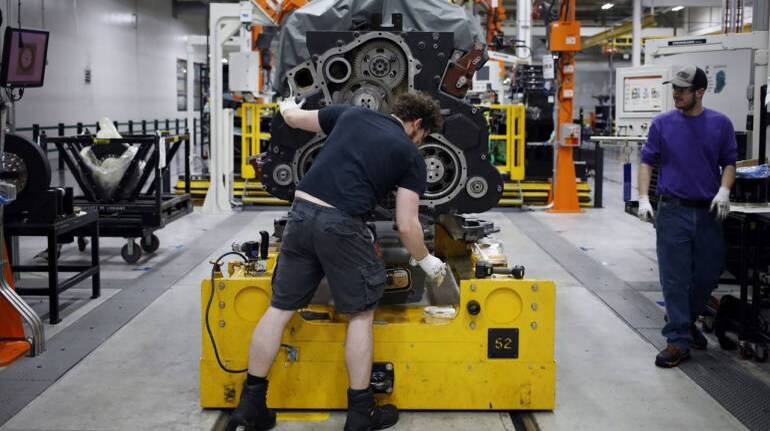
Based on companies’ emissions reporting, it’s none of the above. Instead, the culprit is a century-old manufacturer that President Joe Biden praised for its efforts on clean energy during a factory visit this month, whose philanthropic efforts have turned its small Midwestern hometown of Columbus, Indiana into a modernist architectural paradise.
Cummins Inc. — one of the world’s largest manufacturer of diesel engines and generators — was responsible for a remarkable 1.17 billion metric tons of so-called Scope 3 carbon emissions in 2021, according to its climate disclosures. That’s more than the world’s biggest gas producer Gazprom Inc.; more than Exxon Mobil and BP Plc put together; more than the combined total for GM, Toyota Motor Corp and Volkswagen AG, which
collectively manufacture nearly 23 million cars each year. Indeed, the number is equivalent to about one ton out of every 50 emitted worldwide in 2019.
This almost certainly overstates Cummins's responsibility. The same gallon of diesel can produce Scope 3 emissions for both Cummins (that makes the engine), ConocoPhillips (that produces the crude oil) and Phillips 66 (that refines it into diesel), so the total volume of Scope 3 emissions in the world is several times higher than the sum of global emissions.
That’s in many ways a result of how Scope 3 is measured. A car manufacturer’s Scope 1 emissions come from fuel burnt on-site, while Scope 2 incorporates the impact of its electricity consumption. Scope 3 reflects the broader effect of a company’s products, so would add up the lifetime driving emissions from every vehicle rolling off its production line.
All this likely influences the remarkably high score: “Cummins products can be in the field a long time,” says Blair Claflin, a company spokesman.
Whereas almost every barrel of oil pumped by Exxon Mobil in 2022 will have released its emissions into the atmosphere by the middle of this year, engines made by Cummins may still be coughing out exhaust fumes well into the 2030s, giving its activities in any one year a decade-sized footprint.
The nature of its customer base also lifts the figure: Heavy trucks keep going for about 750,000 miles or more, as opposed to the 200,000 miles after which passenger cars are scrapped. Their engines are bigger, too, and subject to less stringent fuel-economy standards than cars and even the heavy trucks in which they run.
On top of that, the judgement calls required for Scope 3 calculations allow estimates to veer to the high or low side. Canadian oil-sands producer Suncor Energy Inc for many years reported implausibly low numbers, before correcting them in 2020. Russia’s Rosneft Oil Co still cites figures that are far too low in comparison to its petroleum output. It’s possible that Cummins — a company whose mid-20th century leader was a prominent ally of Martin Luther King and still wears its social conscience on its sleeve — is deviating in the opposite direction, inflating the number.
There’s a cynical as well as virtuous reason companies might want to do that. High estimates right now, followed by lower ones down the track, make it easier to achieve ambitious targets. Cummins, for instance,
promises to cut Scope 3 pollution 25 percent by 2030.
There’s no question about the aspiration involved. Biden’s visit this month coincided with an announcement of $1 billion of spending to make engines that can be powered by lower-carbon fuels, part of which will also be spent assembling electrolyzers for producing green hydrogen. It’s invested in a German battery business, bought companies that provide parts for electric drivetrains, and plans to cut emissions from its plants in half by 2030.
Take Johnson Matthey Plc. The British company makes precious metal compounds for the catalytic converters that remove pollutants from vehicle exhausts. It tried in recent years to stake out a position in electric battery materials, to offset the looming decline of its core business. The strategy was an ignominious failure, resulting in £420 million ($525 million) in write-downs, the resignation of its chief executive officer, and a 41 percent decline in the shares over the past five years.
That’s a fate Cummins would hope to avoid, but the task is easier said than done. A world in which the trucking industry has been fully decarbonised is a world in which the decades of diesel expertise it’s developed has been made obsolete by the rise of fuel-cell, catenary or battery-electric trucks
such as Tesla Inc’s Semi. The energy transition was never meant to be easy, even for the companies that have committed themselves to advancing it.
David Fickling is a Bloomberg Opinion columnist covering energy and commodities. Views are personal and do not represent the stand of this publication.
Credit: Bloomberg
Discover the latest Business News, Sensex, and Nifty updates. Obtain Personal Finance insights, tax queries, and expert opinions on Moneycontrol or download the Moneycontrol App to stay updated!
Find the best of Al News in one place, specially curated for you every weekend.
Stay on top of the latest tech trends and biggest startup news.