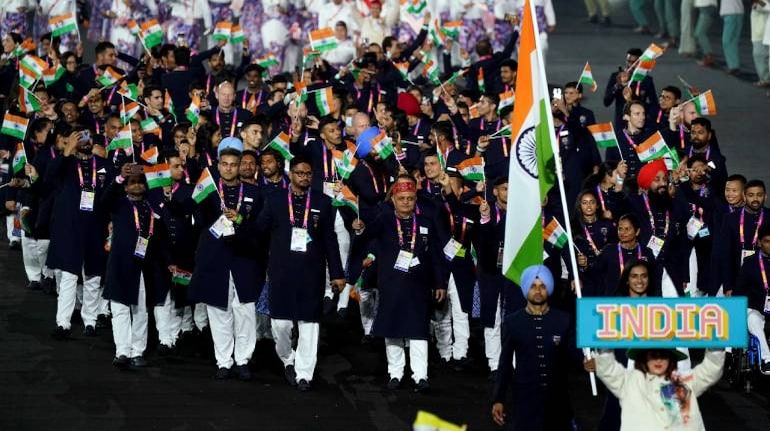
India's performance at the two major multi-disciplinary games in the past year has once again triggered the debate: is the sleeping giant of global sport finally coming of age on the playing field, 75 years since its birth as a nation.
At the Tokyo Olympics a year back, India won its biggest-ever haul: seven medals, including Neeraj Chopra’s gold. At the 2022 Commonwealth Games in Birmingham which concluded on August 8, India finished fourth with a total of 61 medals.
There is no doubt that we should celebrate the medals won at Birmingham and Tokyo. However, taking the performances as a sign that India has finally bridged the wide gulf between potential and achievement may be premature.
Sporting success takes years of planning and execution, by state as well as private establishments and programmes. India has barely started on that front. For instance, the previously-reticent corporate sector has come on board only recently. And, the government-run Sports Authority of India’s (SAI) network of training centres, as well as elite athletes, have started benefitting from a systematic funding framework just about eight years back.
We are talking of programmes such as Target Olympic Podium Scheme (TOPS), started in September 2014, and the entry of entities such as Olympic Gold Quest, Mittal Champions Trust, and JSW Sports into the Indian ecosystem.
TOPS was a more refined version of the funding and assessment programme of that started a little before the 2010 Commonwealth Games in New Delhi. India finished second in Delhi, and won three medals at the 2008 Beijing Olympics, and six at the London Olympics, 2012.
The buzz all this generated got India Inc. interested. Indian corporates were mostly fence sitters or peripheral participants in the country's sporting programmes till then, with the major interest revolving around cricket.
Since 2012, India has had Olympic and world champions, and unprecedented success at the Asian Games and the CWG. But the programmes are rather new and have had their teething troubles and chinks.
For instance, the perpetual problem of Indian sport — the rather ad hoc way in which talent is unearthed — remains. Chopra had a lucky break. So did Hima Das. Both of them got into sport by chance. They were not unearthed by a system. Granted, they were nurtured once they got absorbed into the hybrid model, a mix of private and public establishments for elite athletes.
However, there is still a long way to go because performance at the Commonwealth or Asian level needs to be measured against global benchmarks, and not just the colour of the medals won. That will reveal we are yet to reach the top, barring certain sports which always had a cultural connect in India.
We are talking about wrestling, boxing, and of late, badminton and shooting — the primary medal prospects for India at the Olympic and world levels. The fact that India won both the individual gold medals in badminton at CWG, and dominated wrestling and boxing, demonstrates that the programmes for these disciplines are well-oiled and have garnered enough momentum to be deemed self-sustaining.
We did not get there by fluke. Shooting, post Abhinav Bindra’s gold in 2008, has its own network of academies and reach, which has led to many youngsters taking up the sport.
Even though badminton has its main centres in Bengaluru and Hyderabad, it has become a cultural phenomenon pan-India post the exploits of Saina Nehwal and P V Sindhu.
Wrestling and boxing, both sports with a strong footing in north India, have had their homegrown catchment and nurturing mechanism through which generations of champions have been unearthed. It is still up and running, and thanks to more funding for semi-urban and rural centres, it is growing.
These four sports and how they operate can be a base model for programmes in other disciplines, focussed on the grassroots where the real talent of India lies.
Chopra's gold created a lot of awareness and interest in javelin in particular and athletics in general. However, the establishment is yet to do enough to tap into that excitement.
After 75 years of Independence, India still has a lot of socio-political and economic issues that need to be prioritised and addressed, before we look at sport.
Then again, sport is also a big engine for socio-economic mobility. So it works both ways — India's emergence as a sporting powerhouse, if and when it happens, would be taken as a sign of its economic maturity, and vice versa.
The country has seemingly hit upon a winning formula — hybrid public and private programmes that are gathering momentum in small but significant ways. However, there are miles to go before India can call itself a nation synonymous with sport and sporting excellence.
Discover the latest Business News, Sensex, and Nifty updates. Obtain Personal Finance insights, tax queries, and expert opinions on Moneycontrol or download the Moneycontrol App to stay updated!
Find the best of Al News in one place, specially curated for you every weekend.
Stay on top of the latest tech trends and biggest startup news.