






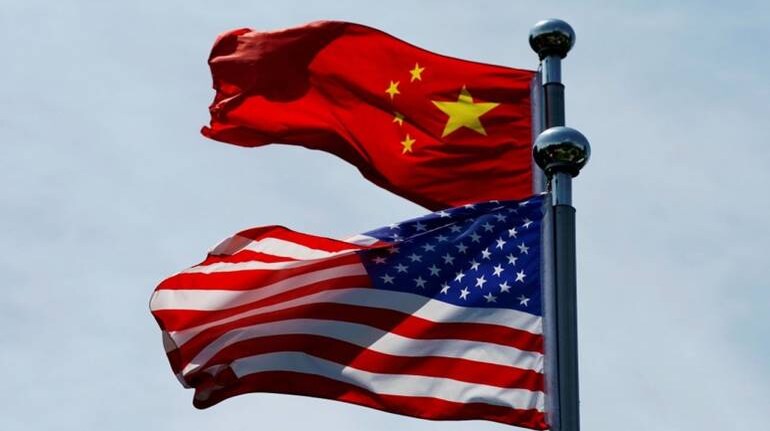
Even as trade talks between the United States and China seem set to resume, geopolitical tensions between the two powers show no sign of abating. At the moment, American and Chinese trade negotiators are using teleconferencing to see how the stalled trade talks can be revived. Even that’s seen as progress in a trade dispute which is causing enormous damage not only to the two economies but to the wider global economic environment.
This month witnessed a ratcheting up of US-China trade tension after a brief detente when the Trump administration officially declared China a currency manipulator, the first time the US had done that to any country in 25 years. China responded with a boycott of American farm products. Last week, however, Washington decided to delay until mid-December tariffs on $300 billion worth of Chinese-made goods slated to go into effect in September. Other issues, such as Washington’s decision on a $8 billion sale of F-16 fighter jets to Taiwan and Trump’s warning against Huawei citing national security threats, have vitiated the atmosphere, unravelling the bilateral relationship between two major economic powers.
For US President Donald Trump, the state of the US economy is key to his re-election prospects in 2020. A serious economic slowdown would make it difficult to him to make a case to the American electorate that he is an efficient economic manager. There is growing stress in the economy with major US equity indexes essentially flat over the past 12 months though the jobless rate in the US has fallen under Trump and wages have started to grow.
Trump has already begun to make an economic case for his re-election by saying that even Americans who hate him “have no choice” but to vote for him or face a stock market collapse. “You have no choice but to vote for me because your 401(k), everything is going to be down the tubes,” Trump recently told a rally. “Whether you love me or hate me, you’ve got to vote for me.” This is also a reason why he is reluctant to let the US-China trade talks fail.
In a recent tweet, he said the US is “doing very well with China, and talking!” even as his administration has been struggling to get the trade talks back in motion.
Meanwhile, the issue of Hong Kong has begun to shape the US-China discourse on trade as well. Initially, Trump was reluctant to engage China on this matter, focusing instead on getting a trade deal with Beijing and describing the protests as “riots” which were a matter for China to handle.
However, as the Hong King protests show no sign of abating, he came under pressure domestically, forcing him to change his stance. He is now suggesting that he would like to see the situation in Hong Kong “worked out in a very humanitarian fashion” and Chinese President Xi Jinping “sure has the ability” to reach a resolution.
This has been followed up by remarks from Vice-President Mike Pence who this week made it clear that chances of a trade deal with China would diminish if Hong Kong's laws are violated and criticised China’s human rights violations as antithetical to American ideals. Pence suggested that China was granted open access to the US economy “in the hope that freedom in China would expand in all of its forms” but over the last 17 years, China has not followed through economically, politically or in the realm of human rights.
China, he mentioned, has continued to pursue “an arsenal of policies inconsistent with free trade.” Reaction in China was predictable with Chinese state media strongly denouncing the move to link trade negotiations with China to the Hong Kong protests.
The escalating US-China crisis represents something much larger than a mere bilateral dispute between two major powers. It underscores the unravelling of the post-Cold War consensus on global economics and politics. The Sino-US economic integration was, in more ways than one, the high water mark of global economic convergence unleashed by the forces of globalisation. For a moment at least, politics was seemingly becoming subservient to economies as two opposite political ideologies in Washington and Beijing were getting intertwined through the forces of economics. That was then.
Political considerations are back in vogue. Today, as the two major global economies focus their energies on decoupling their economic futures, it signifies the broader anti-globalisation landscape of our times, a move that is engendering greater nationalism and inward orientation. The chimera of Chimerica is over. This is the age of American First.
For an emerging economy like India, these are challenging times as global economic conditions deteriorate. It would make it difficult for Indian policymakers to plan effectively for high rates of growth. This is also a moment to reflect on the opportunities emerging out of this geopolitical and geoeconomic flux. As the global economic structures undergo a rapid change, India should be in position to take advantage of this flux. Only those nations which are attuned to these changing trends will able lead the next economic boom.
Harsh V Pant is director, Studies at Observer Research Foundation, New Delhi and professor of international relations, King’s College London. Views are personal.Discover the latest Business News, Sensex, and Nifty updates. Obtain Personal Finance insights, tax queries, and expert opinions on Moneycontrol or download the Moneycontrol App to stay updated!

Find the best of Al News in one place, specially curated for you every weekend.
Stay on top of the latest tech trends and biggest startup news.




