




Jyoti Singh Rathore and Nihit Gupta
The COVID-19 or coronavirus outbreak, which is threatening countries around the world, has been spreading at a rate which possibly would cause further fear in trading economies. By the weekend the total number of confirmed cases reached around 80,000 globally and of these, 78,000 are in China. The deadly virus has brought a large part of China, the world's second-largest economy, to a standstill, and its impact has been felt across industries.
China is the third-largest manufacturer and the largest exporter of goods. A globally significant number of countries depend upon imports from China, not only because it is resource-abundant in various products, including chemical and capital goods, but also because Chinese products are quite lucrative to price-sensitive consumers in less-developed countries.
China’s total exports are around $2,500 billion an annum to all major developed and developing economies. It’s top three export markets are the United States, Japan and Korea.
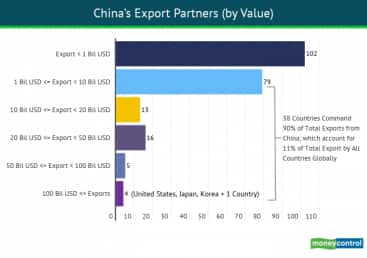
Trade between China and its partner countries has not been impacted significantly in terms of volumes; however, there has been a lot of additional burden on the suppliers to ensure that they meet the various requirements of different countries based on the advisories circulated to shipping lines and ports due to the COVID-19. India is one of the countries which depends on China for input materials and intermediates required by manufacturers.
Ever since the COVID-19 outbreak, transport of goods has slowed down due to check/re-check and paperwork, but services are still on as usual. To ensure clearance of shipments while not compromising on the checks with regard to coronavirus, the customs authorities world over are putting in all efforts. In India, the customs clearance facility will remain open 24X7 at all seaports and airports till May. A help desk on the ICEGATE website, the Central Board of Indirect Taxes and Customs’ (CBIC’s) e-commerce portal, has also gone live.
Further, thanks to globalisation, purchasers have a lot of flexibility in the supply chain. Usually, long-term contracts and the relationship between suppliers and purchasers mean that they work around difficult situations to keep trade flowing — a deadlock is neither desired nor tolerated.
Operational issues in China have meant that the prices of certain commodities have gone up. Due to this, certain segments of manufacturers in India with no alternative value chain available are of the opinion that their exports have been impacted due to lag in the supply of material and an increase in the cost of input materials and intermediates. These industry segments have requested the government to offset the same by lowering import duties and implement other possible measures. So, the impact has been limited with no sign of an effect on a large number of industries. Also, trade in services has quite a significant influence on the overall economy, especially trade itself.
While at one end India’s exports seem to have been dented because inventories have been decreasing with manufacturers dependent upon imports from China, a large part of the industry which has a strong footing sees this as an opportunity to tap the demand-supply gap now created in other countries which are dependent upon finished goods from China.
In order to assess the situation and address the concerns or utilise the opportunities created, the government is planning to convene a meeting on March 3 with stakeholders. This could, however, have a temporary effect.
In the past too China has seen virus attacks (like the SARS attack in 2002), which slowed down its economy to some extent, but it bounced back soon. While the COVID-19 has affected China’s economy, which has had a cascading effect on other economies including India, China is making all efforts to revive the damage being caused.
Meanwhile, of course, temporary measures to combat the situation are being considered and discussed among industry experts. At present, we need to wait and watch how much impact the fatal COVID-19 can have on the global economy. For now, the effect can be felt for a few months. However, if the spread of virus is not contained by then, there could be an adverse impact on the global economy leading to change in even trade dynamics.
Jyoti Singh Rathore, Assistant Secretary-General, Forum for Trade Remedies and Nihit Gupta, Joint Partner, TPM Consultant. Views are personal.

Discover the latest Business News, Sensex, and Nifty updates. Obtain Personal Finance insights, tax queries, and expert opinions on Moneycontrol or download the Moneycontrol App to stay updated!
Find the best of Al News in one place, specially curated for you every weekend.
Stay on top of the latest tech trends and biggest startup news.