Kamlendra Kanwar
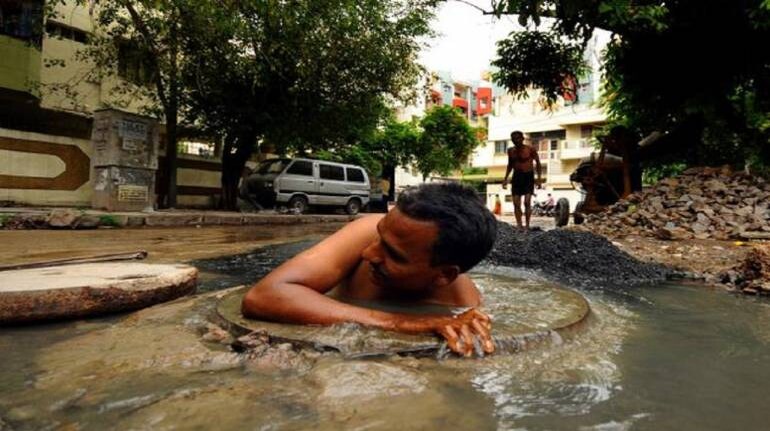
The Supreme Court’s scathing recent observation that despite a legislation passed by Parliament way back in 1993 outlawing manual scavenging without protective gear like mask and oxygen cylinder, the practice is rampant, is ground for some soul-searching.
For the hapless practitioners of this trade, 90 per cent of whom are women of lower castes, it is truly shocking because it is not only undignified but also a serious health hazard. The apex court’s shock has been heightened by the fact that many of these scavengers die a chilling death in inhuman conditions and their kin are ill-organised to raise their voice unitedly.
The court justifiably enquired of Attorney-General KK Venugopal why proper protective gear were not being provided to people engaged in manual scavenging and cleaning of sewage or manholes. It went so far as to say that in no country people are sent to gas chambers to die. The court’s observation that four or five people are dying due to this every month reflects the gravity of this outrageous lack of protective measures for them.
There is also a palpable lack of enthusiasm among states (besides the Centre) which is at the root of the non-action. It is for the Centre to nudge the states to implement the 1993 legislation in letter and spirit. In these times when it is not uncommon for states to defy the Centre, it is vital that proper authority be vested in the Centre to ensure compliance.
The judiciary is, however, not free of blame itself. If primary responsibility for there being not a single conviction under the 1993 law is that of litigants, it is debatable whether the judiciary too has not been insensitive to their plight. The courts could have acted suo moto in all these years since the law was enacted.
In justification of the Centre’s lack of action Venugopal pointed out that that no law of sort has been developed in the country and the magistrates are not empowered to take cognisance on their own of such digressions from law. It is indeed incumbent upon the executive and the judiciary jointly to look into this and take remedial action so that civil wrongs are dealt with appropriately with proper codification of liabilities.
The economic plight of the scavengers needs to be looked into, and medical care needs to be duly provided. The use of robots to do the cleaning of drains needs to be stepped up, as is done in many western countries.
It is not for nothing that the redoubtable BR Ambedkar who was a crusader against untouchability had said that “In India, a man is not a scavenger because of his work. He is a scavenger because of his birth irrespective of the question whether he does scavenging or not.” These words reflected his frustration over the role of heredity in shaping a man’s destiny in India.
That seven decades after Independence we have still not been able to shape off the hereditary burden is a sad commentary on our social system.It was recorded in the 2011 Census that over 700,000 households have their waste and faecal matter cleared by manual scavengers. Another 2,100,000 houses disposed of their faecal matter in dry latrines, which were also cleaned manually. Some estimates put the number of deaths of manual scavengers inside sewers, septic tanks and sewage pits at over 1,500. This shows the extent to which the problem persists.
There is much work to be done to ameliorate the health and economic well-being of manual scavengers. The Supreme Court’s observations should sensitise governments to spring into action. However, considering the huge gap between professing and actual doing, the action needs to be more real and meaningful. Mere lip service is hardly a solution.
Social reform is also an aspect that is crying for attention in a society which is still not out of the mindset of untouchability despite Mahatma Gandhi’s clarion call against it more than half a decade ago. We indeed can do with some introspection on where we are and where we need to be.
Kamlendra Kanwar is a senior journalist. Views expressed are personal.

Discover the latest Business News, Sensex, and Nifty updates. Obtain Personal Finance insights, tax queries, and expert opinions on Moneycontrol or download the Moneycontrol App to stay updated!
Find the best of Al News in one place, specially curated for you every weekend.
Stay on top of the latest tech trends and biggest startup news.