






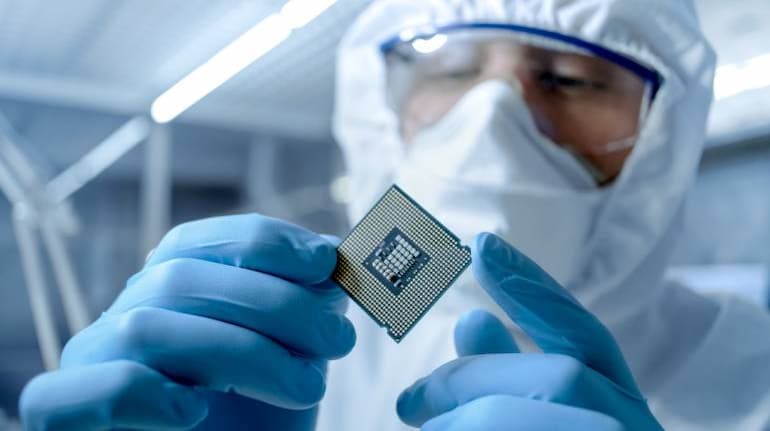
Semiconductor chips are made from the second-most abundant element found on earth. Silicon is present abundantly in every nook and corner of the habitable world in the form of the humble sand. Yet semiconductor chips are in short supply globally right now.
The chip industry is going through the paradox best articulated by poet Samuel Coleridge: ‘Water, water, everywhere, Nor any drop to drink.’ To understand how our lives are inundated by these pervasive semiconductor integrated chips (ICs), sample this: a single modern car consumes upwards of 1,000 ICs, a smartphone uses almost 15-20 ICs, even presumably electromechanical devices such as refrigerators and washing machines now use microcontroller chips more powerful than the most powerful personal computers from the 1980s.
Imports GaloreIndia does not have any commercial semiconductor manufacturing plants (known as ‘fabs’). As a result, we are a net importer of ICs. In 2020 alone, we imported $15bn worth of electronic parts, out of which 37 percent came from China. This prompted the Union government to establish a new system, CHIMS, to track every chip being imported into India.
The story globally is even more lopsided. The tiny island nation of Taiwan manufactures more than 50 percent of all chips produced worldwide. Taiwan’s TSMC and South Korea’s Samsung put together make seven out of every 10 ICs.
Disruption of the supply chain during the initial days of the COVID-19 pandemic in 2020 and the subsequent chip shortage has now made many countries revisit their semiconductor policies. The United States has incentivised Intel and TSMC to setup fabs in the US. Japan has closed a deal with TSMC for a new fab for Sony. Germany has incentivised Intel and TSMC to start a new facility in the European Union.
ICs And GeopoliticsApart from the dependence that many industries have on semiconductor ICs, these chips are crucial for a nation’s defence and aerospace programme. In 2018, Bloomberg published a story claiming that Supermicro’s server motherboards contained tiny spy chips. It created a furore, complicating the already troubled US-China relationship. Unlike software, where the code can be easily analysed to understand its intent, deciphering the true purpose of a questionable IC is particularly challenging.
The US has barred China-based Huawei from the list of 5G equipment suppliers. Even India maintains a small government-owned fab, SCL, in Mohali (Punjab) that provides critical ICs for India’s space and defence purposes.
One of the sanctions currently imposed on Russia after it attacked Ukraine is that leading CPU chip making US-based MNCs cannot sell their products to Russia. If ‘data’ is considered the new oil, then semiconductor ICs are the equivalent of oil rigs. After all, all the software in the world — from the Mars Rover to the observation centre in Antarctica to an MRI machine in a hospital — runs on these semiconductor ICs.
If semiconductor manufacturing is such a vital cog in the wheel, then why don’t all countries give it the importance that it deserves?
Almost two decades ago, when I had just joined this industry, fabs were not limited to a few places such as Taiwan and South Korea. Smaller companies such as Analog Devices had fabs in Ireland, and even Israel. Europe was home to many fabrication units — STM, Philips (now NXP), Siemens (now Infineon), etc. in Germany, Italy, and France. In the US, Motorola, AMD, and Texas Instruments owned multiple units.
However, as technology progressed, transistors on chips became smaller and smaller, from 250nm to 5nm. Now there are only a handful of atoms left in the ‘channel’ of the transistor. Good luck with manufacturing those economically in the presence of quantum effects after pumping in tens of billions of dollars in constructing these fabs!
As a result, the industry ended up splitting vertically halfway. Most design houses outsourced the manufacturing of ICs to specialised companies such as TSMC in Taiwan, while they concentrated on the design aspect. The economics of scale drove these foundries (TSMC, UMC, SMIC, and Samsung) to higher profits and further specialisation.
While globalisation has been great for the industry with design houses concentrated in the US, Israel, and India, fabs in Far East Asia and testing, assembling, and packaging in Southeast Asia, this ecosystem suffered jolts in supply chain when a global calamity (COVID-19) struck. It exposed the chinks in the armour and many countries are now trying to build domestic resilience in semiconductor manufacturing.
Given the increasing complexity in manufacturing, for years now people have been predicting the demise of silicon-based semiconductor manufacturing. As opposed to dying out, semiconductor manufacturing is not only thriving, but becoming an indispensable strategic resource.
Gaurav Goel is a digital design architect with 18 years of semiconductor industry experience currently working with AMD, India. Views are personal, and do not represent the stand of this publication.


Discover the latest Business News, Sensex, and Nifty updates. Obtain Personal Finance insights, tax queries, and expert opinions on Moneycontrol or download the Moneycontrol App to stay updated!
Find the best of Al News in one place, specially curated for you every weekend.
Stay on top of the latest tech trends and biggest startup news.






