






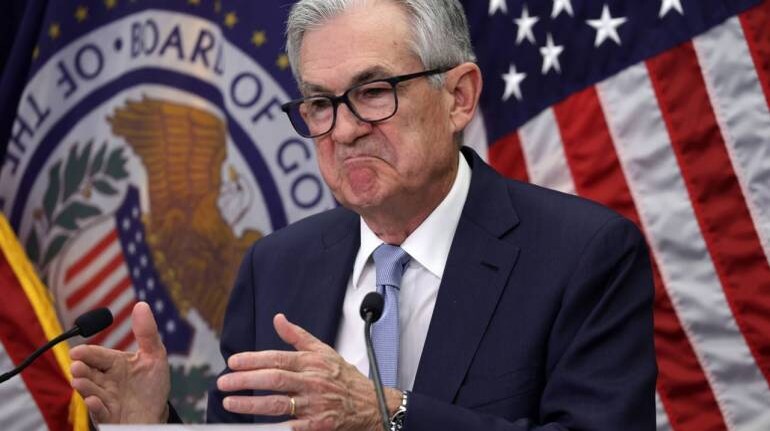
Federal Reserve policymakers decided to forgo any move in their policy rate Wednesday, leaving the target at 5 percent to 5.25 percent to allow time to assess the impact of past monetary tightening. But they are still feeling their way around in the dark to identify the level of rates that will bring down high and stubborn inflation, and the Fed’s Summary of Economic Projections suggests they’re not there just yet.
Notably, the median projection in the so-called SEP — released simultaneously with Wednesday’s rate decision — increased even more for the fed funds rates than it did for projected inflation, implying that the committee sees a need for greater real rates to put sufficient restraint on the economy. A year ago, the Fed thought it could fight inflation by getting policy rates about 1.1 percentage points above projected inflation, but committee members have clearly started to reconsider that. Now, the typical policymaker seems to think that “real rates” will need to be as much as 2 percentage points above inflation in 2024.
The implication is that rates could remain quite elevated even if disinflation picks up steam later in the year.
Adding to the confusion is the notion that policymakers revised up their implied estimates of “sufficiently restrictive” at the same time that they unanimously paused interest-rate increases. As the Wall Street Journal’s Nick Timiraos asked Powell Wednesday, why not raise now if you know you have more work to do? In his response, Powell said that the speed of tightening and the right levels were somewhat separate questions: "Speed was very important last year. As we get closer and closer to the destination, and according to the SEP we’re not so far away from the destination in most people’s accounting, it’s reasonable, it’s common sense to go a little slower."
It’s also true that the Fed seemed to box itself in. In the weeks after the last policy meeting, several officials strongly signaled an intention to “skip” a meeting in June. The Fed is generally reluctant to surprise markets, so they were hamstrung to follow through once the “skip” had been priced in.
While Powell was able to fend off any formal dissents at Wednesday’s meeting, the SEP suggests that some policymakers are clearly getting uncomfortable with the way that inflation is reacting — or failing to react — to the 500 basis points of rate increases since March 2022. The top “dot” in the SEP — which also features an anonymised “dot plot” of individual committee members’ forecasts — showed a risk of rates having to go to 6 percent to 6.25 percent. By and large, the Fed’s preferred inflation measure — the core personal consumption expenditures deflator — has essentially shown a steady rate of price increases for much of the past year. By that measure, inflation isn’t accelerating, but it’s not coming down, either. Meanwhile, there are some signs that the rate-sensitive housing market may have started to rebound a bit, and the job market remains fairly resilient.
Whatever the case, Fed policymakers are signaling that they think the level of “sufficiently restrictive” policy rates is higher — in real terms — than previously thought. And if the past year has taught markets anything it’s that it pays to listen.
Jonathan Levin has worked as a Bloomberg journalist in Latin America and the U.S., covering finance, markets and M&A. Most recently, he has served as the company's Miami bureau chief. He is a CFA charterholder. Views are personal and do not represent the stand of this publication. Credit: BloombergDiscover the latest Business News, Sensex, and Nifty updates. Obtain Personal Finance insights, tax queries, and expert opinions on Moneycontrol or download the Moneycontrol App to stay updated!
Find the best of Al News in one place, specially curated for you every weekend.
Stay on top of the latest tech trends and biggest startup news.




