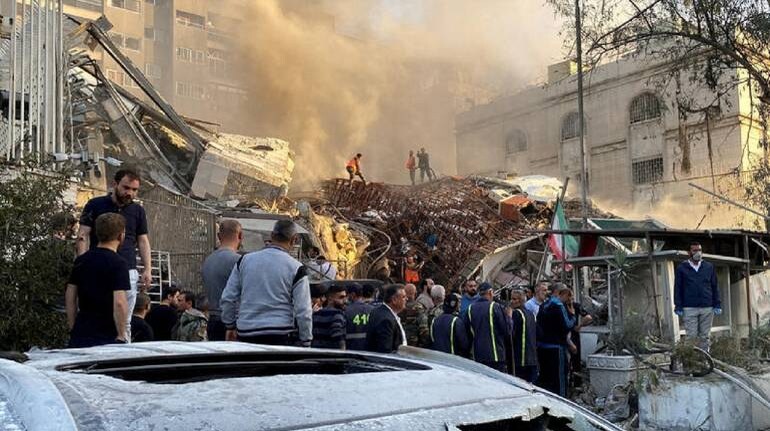
Whatever your view of Israel's war in Gaza, Monday's targeted killing of senior Iranian military commanders in Damascus wasn't just more evidence that, in the words of Iran’s foreign minister, Benjamin Netanyahu has lost his mind.
The attack, attributed to Israel, was dangerous and will bring a response. But that’s because it brought into the open a shadow war that was already escalating, while at the same time exposing the constraints on Washington's ability to control its ally, let alone Tehran or events in the Middle East.
It is, however, the Iranian Supreme Leader, Ali Khamenei, who now has the most consequential choices to make. He should choose wisely, because this is a fight that he picked and although it had so far cost him little, that’s starting to change. If he overreacts, the fighting will leave the shadows entirely and become a much larger war he could lose.
The air strike on Iran’s consulate in Damascus was remarkable for a number of reasons that go beyond the obvious shock and breach of protocol in hitting a diplomatic facility. One was the attack’s extraordinary precision. The pilots had to hit the building where top commanders of Iran's Al-Quds force were meeting, when they were meeting, and without at the same time also destroying the Iranian and Canadian embassies next door.
The point here isn’t the skill or advanced munitions involved, but the detailed intelligence that had to have been delivered in real time. The men killed weren't nine-to-fivers at the location where they died. The most senior had a reputation for extreme operational security bordering on paranoia that — after the US assassination of al-Quds commander Qassem Soleimani in 2020 — was also sensible. So the level of intelligence penetration required to find out where he was and to carry out the air strike while he was still there should be sobering for leaders in Tehran.
The rank of the casualties was also unusual. Topping the list, according to the IRGC-linked news agency Tasnim, was Brigadier General Mohammad Reza Zahedi, who had commanded the air and ground forces of the Islamic Revolutionary Guard Corps, as well as the IRGC’s elite Quds force in Syria and Lebanon. He was responsible for supplying the increasingly sophisticated missiles that Hezbollah fires at Israel.
In other words, this was the forward command of an expeditionary force that’s been arming and coordinating Iran’s so-called Axis of Resistance, in a wrist-length proxy war against Israel. Those proxies include Hamas in Gaza, as well as Hezbollah in Lebanon, Yemen's Houthis and a rash of Shiite militias is Iraq and Syria. Zahedi won’t be easy to replace, in particular as his deputy, another brigadier general, died with him, together with at least five of their officers.
Khamenei made out as if the strike on IRGC commanders in Damascus — for which Israel, as is its custom, has not acknowledged responsibility — came out of nowhere, pledging a harsh punishment and revenge. That
language was inevitable; Khamenei’s repressive regime isn’t widely loved within Iran and he can’t afford to appear weak. Yet he will also be well aware that Monday’s strike was in itself an answer to the war he’s been waging against Israel.
I’m with Makram Rabah, a history professor at the American University in Beirut willing to speak truth to power in a region where that can prove fatal. He says that the men who died on Monday were combatants in an Iranian offensive that won’t stop even after a ceasefire has been reached in Gaza. Moreover, by killing IRGC commanders on internationally protected diplomatic property, Netanyahu was telling Iran’s leaders that he will stop at nothing – including a regional war – to protect Israel against what has become a joint assault on Israel by Tehran and its proxies.
Rabah is no war monger, nor is he a fan of Netanyahu. His point is that peace can come only with a lasting settlement in Gaza, combined with an end to Iran’s proxy wars. Those predate Israel’s campaign in Gaza, but have escalated since, especially in recent days. Earlier on Monday, a drone for the first time struck a naval base at Israel's Red Sea port of Eilat, with an Iran-backed Iraqi militia called Khataib-Hezbollah claiming responsibility soon after.
Monday’s attack on the IRGC in Syria was not like Israel’s war in Gaza. The targets were carefully chosen and hit with the highest possible level of precision. Yet the risk is significant that the shadow war it was part of could now develop into a much wider and more direct conflict that sucks in larger powers. Many will look to US President Joe Biden to stop that, but whether it happens is up to Khamenei.
Marc Champion is a Bloomberg Opinion columnist covering Europe, Russia and the Middle East. Views are personal and do not represent the stand of this publication.
Credit: Bloomberg
Discover the latest Business News, Sensex, and Nifty updates. Obtain Personal Finance insights, tax queries, and expert opinions on Moneycontrol or download the Moneycontrol App to stay updated!
Find the best of Al News in one place, specially curated for you every weekend.
Stay on top of the latest tech trends and biggest startup news.