




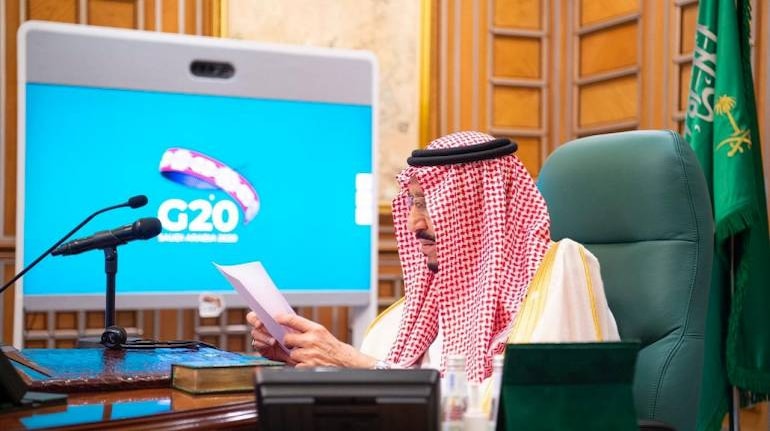
After months of complete disarray in the international community, the leaders of the G-20 met on March 26 in a virtual summit ostensibly to ensure a coordinated response to the global crisis emanating out of the COVID-19 pandemic.
There have been demands that the G-20 step up their level of support for the world’s poorest nations as they tackle the large scale disruptions caused by the pandemic. The World Bank and the International Monetary Fund (IMF) have called for an immediate bilateral debt relief for the world’s most impoverished nations, and the United Nations has called for a humanitarian response fund. However, given that the world’s powerful and richest nations have been focused on managing domestic turmoil, little was expected of the emergency video-conference summit — and it lived up to expectations.
The G-20 member states decided to inject over $5 trillion into the global economy, “as part of targeted fiscal policy, economic measures, and guarantee schemes to counteract the social, economic and financial impacts of the pandemic.” They also agreed to work with multilateral bodies such as the IMF, the World Health Organisation and regional banks to deploy a “robust” financial package to support developing nations. More specifically pertaining to the present crisis, the leaders agreed to assess gaps in pandemic preparedness and increase funding for research and development in vaccines and medicines.
However, these were generalities as the focus of most nations was on their own priorities, and little attempt was made to move towards developing a common framework, let alone global coordination.
In his remarks, Chinese President Xi Jinping proposed tariff cuts and removal of trade barriers to prevent the global economy slipping into recession. This should not have been surprising as China’s economy, after grinding to a halt in February, is seeking a revival. For that it is imperative that rest of the world, and especially the West, comes back on track. The Sino-US contestation continues unabated shaping the wider global response or lack thereof. The G7 foreign ministers meeting also held last week was unable to issue a joint communique after the US insisted COVID-19 be described as the Wuhan virus, in a reference to the city where it originated. Chinese leadership is trying to shift the blame on the US by blaming the US military for this viral contagion in China.
The other issue plaguing the G-20 was the crude oil prices which have severely impacted by the price war between Saudi Arabia and Russia as well by the pandemic’s impact on global demand. Though Riyadh had publicly underlined its reluctance to yield to any pressure, Washington has been asking its West Asian ally to act responsibly.
Unlike the 2008 financial crisis, when the grouping reacted with alacrity to mobilise assistance for vulnerable countries, it has been found wanting this time round with hardly any attempt to come up with any meaningful response. Coordination among G-20 members would have infused a sense of confidence among the wider international community, but the lack of global leadership is quite striking. In place of an effective co-ordinated response by the world’s richest powers, there have been moves towards greater isolation.
There have even been differences with countries like the United States and Brazil refusing to take the lockdown approach to control the pandemic like most other major countries. US President Donald Trump had been keen for the American business to resume normal operations, arguing that the “cure cannot be worse than the problem itself.” Brazil President Jair Bolsonaro has gone to another extreme by not only denying the severity of the COVID-19 crisis but also clearly prioritising economy over isolation measures. “People are going to die, I'm sorry,” Bolsonaro has said. “But we can't stop a car factory because there are traffic accidents.”
So, even in this age of pandemic, global coordination remains a commodity in short supply as political considerations continue to shape national responses. It’s futile to blame the G-20. Such is the nature of global politics that national priorities will continue to overwhelm global imperatives.
Prime Minister Narendra Modi rightly underscored in his own intervention at the G-20 summit, the world needs to “redefine” its conversations on globalisation to include social and humanitarian issues such as terrorism, climate change and pandemics along with financial and economic discussions. However, the G-20 response so far tells us that such a ‘redefinition’ is clearly not a priority for the world’s major powers at this juncture.
Harsh V Pant is director, Studies at Observer Research Foundation, New Delhi and professor of international relations, King’s College London. Views are personal.
Discover the latest Business News, Sensex, and Nifty updates. Obtain Personal Finance insights, tax queries, and expert opinions on Moneycontrol or download the Moneycontrol App to stay updated!
Find the best of Al News in one place, specially curated for you every weekend.
Stay on top of the latest tech trends and biggest startup news.




