By Bose Varghese
Less than two months to go and there is hardly anything in the public discourse about the year-end UN climate change conference, COP29, to be held in Baku, Azerbaijan. From the high-pitched events in Madrid in 2020 and Glasgow in 2021, we have seen a steady erosion of interest, intent, and outcomes through the COP27 in Sharm El Sheikh and the COP28 in Dubai. If the COP27 and the COP28 were held in the backdrop of the war in Ukraine, COP29 will be held under the geopolitical stress of two ongoing wars and the uncertainty of election results in Europe and the US. Added to these are the fatigue and the host-nation factors.
The loss of sheen of this crucial annual event at a time when climate change is hitting us harder than ever before is ominous to the future of climate action and the Paris Agreement itself. The first Global Stocktake of the Paris Agreement during the COP28 pointed to a missed opportunity. It revealed that global action is not in line with the goals of the Paris Agreement; we may have already missed the boat for the 1.5OC target and we are on for a below 3OC global warming, considering all the current commitments. The confirmation came in the form of heightened global warming across the world, both measured and experienced. According to the World Meteorological Organization, 2023 was the hottest year on record with a global average temperature increase of 1.45OC over the pre-industrial average.
Expectations From COP29
Given this scenario, what can we expect from COP29? A key feature of the COP29 Framework for Action is to ‘enhance ambition and enable action’. Enhancing ambition is officially due in 2025 when the parties to the Paris Agreement are required to submit more ambitious Nationally Determined Contributions (NDCs). Enhanced ambition must witness a significant jump in targets and a drop in timeframe to achieve the same. It is, however, unrealistic to expect the 2025 NDCs to be substantially different from the 2020 NDCs, especially considering that most of the large emitters have already committed to Net Zero goals. Nevertheless, COP29 is expected to announce a doubling down on energy storage and green hydrogen. Regarding the second half of the Framework for Action - enabling action - practically means finding more money for climate finance. The USD 100 billion a year Green Climate Fund announced in 2010 for climate action in developing countries has mobilized only about USD 20 billion as of 2023, with another USD 5 billion pledged for 2024-27 period. The Loss and Damage Fund announced at COP27 has only about USD 660 million in pledges and is yet to be fully operationalized. Finding big money to support transition needs of the developing countries will continue to be a challenge.
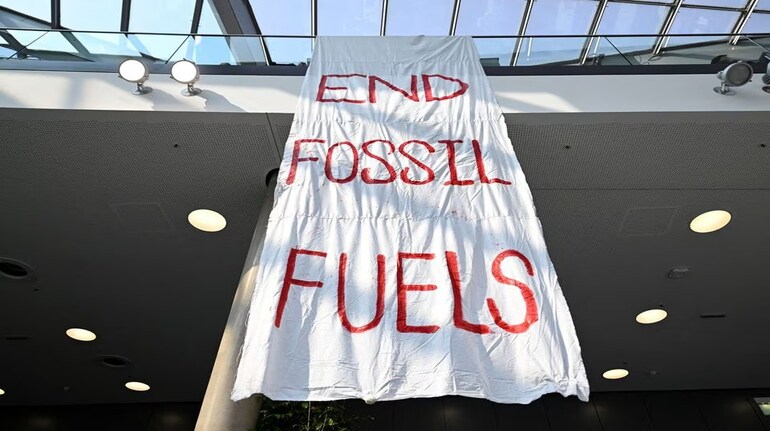
We have been through nearly three decades of COPs, and we have made some progress, but not enough. While we clearly understand the two areas that can move the needle are winding down fossil fuel use and financing transition at scale, we have not been very successful with either. The week-long event has become a platform to announce new coalitions, pledges, and funds that are not funded.
The countries that signed up to the 2030 renewables pledge agreed to collectively double the global average annual rate of energy efficiency improvements from around 2 per cent to more than 4 per cent every year until 2030.
A second COP28 commitment could affect demand for fossil fuels by tripling the world’s renewable energy generation capacity to at least 11,000 gigawatts by 2030.
Discover the latest Business News, Sensex, and Nifty updates. Obtain Personal Finance insights, tax queries, and expert opinions on Moneycontrol or download the Moneycontrol App to stay updated!
Find the best of Al News in one place, specially curated for you every weekend.
Stay on top of the latest tech trends and biggest startup news.