




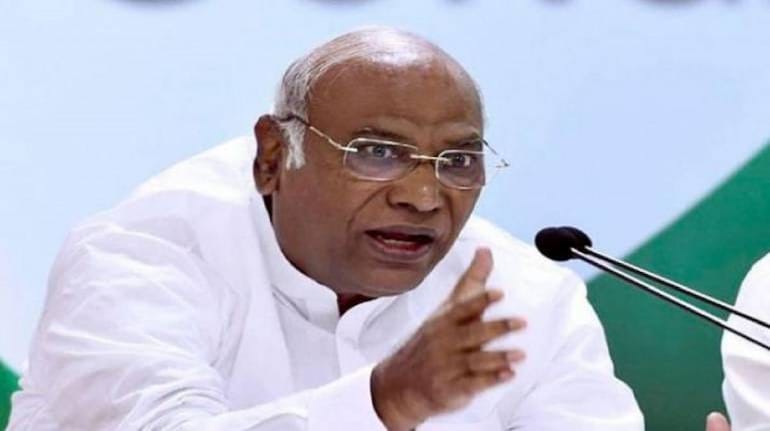
Veteran Mallikarjun Kharge is the new Congress President, becoming the first non-Gandhi to hold the post after 24 years, and also the first Dalit to helm the grand old party in over 50 years.
Kharge, 80, defeated Shashi Tharoor, 66, in a one-sided contest that took place in the 137-year-old party after 22 years. In 2000, Jitendra Prasada had unsuccessfully challenged Sonia Gandhi.
Kharge won 7,897 of the 9,385 valid votes polled by delegates, while Tharoor was backed by 1,072 delegates. A total of 416 votes were declared invalid.
Hailing from Karnataka in southern India, he is the second Dalit chief of the grand old party in over 50 years, after Jagjivan Ram’s tenure in 1970-71.
Sonia Gandhi, 75, who holds the record of longest-serving Congress President, will now play the role of a mentor. She will continue to be the chairperson of the Congress Parliamentary Party (CPP).
Turmoil Before Polls
The run-up to the much-awaited Congress President's elections witnessed dissension, rebellion, and exit of key leaders.
A letter bomb dropped by 23 dissenters in August 2020 on the leadership issue created ripples in the party. Though the letter emphasised the need for organisational elections from top to bottom, and expressed dismay over continued electoral reverses, it was widely understood that the trigger was the apprehension that the Gandhi family would install KC Venugopal as a proxy to run the party.
The ensuing discord sparked a flurry of appeals to former party President Rahul Gandhi to lead the party. However, he remained firm on his suggestion that a non-Gandhi should the role.
Before assuming office again in August 2019, Sonia Gandhi had put a condition that it would be an interim arrangement till the party elected a new chief. However, the internal election process that started after over three long tumultuous years has been no less eventful.
After a failed attempt to get Rajasthan Chief Minister Ashok Gehlot to contest the elections — which in the process saw turmoil in the desert state and rebellion within the party — the Congress leadership turned to a dependable Kharge.
His challenger, Tharoor, had already made up his mind to contest the elections irrespective of the opponent’s stature and position, and he stood his ground.
However, the dice was heavily loaded in Kharge’s favour with Tharoor labelling him the “unofficial official candidate of the establishment” during his campaign, although the Gandhi family stayed neutral.
A part of G-23, Tharoor failed to get the support of his fellow dissenters who rallied behind Kharge.
Not A Proxy
Unsurprisingly, the result threw up no surprises. Kharge is the man in charge now, but the Gandhis will continue to wield their influence.
Throughout his campaign, the veteran leader sought to dispel the notion that he would be a rubber stamp of the Gandhis, but made it a point to mention that he would not shy away from seeking guidance and suggestions from the Gandhi family.
However, to prove that he has a mind of his own and is capable of taking his decisions, Kharge will have to shed the tag of being a proxy of the Gandhi family.
Challenges Ahead
That apart, he has his task cut out for him.
To begin with, his first assignment will be to resolve the Rajasthan imbroglio. It remains to be seen if he will go for a status quo and let Gehlot continue as Chief Minister till the assembly elections next year. Kharge knows very well that any attempt to replace Gehlot with Sachin Pilot would prove counter-productive, and hence a tightrope walk for him.
That apart, launching serious efforts to revive the Congress across India, checking dissensions and desertions besides the electoral slide that had set in after the 2014 Lok Sabha debacle would be high on his agenda.
Maintaining a fine balance between young leaders and the old guard is another challenge for the veteran politician. He has promised to implement the ‘Udaipur Declaration’ in letter and spirit.
One of the proposals envisaged in it is to reserve 50 percent of party posts to those below 50 years of age. Similarly, he has also pledged to allot 50 percent of seats in the 2024 Lok Sabha elections to those below 50 years of age as per the recommendations adopted at the ‘Chintan Shivir (brainstorming session)’ in Rajasthan in May.
To top it all, accessibility to workers would be key to Kharge’s success. Unlike the Gandhis who largely remained inaccessible to workers due to security constraints, Kharge is expected to be reachable to all.
But the biggest test would be to ensure that his appeal transcends the language and regional barriers given that the Hindi heartland holds the key to the Delhi seat of power.
Discover the latest Business News, Sensex, and Nifty updates. Obtain Personal Finance insights, tax queries, and expert opinions on Moneycontrol or download the Moneycontrol App to stay updated!
Find the best of Al News in one place, specially curated for you every weekend.
Stay on top of the latest tech trends and biggest startup news.