Smruti Koppikar
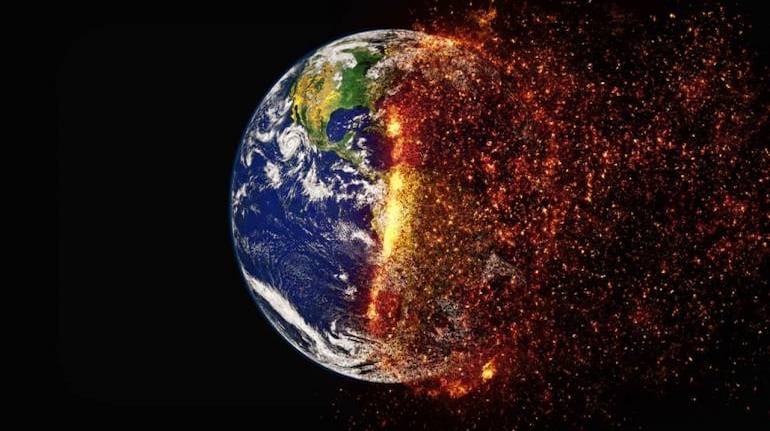
As 2019 closes, it marks a significant shift in the world’s approach to climate change, an issue that could dominate geo-political and international economics in the next decade. In 2019, it was mainstreamed in a neat manner.
Its new star activist, the 16-year-old Swedish schoolgirl Greta Thunberg, was chosen as the Time magazine’s Person of the Year, an honour improbable for an environmentalist even a decade ago. Oxford Dictionaries announced that its chosen word of the year is “Climate Emergency” describing it as “a situation in which urgent action is required to reduce or halt Climate Change”.
If only climate change was given its rightful place at the high table of geo-politics and economics a decade ago, the world might have faced a brighter future heading into the next decade. In this case, the better-late-than-never cliché fails spectacularly.
The evidence is clear: 2019 has been a really hot year with global combined land and sea temperatures 1.7 degrees Fahrenheit (.95 Celsius) above the 20th century average. Its first nine months were the second hottest since 1880, its July and September were the hottest on record. Then, the Amazon witnessed a record surge in forest fires with nearly 31,000 in August -- three times in that month of the previous year -- causing heartburn across the world.
The Amazon is the world’s largest rainforest and important carbon store, which helps slow down global warming and arrest climate change. However, Brazilian President Jair Bolsonaro at the United Nations stoutly refuted that the Amazon was a world heritage. He defunded environmental institutions even as he opened up the rainforest for logging, mining and commercial agriculture. The environmental world watched in dismay. How could this happen in a year in which Climate Emergency was acknowledged?
This put the cursor back on a question that lies at the heart of the economic-environmental debate: How should the world’s agencies protect a precious ecosystem that holds commercial value for a nation and falls within its national border? Negotiating this and similar issues in other countries will call for much delicate tiptoeing around national pride in each country and keeping the focus on preparing for Climate Emergency by the world’s economic and political leaders, provided they have the motivation.
Back home, India suffered damage from climate change in ways that her government and people were not prepared for. From extreme high heat temperatures and heat waves to intense unseasonal rainfall in parts of the country, India saw it all. Farmers across states are still reeling under the impact of unseasonal rain, which saw price surges in essential and perishable commodities. Rainfall pattern in urban areas, including Mumbai, has changed from a steady four-month monsoon to extremely high or intense or freak rain events of two-three days during the season. Coastal cities stare at rising sea levels threatening the map of the country.
There is an economic cost involved. Just how much, would be an informed guesstimate, for India lacks even the data for a detailed assessment of the impact of climate change on crops, industrial activity, jobs and cities. Ideally, there ought to be climate change projections for each crop, district or block, and city in the country, for which models and modelling are necessary, for which data is the basis.
Climate change modelling is usually done for a decade or two. By now, projections should have been drawn up for 2030 or 2030-50. Not having adequate, good and reliable data has set India back, making agriculture -- its largest source of livelihood even today -- vulnerable to the vagaries of weather.
Broad studies indicate changing climate patterns leading to a decline in overall production of rice, jowar, wheat, millets and pulses, but not having district- or crop-wise projections leaves farmers susceptible, affecting a staggering 600 million, according to the World Bank.
What lies ahead? 2020 was the target year in the Copenhagen Accord by which India is supposed to achieve emission intensity -- volume of emissions per unit of GDP (gross domestic product) -- 20-25 percent below its 2005 level. The Paris Agreement has target of emission intensity at 30-35 percent of that level by 2030 for which ground work -- both mitigation and adaptation -- ought to have begun seriously by now. Merely complying with its stated Intended Nationally Determined Contributions (INDCs) could cost an estimated $1trillion, officials have said.
Its challenges heading into 2020 decade are many: It will have to adapt to increased droughts-floods-cyclones and other natural disasters which will have human and resource costs. It has to take its climate change data structure and reliability to the next level, its agriculture and cities have to be made climate-resilient, its natural wealth has to be factored into its GDP, its dependence on coal as the source of power has to reduce – coal-fired plants generated 72 percent of the country’s electricity this year, which must reduce to 50 percent by 2040. Nearly 68 percent of greenhouse gas emissions are from coal now.
India as the fourth-largest emitter of greenhouse gases -- though it has done marginal harm at the cumulative world level -- will come under pressure from the international community to mitigate climate change impact. There is an in-built inequity in this, given that the US and Europe account for around half of CO2 emissions since 1750, according to the Global Carbon Project. The pressure has been -- and will continue to be -- on India to adopt mitigation measures and do so at a faster pace.
This calls for setting up realistic but holistic goals for the coming decade or two, balancing economy and environment as well as recognising the significance of natural resources. In the first four years of Narendra Modi government, as many as 519 infrastructure projects were cleared in protected areas, including a mine in the contiguous Hasdeo Arand forest, nearly twice the number under the UPA 2 government, according to Prerna Singh Bindra, member, National Board for Wildlife. This month, 40,000 trees were cut in Odisha’s Talabira forest for coal blocks, a project steered by India’s top-most business tycoons.
Heading into 2020 and beyond, it cannot be business as usual. Climate change and its mitigation will need to be given the importance it deserves.
Smruti Koppikar, a Mumbai-based senior journalist and chronicler, writes on politics, development, gender and the media.

Discover the latest Business News, Sensex, and Nifty updates. Obtain Personal Finance insights, tax queries, and expert opinions on Moneycontrol or download the Moneycontrol App to stay updated!
Find the best of Al News in one place, specially curated for you every weekend.
Stay on top of the latest tech trends and biggest startup news.