




Two new post-election geopolitical developments concerning Bangladesh have implications for India as it is the resident power with very high stakes in the densely populated Muslim nation next door.
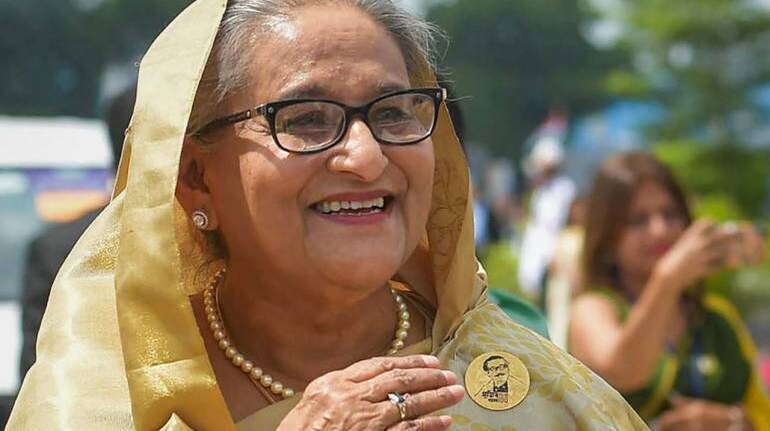
Firstly, United States President, Joe Biden, recently sent an unusually warm letter to Sheikh Hasina, who has become the Prime Minister for a fourth straight term after parliamentary polls that Washington openly criticised as not free and fair. Secondly, China is pulling out all stops to call the shots in post-election Bangladesh and its new found aggression, coupled with Dhaka’s silent acquiescence, is a legitimate cause for concern in New Delhi.
The US and India were not on the same page before and during the Bangladesh elections. While New Delhi unquestioningly threw its full weight behind Hasina and her Awami League as they are indispensable for us, Washington stood with the opposition led by former prime minister Khaleda Zia’s Bangladesh Nationalist Party and the Jamaat-e-Islami by exerting great pressure on Dhaka not to rig the polls.
In a sense, New Delhi should welcome Biden’s olive branch to Hasina – especially as she is so pro-India -- and the resultant thaw in badly strained Dhaka-Washington ties. But it’s not as straightforward and simple as it may seem to the uninitiated.
US U-Turn On Hasina
In reality, any spurt in America’s influence in Bangladesh is against India’s national interests. The goal of our foreign policy is to be the dominant and unchallenged external power in the neighbourhood. India naturally wants to have countries like Bangladesh, Nepal, Bhutan, Maldives and Sri Lanka all to itself, without having to compete for influence in its backyard even with an otherwise friendly power and Quad ally like the US.
Sometimes there are compelling reasons for New Delhi to work closely with Washington’s diplomats and the CIA and share the dividends from partnership, but India has more than enough clout in present-day Bangladesh to go it alone. If the truth be told, US-Bangladesh divergence suits us more than the Washington-Dhaka convergence triggered by Biden’s outreach to Hasina.
Biden’s letter represents the triumph of US interests – strategic interests to be precise – over values like democracy, elections and human rights which the US was forcefully advocating before the elections. The letter speaks of opening a new chapter in relations, stressing on geopolitical cooperation indicating Washington’s resolve to bury the differences and make the relationship work.
All this is not exactly music for New Delhi’s ears, though ironically the principal reason for the US change in tack is to checkmate China – India Enemy No 1. The US initiative is not driven by any overt or covert design to undermine India’s pre-eminence in Bangladesh, but by a steely determination to counter Beijing’s exponentially growing, and to some extent, Moscow’s upward influence.
Yuan Going Places
It’s all about China-US great power competition, but New Delhi is fundamentally opposed to any increase in US activities and clout within its sphere of influence – and that’s where the shoe pinches.
This month, the central banker Bangladesh Bank incorporated the Yuan in the country’s Real Time Gross Settlement (RTGS) credit transfer system for automated clearing in the Chinese currency, underlining Beijing’s fast growing financial-cum-trade muscle in India’s backyard.
Moreover, Commerce Minister Ahsanul Islam has just disclosed that Dhaka has requested Beijing to operationalise a Chinese bank in Bangladesh to facilitate the use of Yuan in bilateral trade. Earlier, RTGS in Bangladesh delivered automated clearing and settlement only in five currencies – US Dollar, Great Britain Pound, Euro, Japanese Yen and Canadian Dollar. The incorporation of Yuan is a major achievement as it brings it at par with the mighty Dollar and highlights China’s penetration of Bangladeshi trade, business and government.
Teesta: Ambassador Wen’s Frontfoot Play
Post elections, China is also capitalising on a major Indian failure – New Delhi’s inability to sign the Teesta River Water Sharing Treaty, pending since 2011. To tide over the crisis caused by our bungling, Dhaka designed the billion dollar Teesta River Comprehensive Management and Restoration Project (TRCMRP) for rejuvenating the basin of the water-starved river running downstream from India into northern Bangladesh. And the Bangladesh Water Board and the Power Construction Corporation of China have been quietly negotiating TRCMRP’s execution for some time.
Importantly, China’s ambassador in Dhaka, Yao Wen, called on Hasan Mahmud no sooner than he was appointed Foreign Minister. After the meeting, Wen claimed before the media that Beijing is ready and willing to implement the TRCMRP, but the government is hesitant to award the contract to China because of objections by a neighbouring country, although people living in northern Bangladesh are suffering a lot because of the delay.
Wen even offered to take Bangladeshi journalists on a guided tour of the water-starved Teesta River basin to take stock of the situation and for a demonstration of how exactly the Power Construction Corporation of China would quickly build key infrastructure for the TRCMRP if it is given the go-ahead.
Wen obviously exceeded his brief as an ambassador in order to exert pressure on the Hasina government which wants to balance ties with India and China. Moreover, Beijing uses funds as bait to entice governments.
Evidently, both the United States and China are on the front foot in Bangladesh post elections. India might appear to be on the backfoot at present, but that should not be mistaken for defensiveness as New Delhi certainly has more aces up its sleeves than the competition.
SNM Abdi is an independent journalist specialising in India’s foreign policy and domestic politics. Views are personal, and do not represent the stance of this publication.

Discover the latest Business News, Sensex, and Nifty updates. Obtain Personal Finance insights, tax queries, and expert opinions on Moneycontrol or download the Moneycontrol App to stay updated!
Find the best of Al News in one place, specially curated for you every weekend.
Stay on top of the latest tech trends and biggest startup news.